

Short version: A site is a place. An asset is the thing you account for. File the paperwork under the asset it proves — never loose at the site level — or the next person who opens that file can't tell what it belongs to.
Real property isn't real estate. In real estate, you file by address and you're done. In real property, the address is just where you stand. The record lives on the asset.
Here's a mess that looks tidy until you try to use it.
You open a site. Sitting right there at the top level are folders. Just folders. Not tied to a building. Not tied to a structure. Not tied to anything you can point to on the ground.
Whose 1354 is that? Which asset does that photo prove? Which building does that inspection belong to?
Nobody can tell you. Not without digging. Not without guessing. And guessing is not a filing system.
We locked the rule on our own work this week, plain and simple:
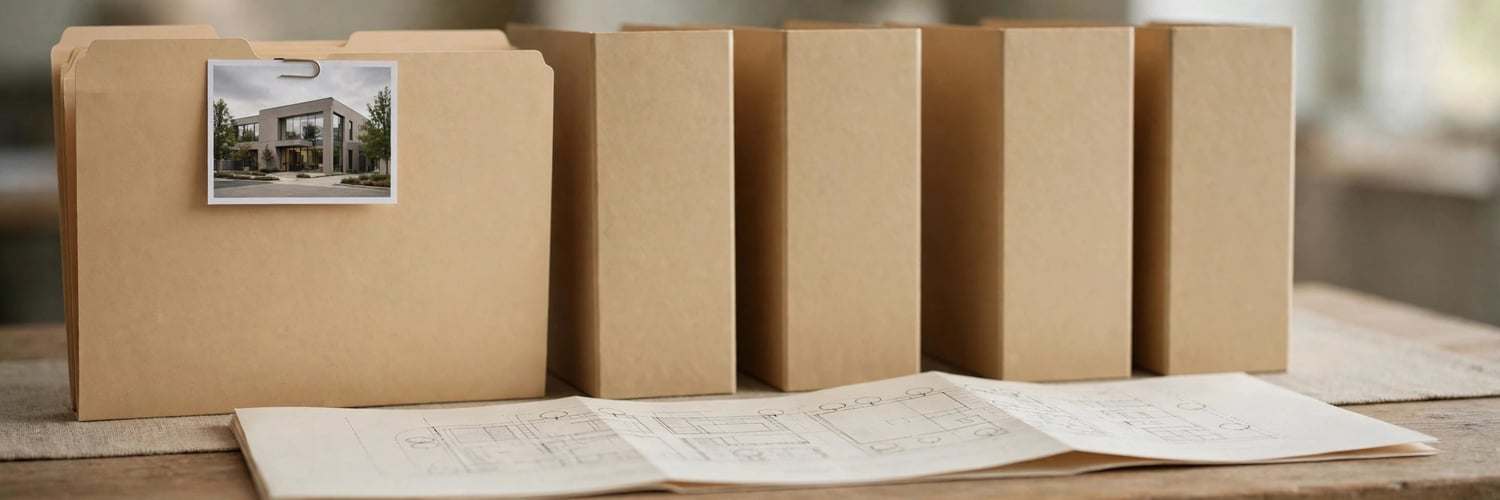
Open a site, you see its assets. Open an asset, you see its folders. Nothing floats at the site level unassigned.
A site shows you the list — the building, the parking, the fence, the land, whatever is actually accounted for there. You pick the asset. Inside that asset are its folders, in order, waiting for its records. That's it. No orphan folders. No loose piles.
Two more parts of the rule matter just as much:
- The standard set has room to grow. We run 13 folders per asset as the standard set. If something belongs to an asset and it fits none of the 13, you don't force-fit it and you don't leave it homeless. You make folder 14. Or 15. You name it for what it actually is. The set serves the record. The record doesn't squeeze itself into the set.
- What you truly can't place goes in one place. Not five mystery buckets. Not an "unfiled" pile that grows forever. One holding folder — we call it ZZZ — for the items nobody can identify yet, with the reason written on its face. One place to look. One place to work down. Everything else gets filed where it belongs.
Why does this matter? Because an auditor, a reviewer, or the person who takes your chair in two years doesn't start with your memory. They start with the file. If a document can't be traced to one asset, it doesn't prove that asset exists, it doesn't prove it was repaired, and it doesn't prove it was disposed of. It just proves somebody saved a paper somewhere.
Filed under the asset, that same paper does its job the first time somebody opens it.
File it to the asset. Name the next folder for what it is. Put the truly unknown in one holding place and say why it's there.
Nothing dropped — not even the paperwork for the paperwork.
Field tested, field graded — by the people doing the job, not experts on a shelf. If you find something different, leave it in the comments so we can fix it. That's how this gets better.
— Patrick G. Ledbetter Jr., Nothing Dropped California Real Property
https://payhip.com/NothingDroppedCaliforniaRealProperty