

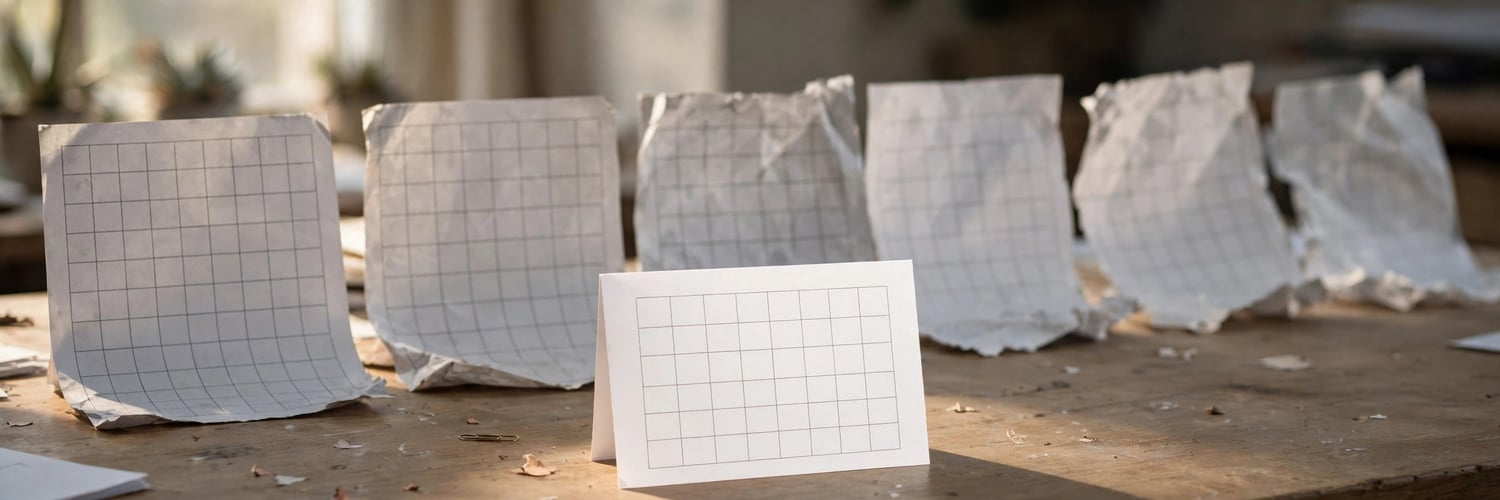
Short version: Copies drift. Numbers get re-typed, boxes shift, a code gets attached to the wrong place and stays there. When two copies disagree, stop arguing with the copies — go back to the original, dated source and let it settle it.
Real property isn't real estate.
In real estate, a copy is usually good enough.
In real property, a copy is how a small error learns to walk.
Here is how it happens. Nobody lies. Nobody fakes anything.
Somebody re-types a figure into a new deck. A box on a slide shifts up one line, and now a pair of numbers sits under the wrong heading. A spreadsheet eats the leading zeros off a set of codes, and turns a few of them into scientific notation. A site code gets written next to the wrong place name in somebody's notes — and then that note gets copied for a year.
Every copy looks clean. Every copy is a little bit wrong.
We hit all three flavors of that this week, in one day's work.
A summary deck did not match the original slides it was pulled from. Not the words — the words were faithful. The placement had drifted, so numbers were paired with the wrong labels. The fix was not a better argument. The fix was finding the original deck, criteria page and all, and letting it adjudicate. Original wins. Every time.
A code our own notes had tied to one installation for a long stretch turned out, on a dated system printout, to belong to a different installation entirely — and the place we thought it named had its own code, printed on the same pages. Two official-looking sources disagreed. The dated printout from the system of record settled it, because it was not a copy of a copy. It was the book, on a date.
And a validation job came back clean in a way that only happens when you check the original twice, two different ways: one pass through the other shop's own filter, one independent pass through the printout itself. Same count. Same list. When two honest reads of the original agree, you can stand on it.
This is the same discipline as the history work, just pointed at our own paper.
A topo map from 1956 proves what was on the ground in 1956 because it is dated evidence, not a later summary of it. A system printout with a date on it works the same way. It freezes what the book said on that day. Everything written after it is a claim about it — and claims get checked against the source, not against each other.
Three rules we run by, and they will save you the same headaches:
1. Name the original. Not "the deck." Which deck, whose, dated when. If you cannot point at the original, you do not have a source yet. You have a rumor with formatting.
2. When copies disagree, do not average them. Do not pick the one you like. Do not smooth it over. Go to the original, read it yourself, and write down what it actually says — including the parts that prove your own earlier note was wrong. Especially those parts.
3. Flag the drift where the next person will find it. A mangled code column, a corrected pairing, a code that moved to its right place — say it on the face of the work. Codes flagged, not silently re-keyed. The next person should inherit the correction, not the trap.
One more thing, and it matters: finding drift is not finding fault. Every shop that has worked real property for more than a year has copies that wandered. That is what paper does when busy people move fast. The embarrassment is not the drift. The embarrassment is defending a copy after the original has already told you the truth.
So keep your originals. Date them. When the fight starts — and it will, usually over a count — do not bring a better copy to it.
Bring the original.
Nothing dropped — not even the source.
Field tested, field graded — by the people doing the job, not experts on a shelf. If you find something different, leave it in the comments so we can fix it. That's how this gets better.
On your crew, when two copies disagree, what settles it?
— Patrick G. Ledbetter Jr., Nothing Dropped California Real Property
https://payhip.com/NothingDroppedCaliforniaRealProperty