
Short version: Before you choose the app, write the procedure, or draw the construction plan, decide what your program stands on. We call ours STRATA: seven layers that keep the work true, secure, proven, taught, and findable.
Most people start with the tool.
Somebody says, “We need a system.” The next meeting is a software demonstration. Then come the logins, the dashboards, the colors, and the promises.
That is the wrong layer.
If the program is written, the tool becomes a binder nobody trusts.
If the program is verbal, it becomes whatever the loudest person remembers.
If the program involves construction, the building can go up before anybody settles how it will be recorded, secured, inspected, taught, audited, or filed.
A tool can help after the ground is settled. It cannot settle the ground for you.
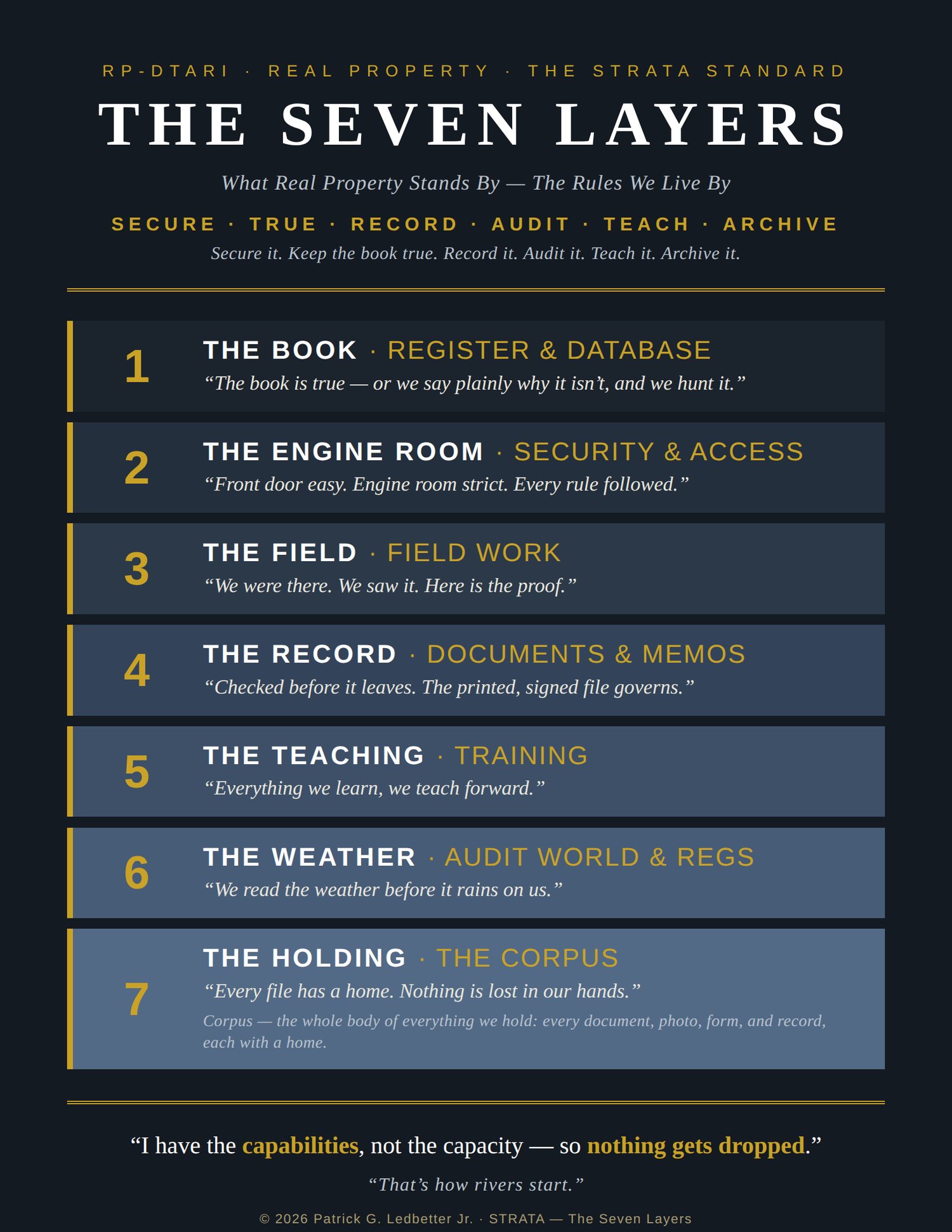
We call our starting diagram STRATA because real property stands on layers of ground. A program stands on layers of decisions. If one layer is soft, everything above it moves.
1. THE BOOK — Register & Database
The rule: “The book is true — or we say plainly why it isn’t, and we hunt it.”
The book is your register: what you say exists, where it is, what condition it is in, who is responsible, and which documents support it.
That means disagreements stay visible. A bad record gets flagged and hunted. It does not get deleted just to make two reports match.
Skip this layer, and the best dashboard in the world will confidently display the wrong answer.
2. THE ENGINE ROOM — Security & Access
The rule: “Front door easy. Engine room strict. Every rule followed.”
The front door should be easy for the right person. Requesting access, signing in, and doing ordinary work should not require a guide.
The engine room is different. Permissions, data, approvals, and administrative controls stay strict. Know who can read, who can change, who can approve, and what happens when somebody tries to enter the wrong room.
Skip this layer, and convenience becomes exposure.
3. THE FIELD — Field Work
The rule: “We were there. We saw it. Here is the proof.”
Real property is physical. A record can say a building is there, but a person still has to stand in front of it.
The field gives you the photograph, the measurement, the condition, and the facts the paper got wrong. Ground corrects the book.
Skip this layer, and you are managing descriptions of places nobody has verified.
4. THE RECORD — Documents & Memos
The rule: “Checked before it leaves. The printed, signed file governs.”
Work becomes dependable when another person can rely on it later. A memo, form, or decision needs to be checked before it travels.
Once a document is signed, that is the version people act on. A loose draft in somebody’s messages does not quietly outrank it.
Skip this layer, and five versions become five truths.
5. THE TEACHING — Training
The rule: “Everything we learn, we teach forward.”
A program that lives in one person’s head has an expiration date.
Training is not just showing somebody which button to press. Teach why the record matters, what proof looks like, and what to do when the paper and the ground disagree.
Skip this layer, and every new person invents a process while every departure takes part of the program out the door.
6. THE WEATHER — Audit World & Regs
The rule: “We read the weather before it rains on us.”
Audits and regulations are not surprises that appear from nowhere. Findings in other organizations, changes in standards, and questions auditors keep asking are all weather reports.
Read them early. Fix the roof while the sun is out.
Skip this layer, and you build a perfect answer to last year’s question.
7. THE HOLDING — The Corpus
The rule: “Every file has a home. Nothing is lost in our hands.”
The corpus is the whole body of the work: source documents, signed forms, photographs, research, drafts, and the history that explains how a decision was reached.
Every file needs a home and a path back to the asset, project, or decision it supports.
Skip this layer, and a file you cannot find is a file you do not have.
Five moves inside seven layers
Do not confuse STRATA with the life cycle of one asset. Real property has five moves: identify it, classify it, record it in the book, update it, and dispose of it at the end of its life. STRATA is bigger than that. Its seven layers wrap the whole program around those five moves, so the work stays secure, proven, checked, taught, watched, and findable from the first asset to the last.
Use the diagram before the shopping list
STRATA works whether the thing you are building is written, verbal, or made of concrete.
For a written program, it tells you what has to exist before the procedure can be trusted.
For a verbal program, it gives the team the same words and the same order of work, even when the founder is not in the room.
For construction, it carries the job past ribbon-cutting: proof from the field, a checked record, trained people, and a file somebody can find ten years later.
Draw the seven layers. Under each one, write what is true today, what is missing, and who owns it. Then start with the weakest layer — not the prettiest purchase.
Why we recommend it
These layers were not invented in a classroom.
They are what years of research, scouring, and doing left standing: reading audit findings, chasing bad records, fixing broken files, watching good intentions fail because one layer was missing, and learning what actually made the next job easier.
We did not keep a layer because it sounded impressive. We kept it because it stopped work from being dropped.
Somebody asked what we run on. The answer is one word:
STRATA.
Take the diagram. Start where we started.
STRATA — The Seven Layers — © 2026 Patrick G. Ledbetter Jr.
Nothing dropped.
Field tested, field graded — by the people doing the job, not experts on a shelf. If you find something different, leave it in the comments so we can fix it. That's how this gets better.
— Patrick G. Ledbetter Jr., Nothing Dropped California Real Property
https://payhip.com/NothingDroppedCaliforniaRealProperty