

You're running on empty — and a holiday didn't fix it. That's not laziness, and it's not a personal failure. For autistic and ADHD adults, burnout often looks different from ordinary work burnout: the exhaustion doesn't clear with a weekend off, skills you used to have feel suddenly out of reach, and noise, light, and social interaction overwhelm you faster than they used to. Here's the part most burnout advice skips: the advice was written for one kind of burnout. It assumes the load is mostly the job, and that a holiday and better boundaries at work will sort it out. For neurodivergent burnout, the load is different — masking all day, sensory overload, and demands that consistently exceed capacity. So the advice misses. Travel is itself a demand: new places, new routines, sensory load, social pressure. You can come back more tired than you left.
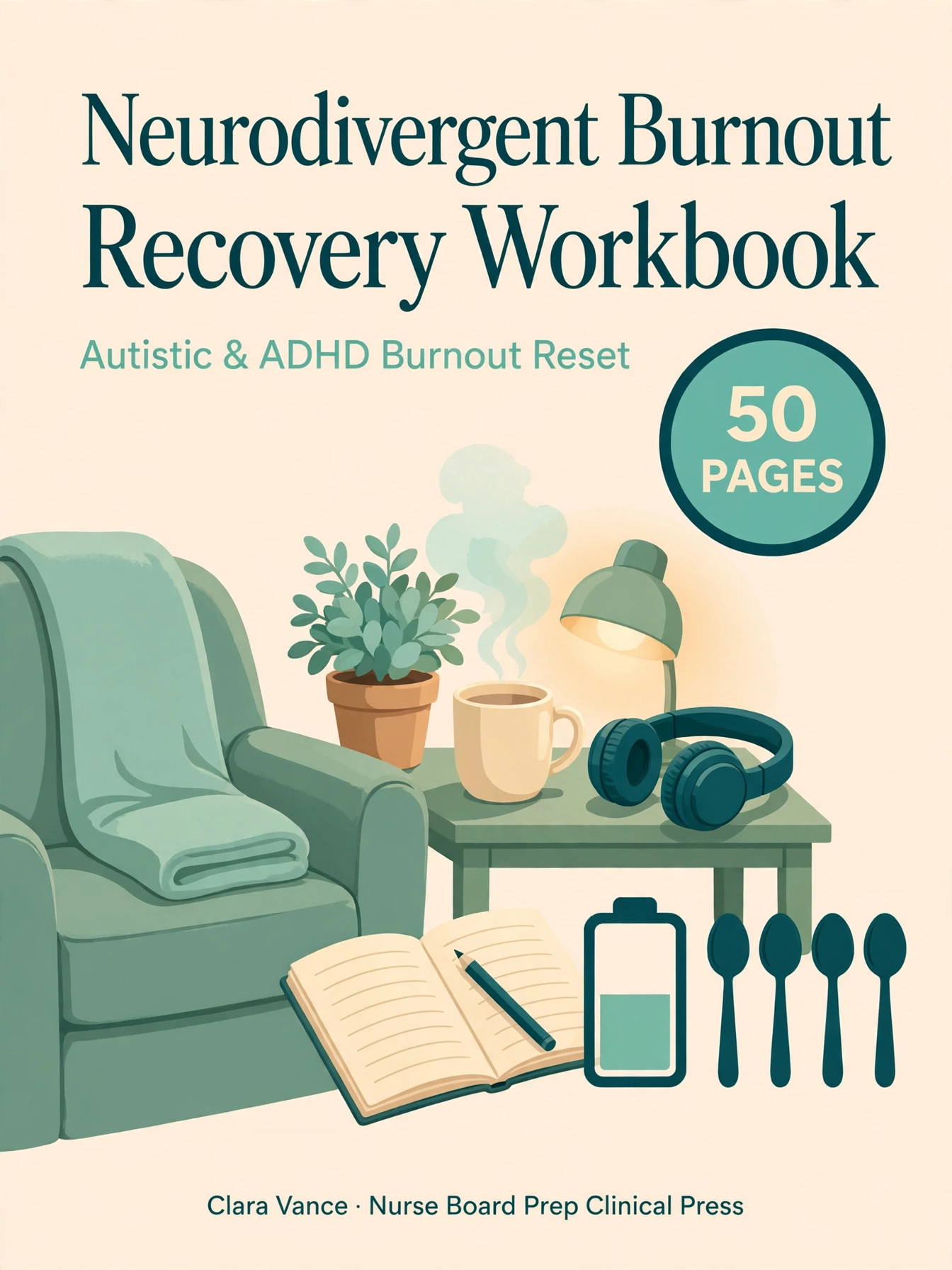
Neurodivergent Burnout Recovery Workbook — Autistic & ADHD Burnout Reset — $22
The one rule: reduce demands before adding anything new. Before you add a single new habit, system, or routine to your life, ask one question: what can I put down? Recovery is not about becoming more productive. It is about getting your capacity back. Every page of the workbook follows that order — if it asks you to do something new, it first asks what you can lower. And when you do plan a day, don't plan it in hours. Plan it in spoons.
Get the workbook — 50 pages, 19 worksheets, 30-day gentle reset — $22
One worked example (from the workbook): The situation: Sam is autistic and has ADHD, works part-time, and has been running on empty for months — masking all day at work, coming home exhausted, and spending evenings too tired to do anything but scroll. Tuesday is a low-demand day, planned the night before. Count the spoons: Spoons for Tuesday: 8. A low day might be 6; a steady day might be 12. Eight is Sam's honest number. Work costs 4. The commute costs 1. That leaves 3. Sam cancels a lunch plan and writes 'NOT on today: the big shop, the phone call to the bank, the group chat.'
The day itself: Sam wears noise-cancelling headphones on the commute and asks for written instructions instead of verbal ones. Lunch is twenty quiet minutes alone, lights low, no screens — sensory rest, not more input. At 5 p.m., Sam is at 2 spoons. The plan says: one essential task only. Sam puts one plate in the dishwasher — and stops. The rest of the kitchen waits. The evening is low-input: blanket, dim light, a familiar show, phone on silent. The win, written that night: 'I kept the low-demand day. I did not crash.' The house is not tidy. The day still counts.
That's one day. The workbook gives you the rest: a masking map, a sensory profile, a six-kind rest menu, a daily spoons budget, low-demand day and week plans, a crisis plan for near-zero-capacity days, and one small action a day for 30 days — so the habit builds slowly enough to hold. Get the full 30-day plan here:
Neurodivergent Burnout Recovery Workbook — Autistic & ADHD Burnout Reset — $22
Inside: 50 pages, 19 worksheets, a 12-item self-reflection check-in, the 30-day gentle reset (Days 1–30, one checkbox a day), a section on autistic burnout and masking, a section on ADHD burnout and the crash after sustained effort, a relapse warning-signs page, and a one-page recovery plan to keep after the 30 days end.
Educational material, not a substitute for professional care. The checklists inside are for self-reflection only, not a diagnostic test. If you are in crisis, contact your local emergency services or a crisis helpline right away — 988 in the US; Samaritans 116 123 in the UK and Ireland. Also on Gumroad: https://nurseboardprep.gumroad.com/l/bfrdvc