

You have been invited to a work drinking party in Japan, you do not drink alcohol, and you are not sure whether skipping is rude or attending means drinking.
Short answer: yes, you can skip a nomikai, and you can also attend without drinking at all — what matters most is telling the organizer early, and choosing which type of party it is.
Short answer
Known: A nomikai is a workplace social event, not a legal duty. No rule requires you to drink alcohol at one. This post describes custom, not law.
My read: Not drinking is workable at almost any nomikai now. Toasting with oolong tea or ginger ale is accepted — the toast is about timing and taking part, not what is in the glass.
Don't know: How much any one team notices an absence. It varies by company and team, which is why the type of party matters.
First, check which party it is
Not all work parties carry the same weight. Rank them before you decide:
- Welcome (kangeikai) or farewell (sōbetsukai) party for your own team — noticed the most. Go if you can, even briefly.
- Your team's year-end party (bōnenkai, December) — usually the team's largest party. Also noticed.
- An ordinary small nomikai — more optional.
- A large cross-department party — noticed the least.
- The second party (nijikai) — more optional than the first. Joining the first and skipping the second is standard.
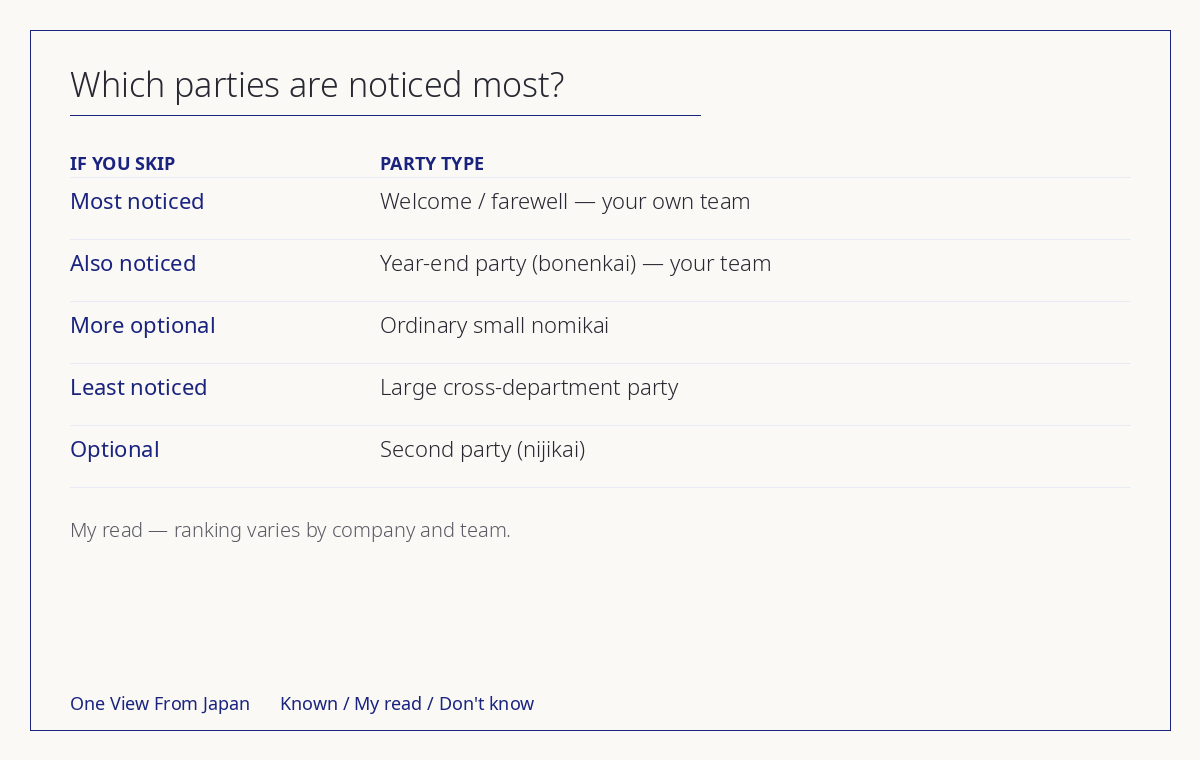 My read: If you are unsure about a specific party, ask a trusted colleague one question: "Is this one an all-hands kind of party?" Their answer is a better guide than any general rule, including this ranking.
If you go without drinking
Three small steps make this straightforward:
- Tell the organizer in advance. Briefly: "I'll join — just to note, I don't drink alcohol." No medical detail is owed.
- Order a soft drink with the first round. Oolong tea and ginger ale are the standard stand-ins. A full glass avoids repeated offers.
- Toast with your soft drink. Wait for the toast (kanpai), then raise whatever you are drinking.
If asked at the table, one phrase closes the topic: osake wa nomenain desu — "I can't drink alcohol." Framing it as "can't" ends follow-up questions faster than "I don't want to," whatever your reason — health, medication, driving, pregnancy, religion, or preference.
My read: You may still be offered a pour once or twice out of habit. A hand lightly over your glass and the same phrase ends it. If pressure continues after you have said no, that is not a custom you have to honor — afterwards, your company's harassment consultation desk or your manager is the reliable route.
If you decide to skip it
Decline early, decline to the organizer directly, and give one short reason. A late decline costs the organizer money on course bookings, which is the part people actually notice.
Templates you can adapt — use your real reason:
- A prior commitment: "Thank you for the invitation. I have a prior commitment that evening, so I won't be able to join this time."
- A family matter: "I'm sorry — something has come up at home that day, so I'll have to miss this one."
- Not feeling up to it: "I'm not in the best condition at the moment, so I'll sit this one out."
- Attending, but leaving early: "I'll join, but I may need to leave partway through."
In Japanese, the prior-commitment version is: Go-annai arigatou gozaimasu. Sono hi wa senyaku ga ari, konkai wa sanka dekimasen. — "Thank you for the invitation. I have a prior commitment that day, so I cannot join this time."
My read: One reason, briefly. A long, detailed excuse invites questions; a short one closes the topic. And if you skip a welcome or farewell party, a short word to the person joining or leaving, on the next working day, repairs most of the social cost.
What this post does not cover
This is one view from inside Japan. Habits vary by company, industry, generation, and region. Expense rules and a specific workplace problem are governed by your company's own policies — check those directly.
A small next step
If you want the full picture — seating, pouring, speeches, the closing clap, who pays, and more decline wording in English and Japanese:
- Nomikai and Year-End Parties: What's Expected, How to Decline ($5): https://payhip.com/b/Y9PHV
New to this series? There is also a free starting point:
- Free sample — 12 Japanese Workplace Expressions, Decoded: https://payhip.com/b/zR8ns
Both use the same labeling as this post: what is known, what is my reading, and what cannot be known in advance.