

You made a mistake at work — a missed deadline, a wrong figure, a file sent to the wrong person — and a one-line "sorry" does not feel like enough, but a long apology feels risky too. Short answer: send a short email the same day that states the facts first, takes clear responsibility, gives a brief cause without excuses, says what you have fixed or will fix and by when, and adds one concrete step to prevent a repeat.
Short answer
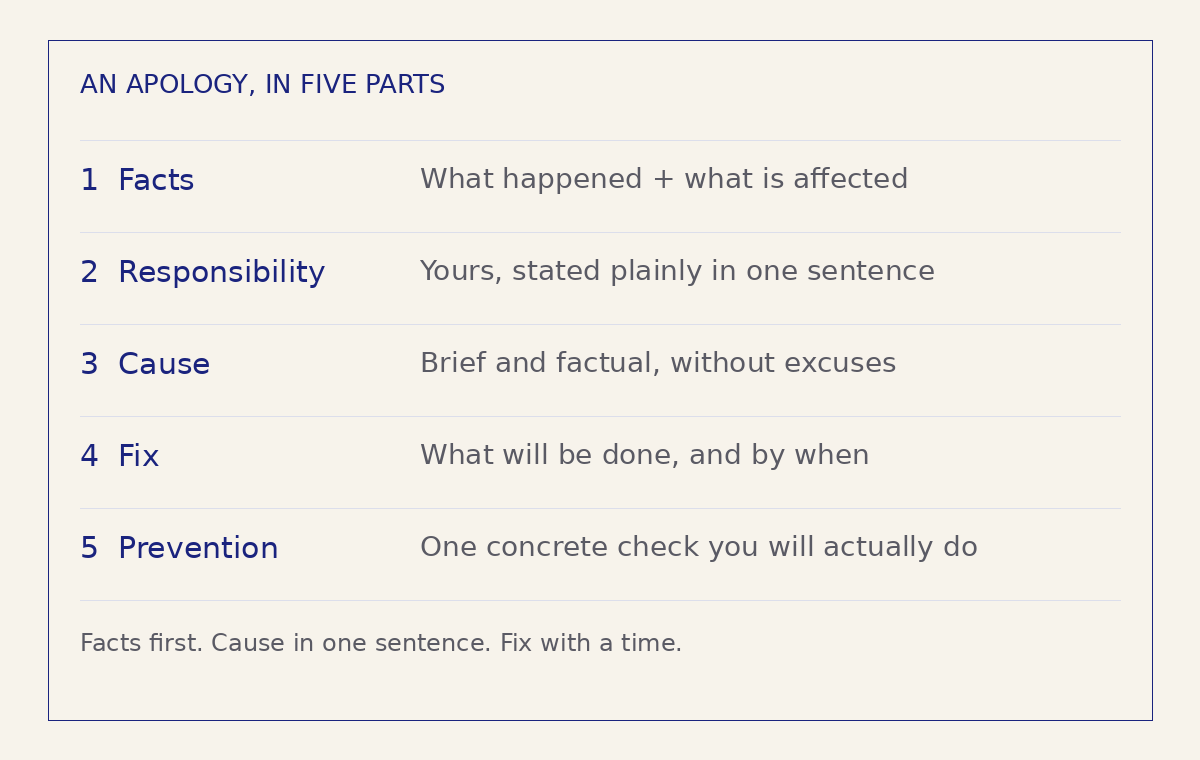
Known: A standard Japanese business apology email has five parts, in this order: the facts (what happened and what is affected), responsibility (that it was your mistake, stated plainly), the cause (brief and factual, one sentence), the fix (what is done or will be done, with a date and time), and prevention (one check or change that stops a repeat). The apology wording itself — for example, moushiwake gozaimasen — opens or closes the email, but it does not replace those five parts.
My read: Most apology emails fail in one of two ways. They apologise several times but never state the new deadline, so the reader still does not know what happens next. Or they explain the cause at length before stating the facts, which reads as an excuse even when it is true. Facts first, cause in one sentence, fix with a time — that order keeps the email short and still complete.
Don't know: How formal your specific case needs to be. That depends on the impact, whether the reader is internal or a client, and whether your manager needs to approve the apology. The levels below are starting points, not a rule for your workplace.
Choose the level before you write
- Level 1 — Small, internal, no outside impact: A typo caught quickly, a file shared a few minutes late. A short email or chat message is usually enough: facts, brief apology, fix.
- Level 2 — Internal deadline or quality issue: Work others are waiting on is delayed or needs redoing. Use the full five-part email, with a new deadline and a progress check.
- Level 3 — A client or another company is affected: The same five parts, in more formal wording — and check with your manager before sending. In many workplaces the manager sends or approves the external apology.
- Level 4 — Money, safety, or a formal complaint is involved: Do not improvise an email from a template. Report to your manager the same day and follow your company's process. This post does not cover that level.
Known: Speed matters more than length. Reporting a mistake the same day you find it, even before you have the full cause, is normal practice in many Japanese teams. A brief first report followed by a fuller email is better than silence while you prepare a perfect one.
The structure, line by line
- Subject: Name the matter, not just the apology. "Apology and correction: figures in the report sent November 13" tells the reader what is affected before they open the email.
- Apology, one line: Kono tabi wa go-meiwaku wo okake shi, moushiwake gozaimasen. — "I am sorry for the trouble this has caused." One line here is enough; do not repeat it in every paragraph.
- Facts: What happened, when, and what is affected — numbers and dates, no adjectives. "The total on page 2 was 1.2 million yen; the correct figure is 1.02 million yen."
- Responsibility: One plain sentence. "This was my error in checking the figures." Do not spread it across the team or a busy week unless that is the checked cause.
- Cause, one sentence: "I did not re-check the figures after the final update." If you do not yet know the cause, say so and name when you will report it.
- Fix, with a time: "I will send the corrected report by 10:00 a.m. tomorrow, November 15, and report progress at 4:00 p.m. today."
- Prevention, one item: One check you will actually do — for example, a second-person check on totals. One real step reads as more serious than three general promises.
An example you can copy
Situation: You missed an internal deadline for a weekly report (Level 2). Your manager already knows the situation from a brief conversation.
Subject: Apology: weekly progress report — new delivery time
Manager Tanaka,
I am sorry — I missed today's deadline for the weekly progress report.
The cause was my estimate: I did not allow time to reconcile the source data.
I will hand it over by 10:00 a.m. on November 18.
So that this does not surface late again, I will report progress at 4:00 p.m. today, November 17.
I am sorry for the delay.
Japanese pattern for the key lines: Shuuji shinchoku repooto no honjitsu shimekiri wo mamoremasen deshita. Gen'in wa watashi no mitsumori de, shuukei deeta wo shougou suru jikan wo mikonde imasen deshita. — "I missed today's deadline for the weekly progress report. The cause was my estimate — I did not allow time to reconcile the source data." Add the new deadline and the progress check, and the five parts are complete.
My read: Notice what this example does not do. It does not explain a busy week, and it does not promise in general terms that it will "never happen again." The progress check at 4:00 p.m. is the prevention — small, dated, and verifiable.
Apology wording, from lighter to stronger
- Sumimasen: Light, everyday. Fine for a very small internal slip; too light on its own for a client or a missed deadline.
- Moushiwake arimasen / moushiwake gozaimasen: The standard formal apology for work email. The gozaimasen form is more polite.
- Fukaku owabi moushi agemasu: "I deeply apologise." For serious cases, usually external — and usually a wording your manager should see before you send it.
Known: Stronger wording does not fix a missing deadline or a vague fix. Readers judge the email mainly on whether the facts, the fix, and the prevention are clear.
What to avoid
- Do not lead with a long explanation of why it happened — facts first, cause in one sentence.
- Do not apologise repeatedly and omit the new date. The reader's first question is "when will it be fixed?"
- Do not promise a broad "I will be more careful" with no check attached. Name the one step you will take.
- Do not send a formal apology to a client before your manager has seen it, if that is your workplace's rule — in many teams, it is.
- Do not hide a mistake you have found and hope it is not noticed. A same-day report is almost always received better than a late discovery by someone else.
What this post does not cover
This is one view from inside Japan. Wording, formality, and who should send the apology vary by company, industry, and the size of the impact. Your manager's instruction and your company's process come before any general guide, including this one. This post also does not cover company press apologies, or apologies involving legal questions, compensation, safety, or harassment — those need your company's formal process, not an email template.
A small next step
If you want the full set of wording by level — the structure part by part, four severity levels, five apology expressions matched to level, and templates you can fill in:
- Apologizing at Work in Japan: Structure and 12 Templates ($5)
- Free sample — 12 Japanese Workplace Expressions, Decoded
Both use the same labeling as this post: what is known, what is my reading, and what cannot be known in advance.