

You finish a task in silence, your manager assumes nothing has moved, and then a small problem surfaces too late to fix easily.
Short answer
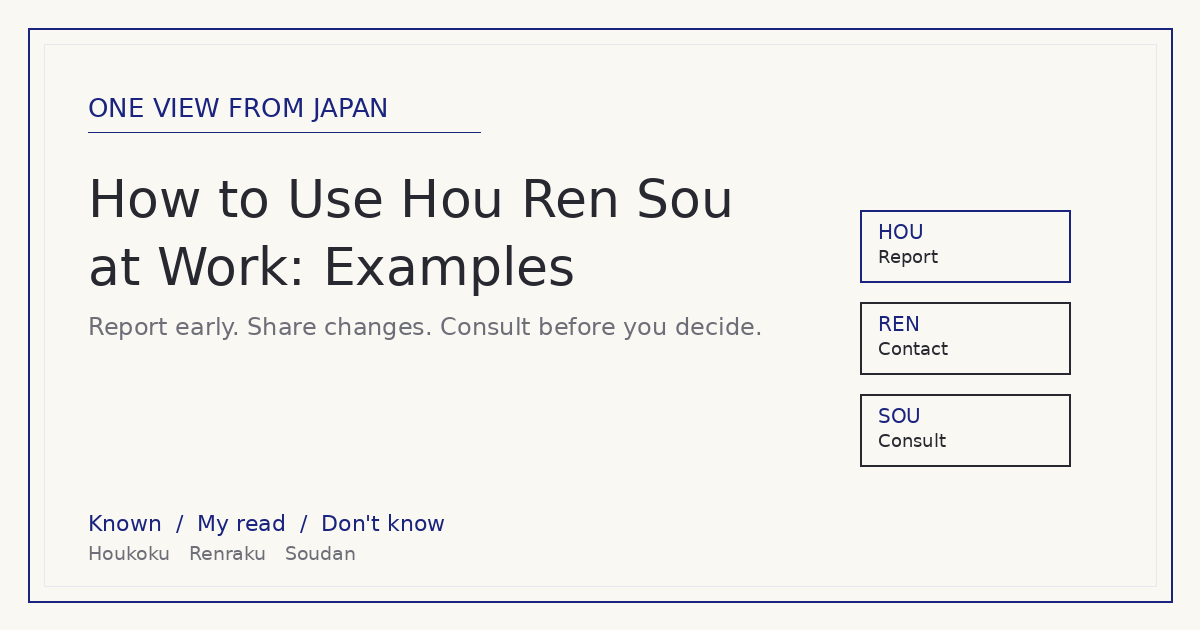
Known: Hou ren sou is short for three words: houkoku (report), renraku (contact / share information), and soudan (consult). It is a common framework in Japanese workplaces for keeping a manager and a team updated. It describes custom and expectation, not law.
My read: Most problems people blame on hou ren sou are timing problems, not language problems. A short update sent early is usually more useful than a detailed report sent late.
Don't know: How often your specific manager wants updates. That varies by manager, team, and project — which is why the examples below include how to check.
The three parts, in plain terms
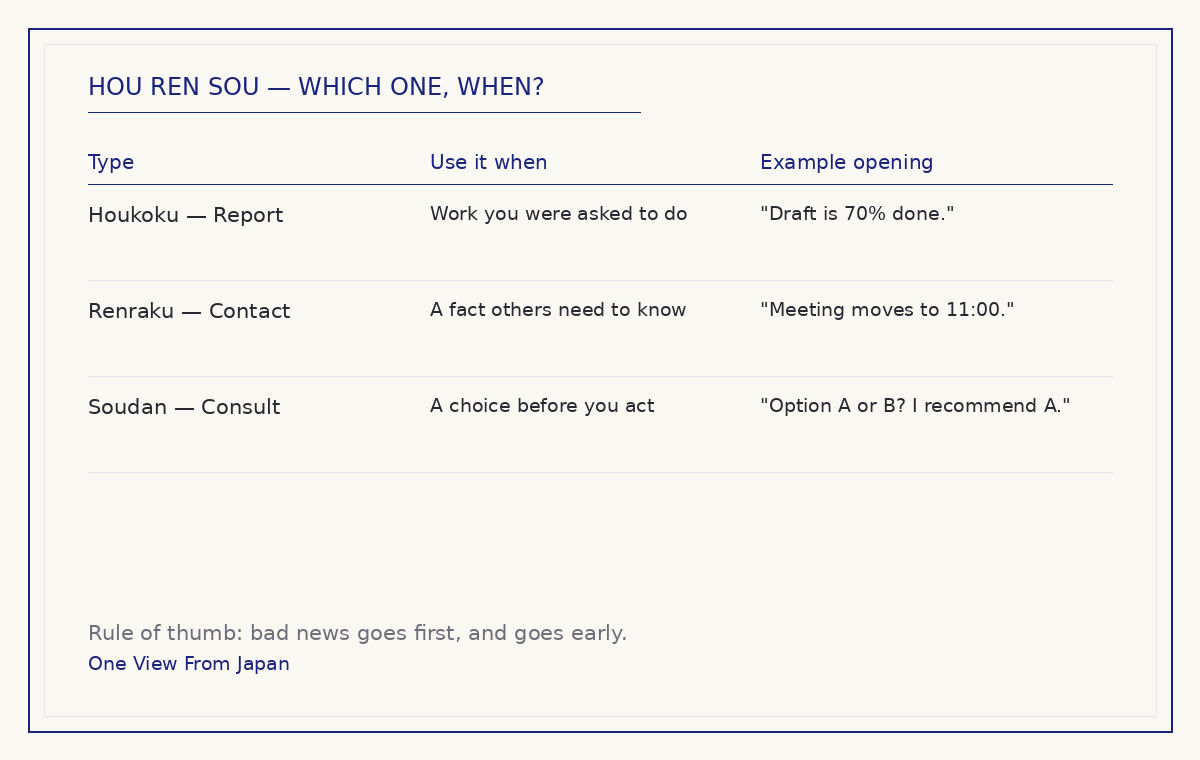
- Houkoku — Report: Tell your manager the result or current status of work you were asked to do. Past tense, outcome first: done, in progress, or delayed.
- Renraku — Contact: Share a fact that others need to know, even if no decision is needed. A time changed, a file arrived, a client replied.
- Soudan — Consult: Ask before you act when the next step involves a choice, a cost, a deadline, or another person's work. You are asking for a decision or advice, not just sharing news.
My read: If you are unsure which one you are doing, name it at the start of your message. "A quick report:", "For information:", or "May I consult you on...?" — that one label removes most confusion.
Examples you can copy
1. Houkoku — a progress report
Situation: You were asked to prepare draft slides by Friday.
- Too late / too vague: saying nothing until Friday, then "I'm still working on it."
- Hou ren sou version, on Wednesday: "Report: the draft slides are about 70% done. The structure and figures are complete. The remaining part is the final page, which I will finish by Thursday evening, ahead of the Friday deadline."
Japanese pattern: Houkoku desu. Shiryō wa yakuhachi-wari kanryō shimashita. — "A report: the materials are about 80% complete." Add what remains and when it will be done.
2. Renraku — contacting about a change
Situation: A meeting moves, or a delivery date shifts by one day.
- Too late: mentioning it in the meeting itself.
- Hou ren sou version, as soon as you know: "For information: tomorrow's 10:00 meeting has moved to 11:00. The room is unchanged. No action is needed from you."
Known: Renraku does not need a reply in most cases. Saying "no action needed" — or "please reply by 15:00" if action is needed — helps the reader sort it quickly.
3. Soudan — consulting before a decision
Situation: A task will miss its deadline unless you cut part of the scope.
- Too late: deciding alone to cut the scope, then reporting the cut afterwards.
- Hou ren sou version, as soon as the risk is clear: "May I consult you? At the current pace, Friday delivery would require dropping the appendix. Options are: (A) keep the appendix and move delivery to Monday, or (B) deliver Friday without it. I recommend A, because the client asked for the detail. Which should I take?"
My read: A good soudan has three parts: the problem in one sentence, the options, and your recommendation. Bringing only the problem leaves all the work with your manager; bringing only your decision removes their chance to weigh in.
How often is often enough?
There is no single company-wide number, so use these starting points and adjust:
- A task lasting several days: a brief report at the halfway point, and immediately if the deadline is at risk.
- Bad news: contact first, consult quickly after. Report a delay, an error, or a complaint the same day you learn of it — earlier in the day is better, even if you do not yet have a full explanation.
- A routine, same-day task: one report when it is done is usually enough.
How to check: In your first weeks, ask directly: "For a task like this, would you like a progress report midway, or only when it is complete?" One question sets the interval for months.
What hou ren sou is not
It is not reporting every small step — over-reporting makes important updates harder to spot. It is not asking permission for decisions that are already yours. And for dates, numbers, and decisions, follow a conversation with a short written note.
What this post does not cover
This is one view from inside Japan. Expectations vary by company, industry, manager, and how urgent the work is. Your team's own rules and your manager's stated preference come before any general guide, including this one.
A small next step
If you want the full picture — when to report, how often, example wording for delays and bad news, and how hou ren sou differs from a simple CC:
New to this series? There is also a free starting point:
Both use the same labeling as this post: what is known, what is my reading, and what cannot be known in advance.