

You sent an email, heard nothing back, and now you are not sure whether to wait, resend it, or apologise for asking again. Short answer: wait a reasonable interval, then send a short follow-up that names the original email, restates only the one thing you need, gives a clear date, and makes it easy to reply.
Short answer
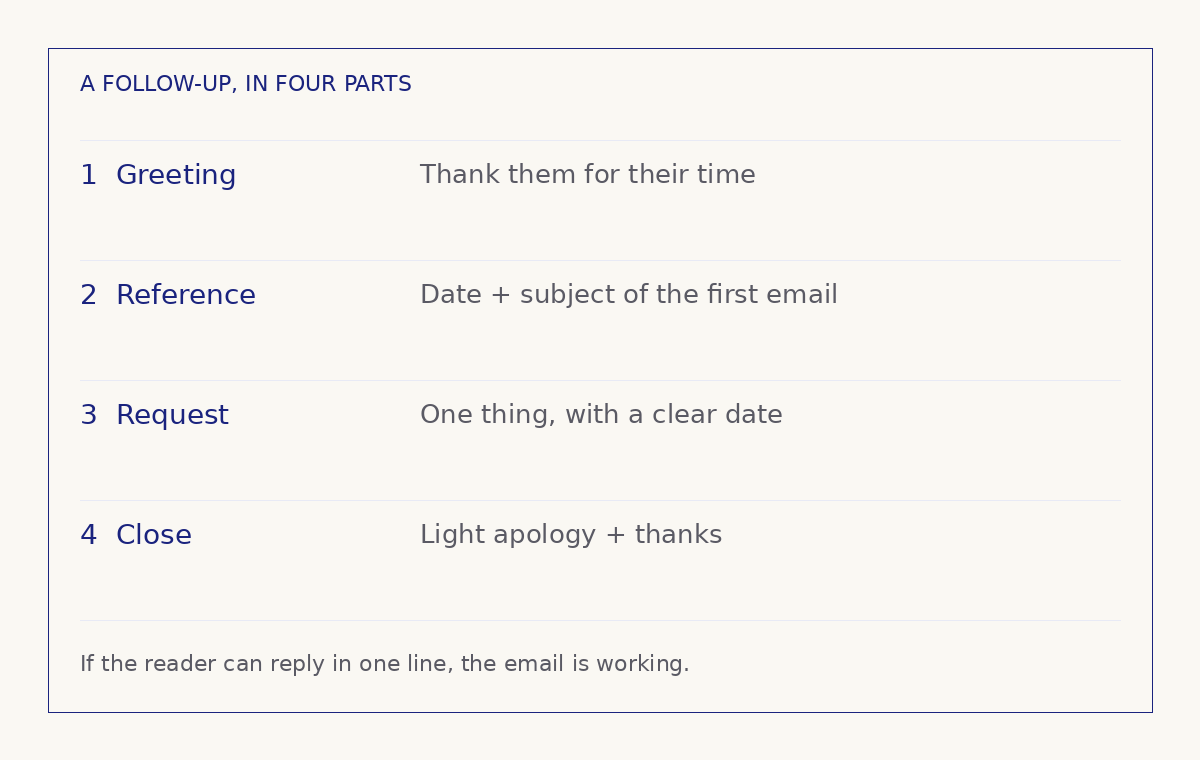
Known: A polite follow-up in Japanese business email usually has four parts: a greeting that thanks the reader for their time, a brief reference to the previous email (date and subject), the single request restated in one sentence, and a closing that apologises for the extra contact and thanks them again. The request itself is normally softened — for example, go-kakunin itadakemasu deshou ka (“could you please check”) rather than a direct demand.
My read: Most follow-ups fail for a practical reason, not a language reason: the reader has to dig through the old thread to work out what is needed and by when. A good follow-up removes that work. If the reader can understand the request from the new email alone, and reply in one line, it is polite enough in most workplaces.
Don't know: How long you should wait in your specific case. That depends on the deadline, the relationship, and whether the other person is internal or external — the guide below gives starting points, not a rule.
When to send it
Use these as starting points and adjust to the deadline you named in the first email:
- No deadline was given, routine request: after 3 business days.
- A deadline is approaching: 1–2 business days before that deadline, framed as a confirmation, not a reminder of fault.
- The deadline has passed: on the next business day, briefly and without blame. State the effect plainly if work is blocked.
- Urgent, same-day matter: do not rely on email alone. A short chat message or a brief conversation, followed by the email for the record, is normal in many teams.
Known: Weekends and public holidays are not business days. Counting them makes a follow-up feel earlier — and more pressing — than you intend.
The structure, line by line
- Subject: Keep the original subject, or add reminder wording only if your workplace does. Changing the subject breaks the thread for many readers.
- Greeting: Name + title, then a standard opening: Osewa ni natte orimasu — “Thank you for your continued support.” For internal mail, some teams use a shorter opening.
- Reference: “I am writing again about my email of [date] regarding [topic].” One sentence. Attach or quote the key part if the reader may not find it quickly.
- Request: One request, one date. “Could you please confirm [X] by [date]?” If there are options, list them so a one-word reply works.
- Softening and close: Oisogashii tokoro kyoushuku desu ga — “I am sorry to ask while you are busy, but…” followed by thanks. Then your name and, for external mail, your company and contact details as usual.
An example you can copy
Subject: Re: Estimate request — confirmation by Friday
Tanaka-san,
Osewa ni natte orimasu. This is [Your Name] from [Team / Company].
I am following up on my email of November 10 about the estimate for [project]. Could you please let me know whether the estimate can be ready by Friday, November 14? If that timing is difficult, a rough date would also help — I need it to set the next step.
I am sorry to ask again while you are busy. Thank you for your help.
Japanese pattern for the key line: 11-gatsu 10-nichi ni soushin shimashita [topic] no ken ni tsuite, go-kakunin itadakemasu deshou ka. — “Regarding the matter I sent on November 10, could you please check?” Add the date you need and it becomes complete.
My read: The sentence “a rough date would also help” does a lot of work. It gives the reader a smaller, easier reply than the full answer, and it signals that you are coordinating, not accusing.
Three situations, three adjustments
- First follow-up, no reply: Use the full structure above. Assume the email was missed, not ignored.
- Second follow-up: Shorter. Reference both earlier emails, restate the request and date, and state what happens next: “If I do not hear back by Thursday, I will proceed with option A.”
- Following up upward, to a manager or a client: Keep the apology light and the facts clear. One extra softener is fine; several apologies in one short email can make a simple confirmation sound like a problem.
What to avoid
- Do not resend the identical email with no new information — the reader still has to do the work.
- Do not add new requests inside a follow-up. One email, one request; send a separate email for a new topic.
- Do not use wording that assigns blame, such as asking why there was no reply. State dates and facts instead.
- Do not mark a routine follow-up as urgent in the subject. Save that marking for cases where a deadline today is genuinely at risk.
What this post does not cover
This is one view from inside Japan. Wording, waiting times, and how direct you can be vary by company, industry, seniority, and your relationship with the reader. Your team's own examples and your manager's stated preference come before any general guide, including this one. This post also does not cover follow-ups after a mistake or a complaint — those need an apology structure first, not a reminder structure.
A small next step
If you want ready-to-use wording for this and the other situations that come up most often — requests, confirmations, apologies, scheduling, and thank-you emails:
- Writing Polite Japanese Emails: 20 Templates by Situation ($5): https://payhip.com/b/xZsF0
New to this series? There is also a free starting point:
- Free sample — 12 Japanese Workplace Expressions, Decoded: https://payhip.com/b/zR8ns
Both use the same labeling as this post: what is known, what is my reading, and what cannot be known in advance.