
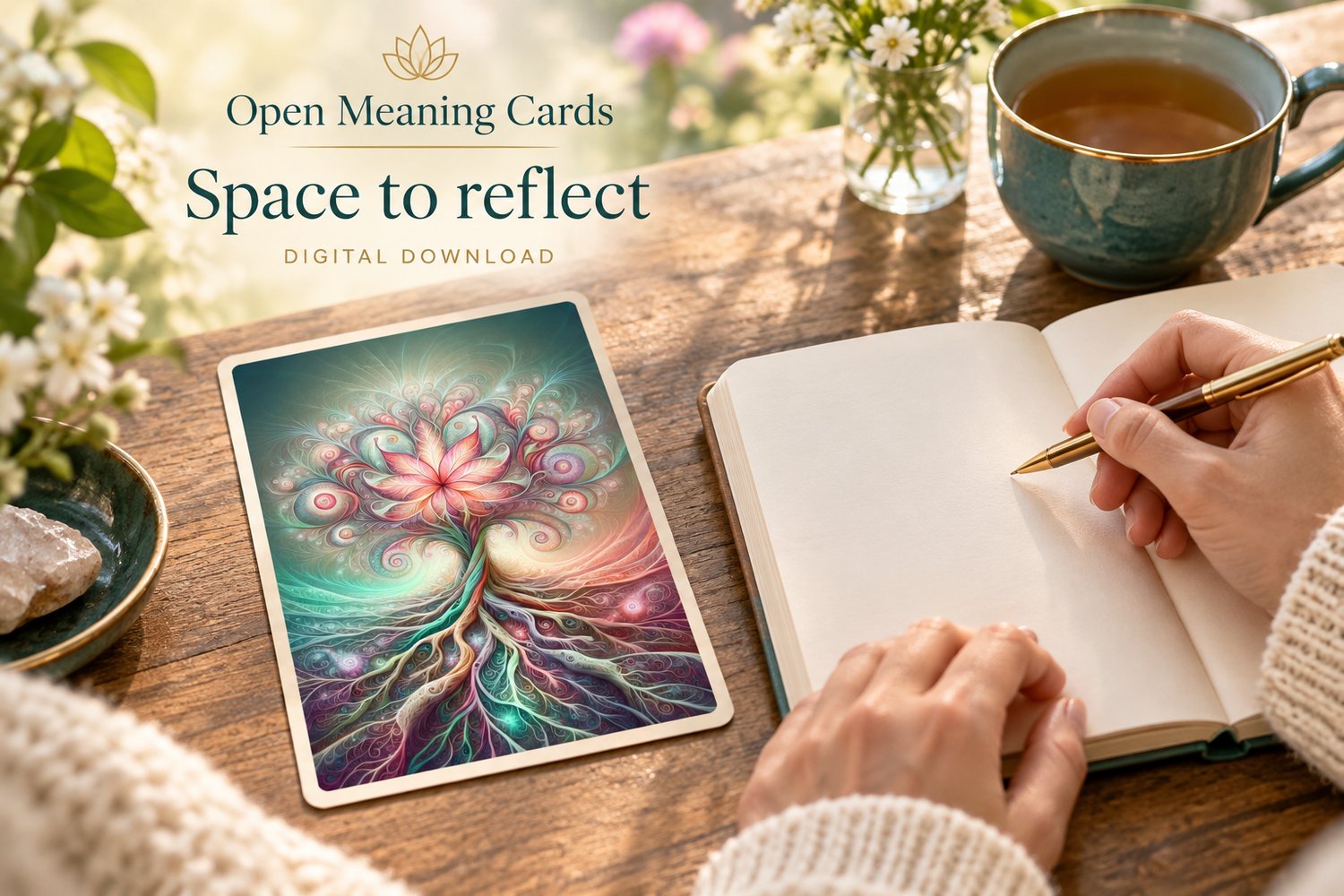
Metaphorical associative cards — usually shortened to MAC cards — are decks of open-ended images used for reflection, coaching and therapy. There is no fixed meaning printed on them and nothing to memorise. You look at a card, notice what it stirs up, and talk or write about that. The meaning comes from you, not from the deck.
This beginner's guide explains what metaphorical associative cards are, where they come from, why such a simple tool works so well, how they differ from tarot and oracle cards, and how to start using them — with a five-step first session, five easy exercises and tips for choosing your first deck.
Key takeaways
• Metaphorical associative cards are open-ended image (and word) cards with no fixed meaning.
• They work through projection: you see your own situation in an ambiguous picture.
• Unlike tarot or oracle cards, they do not predict or advise — the meaning is always yours.
• Coaches, therapists, teachers and individuals use them for reflection, journaling and conversation.
• One card and five simple steps are enough to start.
What are metaphorical associative cards?
A MAC deck is a set of picture cards — sometimes paired with word cards — designed to be deliberately ambiguous. A path disappearing into fog. An open door. A wave about to break. A single chair in an empty room. Each image can mean many things, and that is exactly the point.
When you ask someone "What do you see in this card?", they don't describe the picture objectively. They describe it through their own experience, mood and concerns. The card becomes a mirror: a safe, indirect way to put words to something that was hard to say head-on.
The best-known early deck is OH Cards, created by the Canadian artist Ely Raman and first published in Germany in the early 1980s (read more about OH Cards). It combined 88 picture cards with 88 word cards. Since then, metaphorical associative cards have spread widely among coaches, psychologists, counsellors, teachers and facilitators, and today there are decks for almost every theme — emotions, decisions, relationships, grief, career and more.
The psychology behind the cards
Metaphorical associative cards belong to a long tradition of projective techniques — methods that use ambiguous pictures to help people express inner experience. The best-known example is the Thematic Apperception Test, developed at Harvard in the 1930s, in which people tell stories about ambiguous scenes. MAC cards borrow the principle but not the testing: there is no scoring and no interpretation by an expert. The person simply notices what the image brings up.
Metaphor matters too. We already think in metaphors — "I'm at a crossroads", "it feels like a weight", "I'm stuck". A card turns that inner metaphor into something visible that you can look at, describe and even change.
Why do metaphorical associative cards work?
The working principle is projection: when we look at something open and ambiguous, we naturally fill in the gaps with our own thoughts and feelings. A card showing a boat far from shore might feel like freedom to one person and loneliness to another. Neither answer is wrong — and both reveal something useful.
This makes MAC cards helpful in a few specific ways:
• They slow things down. Choosing and describing a card gives people a moment to pause before answering.
• They lower the pressure. Talking about "the person in the card" feels safer than talking about yourself directly.
• They bypass the rehearsed answer. An unexpected image can surface something that a direct question would not.
• They give language to feelings. Many people find it easier to point at an image than to name an emotion.
• They work across ages and languages. Images need no translation, which makes them useful in groups and international settings.
Metaphorical associative cards vs tarot and oracle cards
At first glance, all three are illustrated card decks. In practice, they work very differently:
• Tarot has a fixed structure (78 cards: Major and Minor Arcana) and a traditional meaning for each card. Reading tarot means interpreting those meanings in a spread.
• Oracle cards usually carry a written message or theme, and come with a guidebook explaining what each card "says".
• MAC cards have no system, no doctrine and no prescribed meaning. There is nothing to learn by heart. The person holding the card is the only authority on what it means.
That is why MAC cards are used in professional coaching and therapeutic settings: they don't predict, advise or diagnose. They simply open a conversation.
Who uses metaphorical associative cards?
• Coaches — to clarify goals, explore obstacles and find a next step.
• Therapists and counsellors — as a gentle entry point into difficult topics, within their own scope of practice.
• Teachers and facilitators — for group check-ins, workshops and team sessions.
• Individuals — for journaling, self-reflection and making sense of a situation on their own.
Types of metaphorical associative cards
• Image decks — the classic form: open, wordless pictures of scenes, objects, people or abstract forms.
• Word decks — single words such as "trust", "loss" or "freedom", used alone or paired with images.
• Combined decks — image and word cards designed to be drawn together, as in the original OH Cards.
• Themed decks — focused on one area such as emotions, grief, decisions, relationships, career or identity.
• Light and dark decks — gentle, open imagery helps people imagine; darker imagery gives permission to name difficult things.
Benefits of metaphorical associative cards
• They make it easier to talk about feelings that are hard to name.
• They create a safe distance: you talk about the card before you talk about yourself.
• They bypass rehearsed, logical explanations and surface fresh insight.
• They work with any age, culture or language.
• They keep the person in charge of the meaning, which builds self-awareness and autonomy.
• They make reflection memorable — an image stays with you long after the conversation.
How to use metaphorical associative cards: a simple first session
You don't need training to start reflecting with MAC cards on your own. Here is a gentle, five-step way to begin:
1. Choose a question. Keep it open: "What do I need to see about this situation?" or "What is really bothering me this week?"
2. Draw a card. Either face-up (choose the image you are drawn to) or face-down (draw at random). Face-up tends to show what you consciously feel; face-down often brings a surprise.
3. Describe what you see. Say or write it plainly, as if to someone who cannot see the card. Notice colours, movement and details.
4. Notice what it stirs. Ask: What feeling does this card give me? What in my life does it remind me of? What surprised me?
5. Close with one step. Finish with: "What is one small thing I could do next?" and write it down.
If you are working with a client, your role is to ask, not to interpret. Questions like "What do you notice first?", "What is happening in this picture?" and "Where is that in your life right now?" keep the meaning where it belongs — with them.
Useful questions to ask with any card
• What is the first thing you notice?
• If you were in this picture, where would you be?
• What happened just before this moment? What happens next?
• What does this card want you to know?
• What would you change in this picture, if you could?
5 simple exercises with metaphorical associative cards
Once you are comfortable with a single card, try these short exercises. Each takes 10–20 minutes and works with any deck.
1. Card of the day. Each morning, draw one card face-down and write three sentences: what you see, what you feel, and what it might say about the day ahead.
2. The journaling prompt. Choose a card face-up that shows "how I really am this week" and free-write for ten minutes without stopping.
3. Now · obstacle · resource. Draw three cards for where you are, what is in the way, and what can help. Finish with one small action.
4. The card dialogue. Imagine the figure or object in the card could speak. Write a short conversation between you and the card.
5. The values pairing. Choose one image and one word card that belong together. The pair often names a value more clearly than either card alone.
Working with a client rather than on your own? Our step-by-step guide on how to use MAC cards in coaching covers a full session structure, six layouts and more than 40 coaching questions.
Face-up or face-down?
Both have a place. Face-up draws are good for naming what someone already feels — "Pick the card that shows how this week has been." Face-down draws introduce chance and often cut through overthinking, because the person has to respond to an image they didn't choose. Many facilitators use one of each in the same session.
A few important notes
• There are no right or wrong answers — resist the urge to explain what a card "means".
• Let silence happen. The most useful answer often comes after a pause.
• MAC cards are a reflective tool, not a psychological assessment, a diagnostic instrument, or a substitute for therapy or medical care.
How to choose metaphorical associative cards
There are hundreds of decks available, and they are not all equally useful. When you compare metaphorical associative cards, look at:
• Ambiguity. The best images can be read in several ways. If a card has only one obvious meaning, it will not invite much reflection.
• No text on the image. Words printed on a picture card steer the interpretation. Keep words on separate word cards.
• A clear theme. Decks focused on emotions, decisions, grief or relationships make it easier to match the tool to the conversation.
• A facilitator guide. Layouts, suggested questions and ethical guidance matter as much as the images, especially for professional use.
• Card size and compatibility. Decks that share one card size can be shuffled together as your collection grows.
• Online use. Single card images make it easy to work with clients over video.
Printable or printed?
Printable metaphorical associative cards are delivered as PDF files you print at home or at a local print shop. They cost less, arrive instantly and can be reprinted whenever cards wear out. For the best result, print at 100% scale on 250–300 gsm matte card stock and cut along the lines.
Choosing your first deck of metaphorical associative cards
Start with a deck that matches the conversations you have most often. At Open Meaning Cards, each deck has a clear focus:
• **Inner Weather** — for naming feelings and emotional states.
• **Undercurrent** — for grief, endings and the sessions that are not light.
• **Crossroads** — for decisions and clarity.
• **Surreal & Fractal** — for open-ended reflection and insight.
• **Words** — fifty feelings, needs and values words to draw alongside any image deck.
All decks are printable digital downloads, and the coaching decks come with a full facilitator guide including layouts, a coaching framework and a question bank.
Explore the card decks → https://openmeaningcards.com/card-decks/
Frequently asked questions about metaphorical associative cards
What are metaphorical associative cards used for?
Metaphorical associative cards are used for self-reflection, journaling, coaching, counselling, therapy, team facilitation and education. They help people put thoughts and feelings into words by responding to an open, ambiguous image.
Do I need training to use MAC cards?
Not for personal reflection. For professional use, solid listening and questioning skills matter more than a certificate. A facilitator guide with layouts and suggested questions — like the one included with each Open Meaning Cards coaching deck — makes the first sessions much easier.
Are metaphorical associative cards the same as oracle cards?
No. Oracle cards usually carry a message or a meaning described in a guidebook. Metaphorical associative cards have none: the meaning comes entirely from the person using them.
Can metaphorical associative cards predict the future?
No. MAC cards are not a divination tool. They do not predict, advise or diagnose — they simply help you notice what you already think and feel.
Can I use MAC cards online?
Yes. Share a single card image on screen during a video call, or ask the other person to choose a number and reveal that card. Printable decks usually include single card images for exactly this purpose.
How many cards should I draw?
One card is enough to start. Three cards — for example "where I am, what is in the way, what helps" — make a simple and powerful layout for both personal reflection and coaching.
Are printable MAC cards as good as printed decks?
Yes, if they are designed for print. Look for high-resolution files, cut lines, both A4 and US Letter formats and a recommended paper weight. Printed on 250–300 gsm matte card stock, a printable deck feels and works like a boxed one.