

As at 24 October 2026. By Plain Numbers Co team.
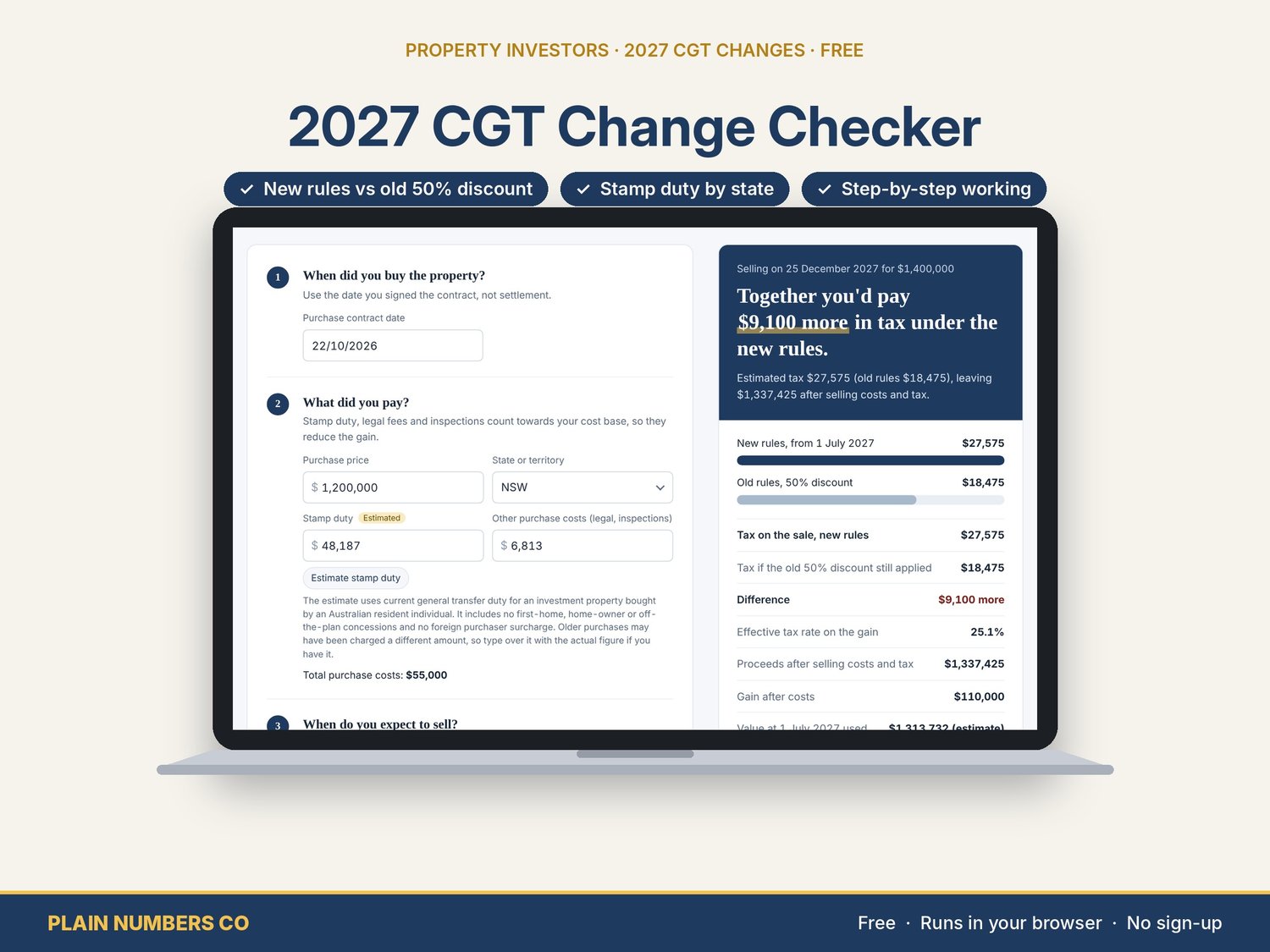
If you sell an investment property you already own after 1 July 2027, your gain is split in two. The growth up to 1 July 2027 still gets the 50% CGT discount, and the growth after that date is taxed in full once inflation is taken out (cost base indexation), with a 30% minimum tax on that later part. For many long-held properties the extra tax is modest. It depends on how much of the growth comes after 1 July 2027, and you can check your own numbers in two minutes with our free 2027 CGT Change Checker.
Key takeaways
- Sold before 1 July 2027: the current rules apply in full, including the 50% discount after 12 months.
- Sold on or after 1 July 2027: the growth to 1 July 2027 keeps the 50% discount; growth after that is indexed for inflation but not discounted, with a 30% minimum tax on it.
- You'll need the property's value at 1 July 2027: either a market valuation or the apportionment method the Government is still developing.
At a glance
- Start date: Applies to CGT events from 1 July 2027
- Law status: Core rules are law (Treasury Laws Amendment (Tax Reform No. 1) Act 2026, Act No. 49 of 2026); Tranche 2 pending
- Before 1 July 2027 growth: Current rules, 50% discount if owned 12+ months
- After 1 July 2027 growth: Cost base indexed by inflation; no 50% discount
- Minimum tax: 30% on the real gain after 1 July 2027 (income support recipients exempt)
- Value at 1 July 2027: Market valuation, or the apportionment method (still being developed)
- Main residence: The main residence exemption isn't changing
Contents
- What changes on 1 July 2027
- How the gain is split
- Worked example: selling in September 2029
- Valuation or the apportionment method?
- What this means for you
- FAQ
- Sources
What changes on 1 July 2027
The ATO says the first stage of the reform, the Treasury Laws Amendment (Tax Reform No. 1) Act 2026, is now law. From 1 July 2027, for resident individuals, trusts and partnerships:
- the 50% CGT discount is replaced by cost base indexation (your cost base rises with inflation) for gains that accrue from 1 July 2027;
- individuals pay a minimum 30% tax on real (above-inflation) capital gains that accrue from 1 July 2027. The Budget explainer says this won't affect people whose gains are already taxed at 30% or more, and people who receive a means-tested income support payment (such as the Age Pension) in the year of the sale are exempt;
- the definition of a CGT asset, the CGT events and the main residence exemption don't change.
New residential dwellings and affordable housing can choose to keep the 50% discount. A second tranche of legislation (Tranche 2) was still pending at the date of writing, so watch for changes to the detail.
How the gain is split
For property you owned before 1 July 2027 and sell on or after that date, the law treats it as if you sold and bought it back on 1 July 2027:
- Before part: value at 1 July 2027 less your cost base. The current rules apply, so the 50% discount applies if you've owned the property for at least 12 months.
- After part: sale proceeds less the 1 July 2027 value, with that value indexed for inflation. No discount; this real gain is taxed at your marginal rate, and never at less than 30%.
You need 12 months of ownership before the sale to use the discount or indexation. The ATO's own example says that if you bought less than 12 months before 1 July 2027 but hold for at least 12 months, you get the discount on the before part and indexation on the after part.
Worked example: selling in September 2029
Sam owns an established investment property on their own. Sam has $120,000 of other taxable income in the year of sale and gets no income support payment. We assume inflation of 2.5% a year (the same rate the Budget examples imply) and the current tax rates continue, with the 14% second bracket that starts on 1 July 2027.
- Bought March 2018: price $700,000 + stamp duty and legal costs $30,000: Cost base $730,000
- Market valuation at 1 July 2027: $1,000,000
- Sold 15 September 2029 for $1,150,000, less $25,000 selling costs: Net proceeds $1,125,000
Step 1 – Before part. $1,000,000 − $730,000 = $270,000. Owned over 12 months, so 50% discount: $135,000 taxable.
Step 2 – Index the 1 July 2027 value. 1 July 2027 to 15 September 2029 is 807 days. Inflation factor = 1.025^(807 ÷ 365.25) = 1.056073. Indexed value = $1,000,000 × 1.056073 = $1,056,073.
Step 3 – After part. $1,125,000 − $1,056,073 = $68,927 real gain, taxable in full (no discount).
Step 4 – Net capital gain. $135,000 + $68,927 = $203,927.
Step 5 – Tax on the gain (on top of $120,000 of other income):
- $15,000 at 30% (up to $135,000) = $4,500
- $55,000 at 37% (up to $190,000) = $20,350
- $133,927 at 45% = $60,267
- Medicare levy 2% × $203,927 = $4,079
- Total: $89,196
Step 6 – 30% minimum check. The after part sits at the top of Sam's income, taxed at 45%. That's above 30%, so there's no top-up.
Step 7 – Compare with the old rules. Whole gain $1,125,000 − $730,000 = $395,000 × 50% = $197,500 taxable. Tax: $4,500 + $20,350 + $57,375 (45% on $127,500) + Medicare $3,950 = $86,175.
Result: Sam pays about $3,021 more under the new rules ($89,196 vs $86,175). Most of the growth happened before 1 July 2027, so most of it keeps the discount. If the property grows strongly after 2027, or Sam holds for many more years, the gap widens. These figures match the 2027 CGT Change Checker to the dollar.
Valuation or the apportionment method?
The ATO says you may need the property's market value just before 1 July 2027, but you won't need it until a return for a year in which you sell (2027-28 at the earliest). The alternative is the apportionment method, which the Government is still developing; commentary on the Tranche 2 exposure draft says it assumes an even growth rate over your ownership. If most of your growth came before mid-2027, a valuation is likely to give a higher 1 July 2027 value and less tax. It's worth getting one close to the date.
Our free checker lets you try both: enter a valuation, or let it estimate the value with steady growth from purchase price to sale price.
What this means for you
- If you're happy to sell before 1 July 2027, the current rules apply in full.
- If you'll hold, plan for a valuation around 30 June 2027, keep your purchase and selling cost records, and check whether the 30% minimum could apply in a low-income year.
- Run your own dates and prices in the free 2027 CGT Change Checker. For two scenarios side by side, losses and new-build options, the CGT Reform Planner goes further.
FAQ
Do the new CGT rules apply if I sell before 1 July 2027?
No. Assets bought and sold before 1 July 2027 are taxed under the current rules, including the 50% discount.
Is the 2027 CGT change law yet?
Yes, the core rules are in the Treasury Laws Amendment (Tax Reform No. 1) Act 2026 (Act No. 49 of 2026). A second tranche of legislation is still pending.
Do I need a valuation at 1 July 2027?
You'll need a 1 July 2027 value when you sell. It can be a market valuation or the apportionment method once it's finalised.
Does the 30% minimum tax affect high-income earners?
Usually not. It only tops up the tax where the after-2027 gain would otherwise be taxed below 30%.
Does this change my main residence exemption?
No. The ATO says the main residence exemption is not changing.
General information only, not tax, legal or financial advice. Check your own situation with a registered tax agent.
Sources
- ATO, Capital gains tax reform (published 13 October 2026)
- ATO, Tax reform – boosting home ownership, reforming negative gearing and capital gains tax (updated 29 June 2026)
- Federal Register of Legislation, Treasury Laws Amendment (Tax Reform No. 1) Act 2026, Act No. 49 of 2026
- Budget 2026-27, Tax explainer: negative gearing and capital gains tax
- ATO, Tax rates – Australian residents
- Treasury, Capital Gains Tax and Negative Gearing consultation (Tranche 2)