
High-performing teams are often explained through complex leadership theories, management frameworks, and organizational psychology models. While many of these are valuable, they can also feel overly technical for leaders who simply want a practical way to understand people and improve collaboration.
One recurring challenge appears across industries:
Why do capable, talented individuals struggle to perform effectively as a team?
The issue is rarely intelligence or skill.
More often, it involves differences in temperament, working style, decision-making preferences, and communication behavior.
Teams don’t fail because members lack strengths.
They struggle because strengths are misaligned, misunderstood, or unbalanced.
Over time, I found it useful to view team dynamics through a simplified lens — not as a scientific classification, but as a mental model for easier understanding.
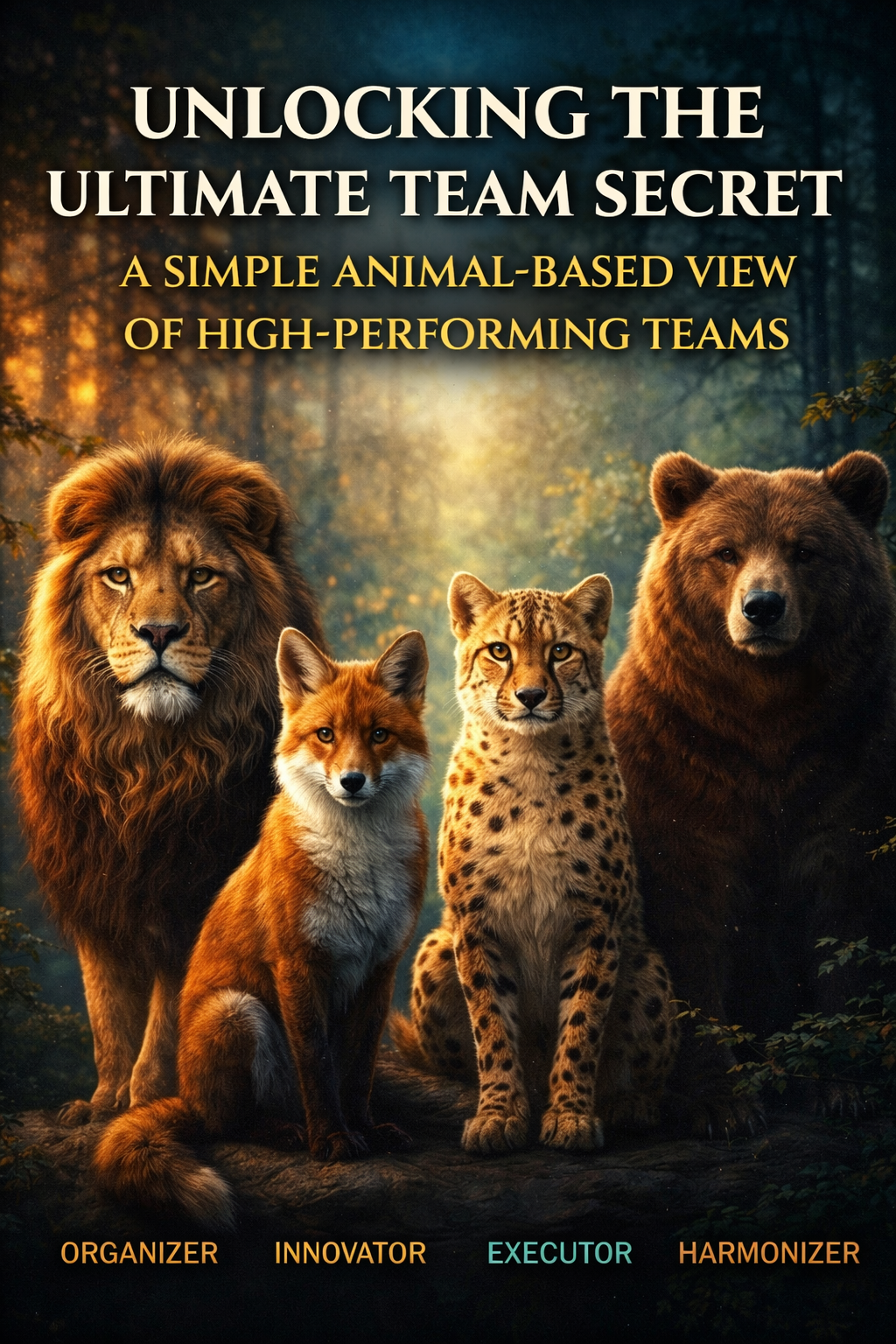
To make the principles memorable, imagine four symbolic animal roles within a team.
Not labels.
Not rigid personality types.
Just representations of common contributions.
The Lion — The Organizer
The lion represents structure and direction.
These individuals naturally:
- Establish order
- Coordinate tasks
- Clarify priorities
- Drive accountability
- Create systems
They are comfortable taking the lead and ensuring that work progresses in a controlled, organized manner.
Without lions, teams often experience:
- Confusion
- Lack of direction
- Poor prioritization
- Weak execution discipline
With too many lions, teams may face:
- Control struggles
- Micromanagement
- Reduced creativity
The Fox — The Innovator
The fox symbolizes creativity and strategic thinking.
These individuals tend to:
- Generate ideas
- Challenge assumptions
- Explore alternatives
- Spot opportunities
- Reframe problems
They bring imagination and fresh perspectives.
Without foxes, teams risk:
- Stagnation
- Predictable thinking
- Resistance to change
With too many foxes:
- Ideas multiply without closure
- Discussions replace decisions
- Execution slows
The Cheetah — The Executor
The cheetah represents action and momentum.
These individuals are driven to:
- Implement plans
- Push progress
- Solve quickly
- Maintain speed
- Convert ideas into results
Without cheetahs:
- Plans remain theoretical
- Deadlines slip
- Energy declines
With too many cheetahs:
- Rushed decisions
- Incomplete analysis
- Burnout
The Bear — The Harmonizer
The bear reflects stability and relationships.
These individuals focus on:
- Team cohesion
- Conflict reduction
- Emotional awareness
- Communication flow
- Trust building
Without bears:
- Tension escalates
- Misunderstandings linger
- Collaboration weakens
With too many bears:
- Avoidance of tough conversations
- Delayed accountability
What This Model Really Represents
This is not an official doctrine, psychological diagnosis, or rigid system.
It is a memory framework for understanding functional team balance.
Strong teams require a mix of:
Structure
Creativity
Execution
Relationship management
Imbalance creates predictable problems.
Too much control suppresses ideas.
Too many ideas delay action.
Too much speed increases errors.
Too much harmony weakens accountability.
Balance drives performance.
A Practical Workplace Reflection
In one project team I observed, friction was constant.
Meetings ran long.
Decisions stalled.
Deadlines slipped.
The members were competent and experienced.
The problem was composition.
Multiple strong organizers competing for control.
Several creative thinkers generating endless alternatives.
Few action drivers pushing closure.
Almost no stabilizers managing interpersonal tension.
Everyone was effective individually.
Collectively, the team struggled.
Not due to lack of talent —
but due to misaligned strengths.
Practical Takeaways for Leaders
Use this model as a thinking aid, not a labeling tool.
When evaluating your team, ask:
Which role is dominating?
Which role is missing?
Where are conflicts predictable?
When building teams:
Avoid stacking identical working styles
Balance planners, thinkers, executors, and connectors
Align responsibilities with natural tendencies
When managing conflict:
Recognize style differences
Translate between perspectives
Reduce misinterpretation of behavior
When leading:
Adapt communication
Provide structure without rigidity
Encourage creativity without chaos
Drive execution without burnout
Promote harmony without avoidance
Final Thought
High-performing teams are not created by removing differences.
They succeed by understanding, balancing, and leveraging them.
Sometimes, the simplest frameworks are the most practical — especially when they help leaders remember what truly matters:
People contribute differently.
Balance determines results.
Comments ()