
What I believe makes training effective
When it comes to training, there are three things I believe make up the foundation of an effective training approach. They're not specific exercises, programs, or training methods. Instead, they're three principles that I believe can help you build muscle, get stronger, and improve your overall performance, regardless of what you're training for.
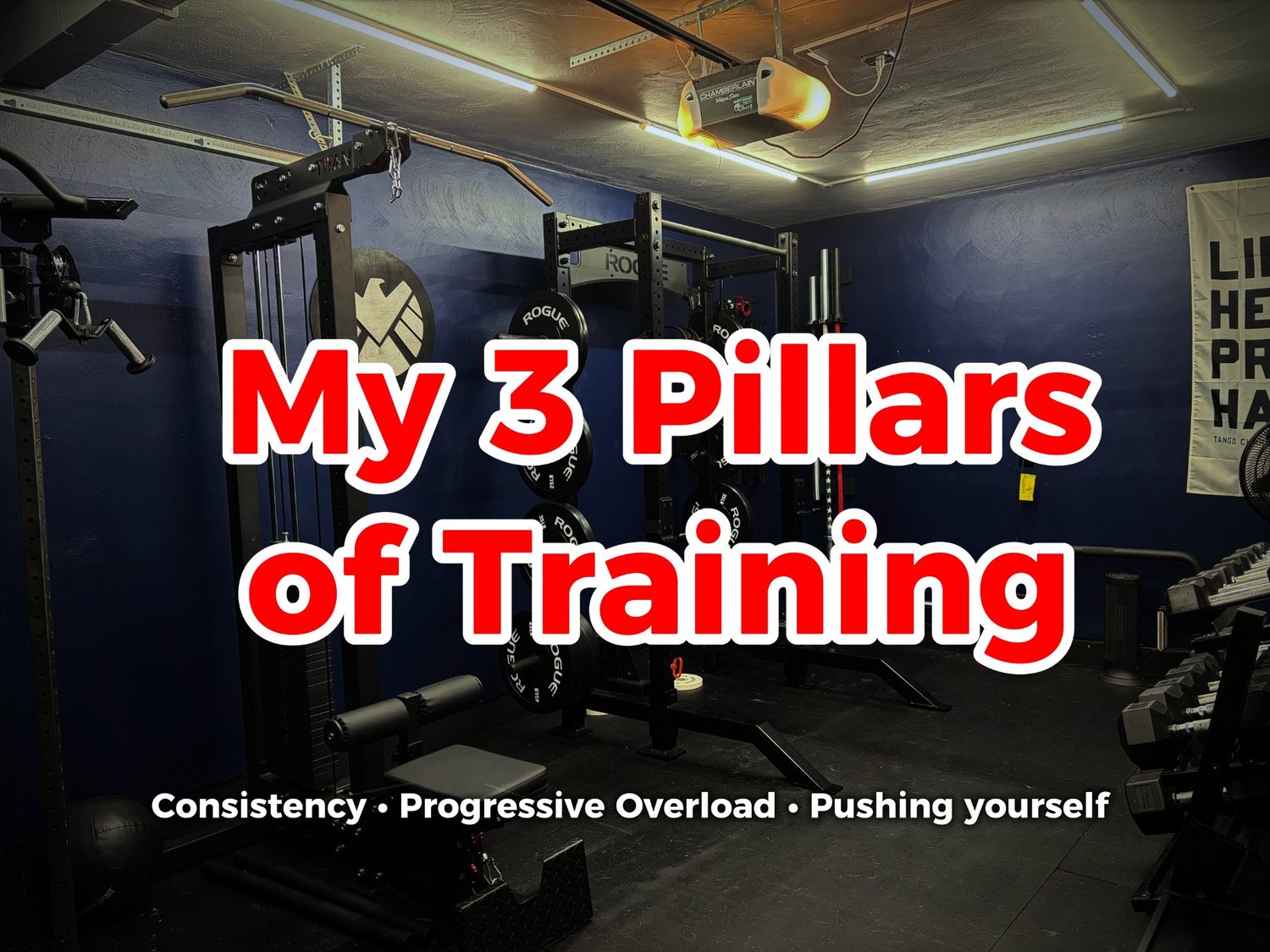
Consistency, progressive overload, and pushing yourself.
These three principles are the foundation of how I approach training.
I truly believe you can have the best training program in the world, with perfect exercise selection, a great set and rep scheme, and just the right amount of recovery. But without these three pillars, you're going to have a difficult time achieving the goals you're working toward.
Let's break down why I believe each of these pillars matters.
Pillar 1 – Consistency
My first pillar is consistency.
I know this one might seem obvious, but without consistency, you're going to have a difficult time making meaningful progress in your training.
As I mentioned earlier, you can have the best training program in the world, but if you're not consistently following it, you're going to struggle to reach your goals.
Our bodies adapt to the demands we place on them. But those adaptations take time. We need to repeatedly expose our bodies to the appropriate training stimulus to achieve the adaptations we're looking for.
That's why consistency matters.
Now, I'm not saying consistency means perfection.
You don't need to train every single day of the week. It doesn't mean you can't miss a workout or that every session needs to go exactly as planned.
What it means is building a routine that you can realistically maintain.
Maybe that means training twice a week because that's all your schedule allows. That's perfectly fine. The goal is to develop a routine that provides enough training stimulus, allows for adequate recovery, and is something you can stick with over time.
Life happens. You're going to have days when you miss a workout, your schedule changes, or things don't go as planned.
That's part of the process.
What matters most is your ability to remain consistent over a long period of time.
Consistency is what builds the foundation for progress.
Pillar 2 – Progressive Overload
My second pillar is progressive overload.
Regardless of the adaptation you're trying to achieve, whether that's building strength, increasing muscle mass, improving muscular endurance, or developing power, your training needs to provide an appropriate stimulus for your body to adapt.
As your body becomes more capable of handling those demands, your training needs to evolve to support continued improvement.
That's where progressive overload comes in.
Progressive overload is the gradual increase in training demands over time as your body adapts.
This could mean adding more weight to the bar, performing a few more repetitions with the same load, or increasing your productive training volume when appropriate.
But something I think is important to understand is that progress doesn't always come in the same form.
You're not always going to be able to add more weight or perform more repetitions every time you train.
Factors such as fatigue, recovery, and training experience all play a role in your performance.
Some weeks, you might be able to increase the load you're lifting. Other weeks, you might maintain your performance despite experiencing greater fatigue. While maintaining performance isn't necessarily progressive overload itself, it can still be a positive sign depending on the circumstances.
Improving your technique, control, and overall execution can also demonstrate progress, even when the load stays the same.
And that's something I want to emphasize.
Progressive overload isn't about making every workout harder just for the sake of making it harder.
It's about gradually increasing the demands of your training when appropriate to continue supporting the adaptations you're trying to achieve.
There are going to be times when increasing the demands makes sense, and there are going to be times when maintaining your current training or allowing additional recovery is the better decision.
The goal is to continue moving forward over time, not necessarily every single workout.
Progressive overload gives your training direction and helps you continue improving.
Pillar 3 – Pushing Yourself
My third pillar is pushing yourself.
This is one that I believe is extremely important, but it's also one that I think can be difficult sometimes.
If you're serious about your training and want to improve, you have to be willing to challenge yourself.
It's easy to get comfortable lifting the same weights because you know you can complete the repetitions without worrying about failing.
It's easy to perform the prescribed number of repetitions without questioning whether you could have done more.
But there's a difference between simply going through the motions and completing a workout versus applying the effort necessary to create a meaningful training stimulus.
That's where pushing yourself comes in.
Now, let me explain what I mean by that.
I'm not talking about taking every set to failure, lifting weights so heavy that your technique breaks down, or leaving every workout completely exhausted.
Pushing yourself means challenging yourself appropriately based on what you're trying to achieve.
Let me give you an example.
If you're training for hypertrophy, pushing yourself might mean taking your working sets relatively close to muscular failure. Depending on the exercise and situation, you might occasionally train to failure, but that isn't necessary for every set.
If you're training for strength, pushing yourself might mean working with heavier loads and challenging yourself to complete demanding sets while maintaining proper technique. You don't necessarily need to fail a repetition to know you've challenged yourself.
And if you're training for power, pushing yourself might mean producing the most explosive, high-quality repetitions possible rather than continuing until fatigue begins to affect your performance.
All three examples require effort, but that effort looks different depending on your goal.
That's why I don't believe the quality of a workout should be determined solely by how exhausted you feel afterward.
But there's another side to pushing yourself that I think is just as important.
The mental side.
I'm going to be honest here. I know I've done it, and it wouldn't surprise me if you've done it as well.
We underestimate what we're capable of.
We get comfortable with how we're training. We stick to weights we know we can lift, repetitions we know we can complete, and challenges we're confident we can handle.
And sometimes, we hesitate to push beyond that comfort zone because we don't know whether we'll succeed.
But if we want to find out what we're truly capable of, we have to be willing to challenge ourselves.
That might mean attempting a heavier weight when we're prepared for it, pushing through the discomfort of a challenging set, or simply realizing that we had more to give than we originally thought.
Those experiences can help us build confidence, develop our abilities, and discover what we can accomplish.
However, pushing yourself doesn't mean ignoring what your body is telling you.
There are going to be days when you're ready to challenge yourself more, and there are going to be days when adjusting your training is the smarter decision.
Knowing when to push and when to pull back is an important part of training.
To me, pushing yourself means giving your training your best effort with purpose, applying meaningful effort, and being willing to challenge your current capabilities while respecting your recovery.
Challenge yourself without unnecessarily sacrificing technique, recovery, or overall performance.
How They All Work Together
Each of these pillars is important on its own, but I believe they're most effective when they work together.
Consistency gives you repeated opportunities to expose your body to training demands.
Progressive overload helps ensure those demands evolve as your body adapts.
And pushing yourself allows you to apply the effort necessary to make those training demands meaningful.
Let's look at it this way.
Imagine two different approaches to training.
The first approach:
You go to the gym two or three times a week. You follow your program, complete your exercises, and leave feeling like you've accomplished something.
But over time, you notice you're not making much progress.
You've been using the same weights, performing the same repetitions, and haven't really challenged yourself beyond what you know you can already do.
You're consistent, but you're mostly going through the motions.
Now, the second approach:
You still go to the gym two or three times a week. You follow your program, complete your exercises, and remain consistent.
But this time, you're paying attention to your performance.
As you become stronger and more capable, you gradually increase the demands of your training. Maybe that means adding weight, performing additional repetitions, or adjusting your program to continue challenging yourself appropriately.
You're not necessarily progressing every single workout, but over time, you're seeing improvements.
The difference isn't simply how often you're training.
It's how you're approaching that training.
You're combining consistency with a structured approach to progression and the willingness to challenge yourself.
That's why I believe these three pillars work best together.
Consistency builds the foundation. Progressive overload provides direction. Pushing yourself brings the effort.
My Approach to Training
My goal is to help people build strength, improve movement, and enhance overall performance through structured, purposeful training.
I believe a successful training program should be more than just a list of exercises to complete.
It should challenge you, give you a clear direction, provide opportunities to improve, and help you make progress toward your goals.
That's why consistency, progressive overload, and pushing yourself are my three main pillars of training.
They're principles I emphasize in my own training, and they're principles that influence how I approach the programs I create.
Every workout doesn't need to be perfect.
You don't need to increase the weight every time you step into the gym.
And you don't need to leave every training session completely exhausted.
But you do need to show up, give yourself opportunities to improve, and be willing to put in the work.
Because meaningful progress isn't built from one workout.
It's built through consistent, purposeful training over time.
Move Better. Build Strength. Perform Higher.
Comments ()