

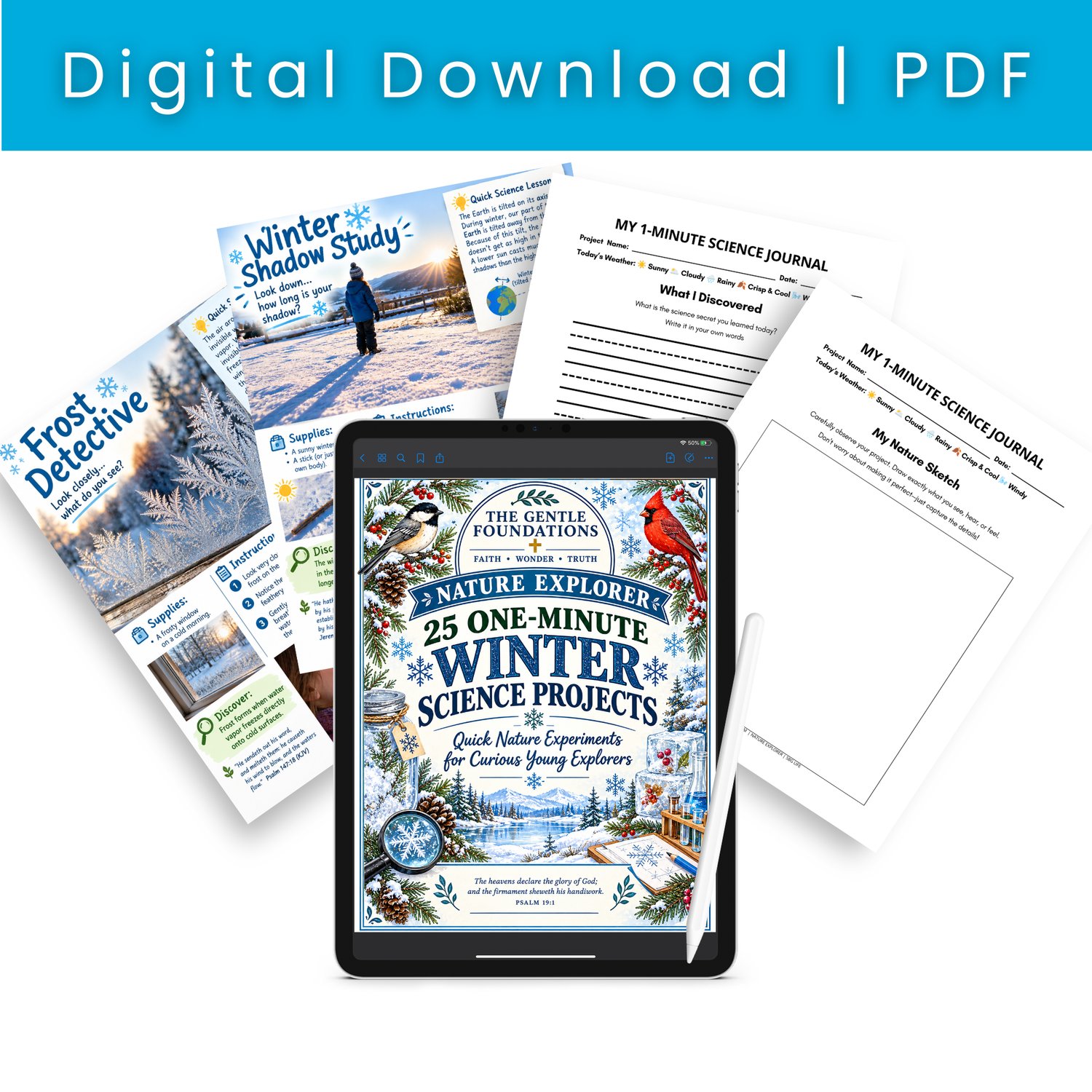
Winter may seem like a quiet season, but step outside and look closely. You may discover frost sparkling on a surface, pinecones opening and closing, birds searching for food, clouds moving across the sky, or ice forming in a puddle.
For homeschool families, these ordinary moments can become extraordinary science lessons.
That's the inspiration behind The Gentle Foundations Nature Explorer: 25 One-Minute Winter Science Projects.
This collection encourages children to observe the natural world, ask questions, make predictions, and discover how things work through short, hands-on investigations.
Why Study Science in Winter?
Science doesn't have to begin with a textbook or complicated experiment.
Sometimes it begins with a simple question:
- Why does ice melt?
- Where does frost come from?
- Why do some trees stay green in winter?
- How can we tell which way the wind is blowing?
- What can animal tracks tell us?
These questions encourage children to think like scientists.
Winter is especially useful for exploring weather, water, plant adaptations, animal behavior, and seasonal changes. Even a short walk around the yard can reveal something worth investigating.
Explore Ice, Snow, and Frozen Water
Some of the most exciting winter science observations involve water.
Children can compare how quickly ice cubes melt, investigate the effect of salt on ice, observe icicles, and explore how water expands when it freezes.
The Ice Cube Race, Salt and Ice Investigation, and Frozen Water Expansion projects introduce important physical science concepts through simple observations.
When snow is available, children can also compare snowballs placed in different locations to see which melts first.
These activities provide opportunities to make predictions and compare results rather than simply being told what will happen.
Safety reminder: Never taste outdoor snow or ice. Freezing-water activities should be supervised by an adult.
Become a Winter Weather Detective
Winter weather changes from day to day, giving children plenty to observe.
With Frost Detective, children look for frost and record where it forms.
Winter Cloud Watch encourages them to examine cloud shapes and sky conditions.
Winter Wind Finder helps them look for clues that reveal moving air, while Temperature Detective introduces thermometer readings and comparisons between locations.
Children can record their observations in a science journal and look for patterns over several days.
This is an easy way to combine science with writing, drawing, mathematics, and nature study.
Discover the Secrets of Evergreen Trees
Evergreen trees are wonderful subjects for winter observation.
While many deciduous trees lose their leaves, many evergreens retain their needles or leaves throughout the year.
Children can compare needle lengths, examine how needles are arranged, and investigate the textures and scents of different safe-to-handle evergreen materials.
The Pinecone Weather Predictor project provides another opportunity to explore how natural materials respond to environmental conditions. Pinecone scales can open or close depending on moisture and drying conditions, although a pinecone is not a reliable forecast of future weather.
These small discoveries help children notice the remarkable details of the natural world.
Watch Birds and Look for Animal Tracks
Winter provides opportunities to observe wildlife behavior.
During Winter Bird Watch, children can quietly watch from a window or outdoor observation spot and record which birds visit.
The Animal Track Search encourages children to look for tracks in snow, mud, or soft ground. They can sketch what they find and compare the size, shape, and arrangement of tracks.
The bonus Mini Bird Feeding Station offers a starting point for discussing responsible wildlife care and observing which birds visit a feeding area.
Children should observe wild animals from a respectful distance and avoid disturbing nests, dens, or other wildlife habitats.
Use All Five Senses
Science also involves careful sensory observation.
The Winter Sound Hunt encourages children to listen for birds, wind, rustling branches, and other outdoor sounds.
The Winter Color Hunt invites them to find colors in a season that may initially seem gray or brown.
The Breath Cloud Experiment provides an opportunity to observe visible breath on cold days and discuss how water vapor in exhaled air condenses into tiny droplets in cool air.
These activities remind children that scientific discovery begins with paying attention.
Make Quick Science Part of Your Homeschool Routine
One benefit of short investigations is that they can fit into an ordinary homeschool day.
Try one activity before breakfast, during a nature walk, after lunch, or as part of a morning basket.
Encourage children to use a simple routine:
- Observe: What do you notice?
- Wonder: What question do you have?
- Predict: What do you think will happen?
- Investigate: What can you test or compare?
- Record: What did you discover?
Some activities take only a moment to begin, while others require waiting for ice to melt, water to freeze, or weather conditions to change. That waiting time is part of the scientific process.
Extend Learning With a Science Journal
The included science journal pages give children a place to draw what they see, write questions, record measurements, and compare observations.
Younger learners might draw a pinecone or describe the texture of ice. Older students might record temperatures, compare melting times, or explain why their results differed from their predictions.
This flexible approach makes the projects useful for families teaching several ages together.
Bring Winter Science to Life
Winter doesn't have to be a season when nature study stops.
With a curious mind and a willingness to look closely, children can discover science in frozen puddles, bare branches, evergreen trees, winter skies, and backyard birds.
The Gentle Foundations Nature Explorer: 25 One-Minute Winter Science Projects helps make those discoveries accessible through short, approachable investigations.
Explore the season. Ask questions. Record what you find. Celebrate the wonders of the natural world.
Explore. Observe. Discover. Become a Nature Explorer!