
Christmas offers Christian homeschool families a special opportunity to bring Scripture, history, geography, and nature study together while remembering the birth of our Savior.
Rather than treating Christmas as simply a holiday to prepare for, families can use the season to explore the biblical account, ask thoughtful questions, discover the world surrounding the story, and reflect on the meaning of Christ's birth.
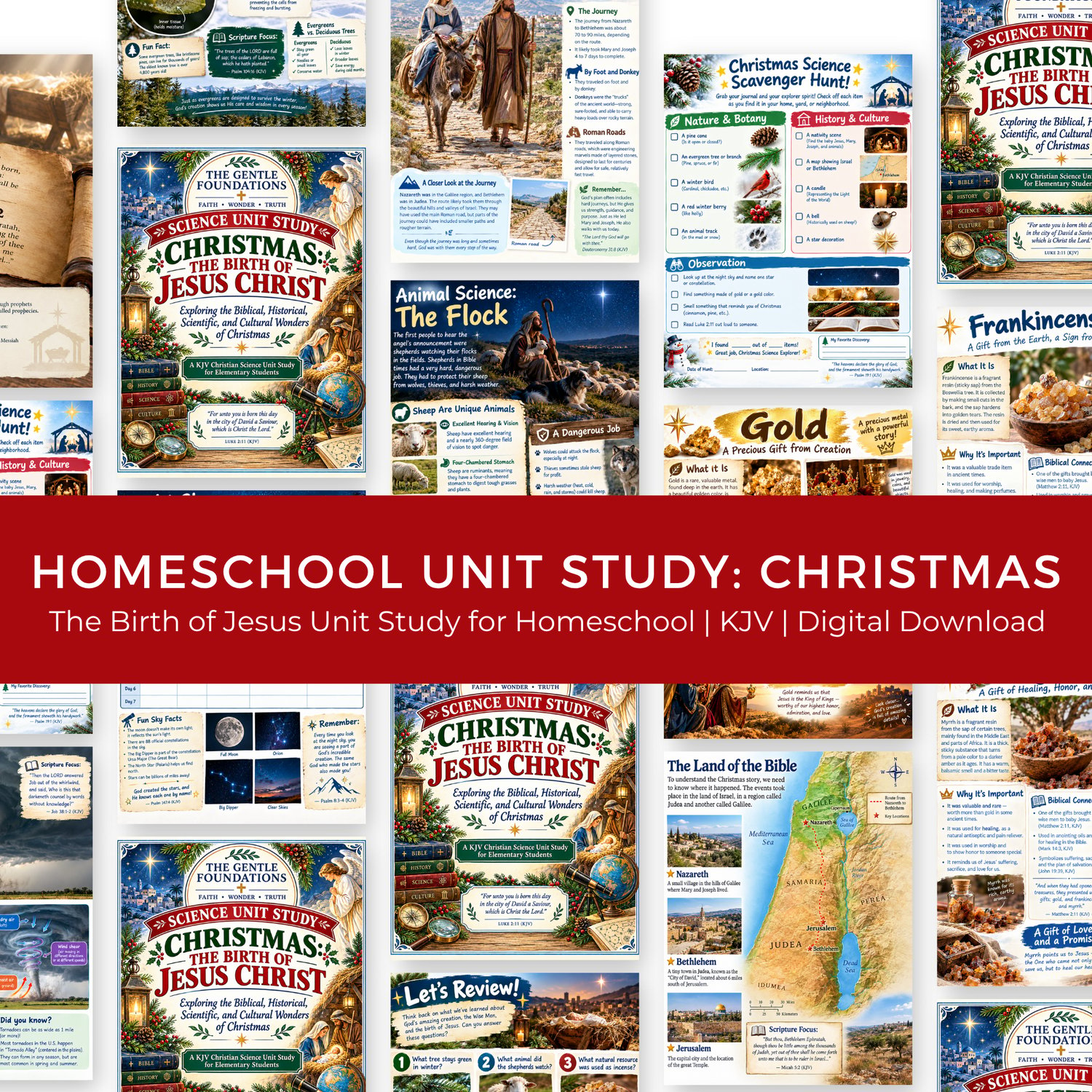
That's the heart behind The Gentle Foundations Nature Explorer: Christmas — The Birth of Jesus Christ.
This Christ-centered unit study combines ten lessons with vocabulary, journal pages, activities for older students, a memory verse page, a badge, and a certificate.
Begin With the Biblical Account
The Christmas story begins with God's promises and unfolds through the accounts of Jesus' birth in the Gospels.
Children can explore why Christians celebrate Christmas, learn about the promise of the Savior, and read the biblical passages that tell of Jesus' birth.
Luke 2:11 (KJV) declares:
For unto you is born this day in the city of David a Saviour, which is Christ the Lord.
This verse provides a meaningful focus for the season. It reminds children that the center of Christmas is not merely decorations, gifts, or traditions, but Jesus Christ.
Discover the Geography of the Christmas Story
The Christmas account also provides an opportunity to explore biblical geography.
Where is Bethlehem? What was the journey like for Mary and Joseph? What can we learn about the places mentioned in the biblical narrative?
Children can locate Bethlehem on a map, examine the surrounding region, and discuss how geography helps us understand the setting of a historical event.
Map work can be adapted to different ages. Younger children might locate and label places, while older students can explore distances, routes, and historical context.
Look Up at the Night Sky
The night sky is another fascinating connection between Christmas and nature study.
Matthew 2 describes the wise men seeing a star and traveling to find Jesus. Families can read this passage and discuss what the Bible tells us about their journey.
Children can also study stars, constellations, and the night sky as an introduction to astronomy.
An important distinction makes this lesson especially valuable: Scripture records the star associated with the wise men's journey, but it does not identify it with a specific modern astronomical event. Families can explore astronomy while recognizing what the biblical text does—and does not—tell us.
On a clear evening, children might observe the Moon, identify visible stars, or sketch the night sky in a nature journal.
Learn About Shepherds and Sheep
Shepherds are an important part of the account in Luke 2.
Children can investigate what shepherds do, how sheep behave, and how people historically cared for flocks.
This topic offers natural connections to animal science, habitats, animal needs, and the work of caring for living things.
It also provides an opportunity to reread the passage about the shepherds who heard the announcement of Jesus' birth.
Follow the Wise Men's Journey
Matthew 2 describes wise men who came to worship Jesus and brought gifts of gold, frankincense, and myrrh.
Children can explore the journey described in Scripture and discuss the significance of the gifts within the biblical account.
Families can also investigate the historical uses of aromatic resins and other natural materials, connecting the story with plant products and trade.
The lesson encourages children to distinguish the details Scripture provides from traditions that developed later.
Discover Evergreens and Winter Science
Nature study makes a wonderful addition to a Christmas unit.
Why do many evergreen trees remain green through winter? What is the difference between a deciduous tree and an evergreen? How do needles and leaves differ?
Children can observe evergreen branches, compare textures, sketch needle arrangements, and learn about plant adaptations.
This lesson connects the seasonal beauty of evergreens with science and careful observation.
It also encourages children to appreciate the variety and complexity of the natural world.
Gifts From God's Creation
The natural world provides many materials people use in everyday life.
Children can investigate plant-based materials, natural scents, wood, fibers, fruits, and other resources. They can consider how people use these materials and why responsible stewardship matters.
For Christian families, these observations also create opportunities to reflect on gratitude for God's creation.
A simple nature walk or collection of safe natural specimens can lead to questions, drawings, and thoughtful conversations.
Make Room for Journaling and Reflection
The unit includes Christmas journal pages and blank nature journal pages so children can record what they learn.
They might draw a map of Bethlehem, sketch a sheep, write a short reflection on Luke 2, observe an evergreen branch, or illustrate the night sky.
Younger students can draw and dictate their observations. Older students can write summaries, compare information, and explore additional questions.
The Christmas Explorer Level Up activities provide further opportunities for older learners to extend their studies.
Keep Christ at the Center
Christmas learning can be both joyful and educational.
Through Scripture, geography, nature science, and journaling, children can explore the world surrounding the biblical account while returning to its central message: the birth of Jesus Christ.
Whether you use the unit throughout December, during an Advent study, or as part of a family Christmas tradition, it offers a way to combine meaningful Bible learning with the curiosity and wonder at the heart of nature study.
Explore. Observe. Discover.
Keep Christ at the center of Christmas.