
What lives beneath the ocean's surface?
How do tides work?
Why are coral reefs so important?
How does a tiny organism like plankton help support enormous whales?
The ocean is filled with questions like these—and that makes it an incredible place for children to begin exploring science.
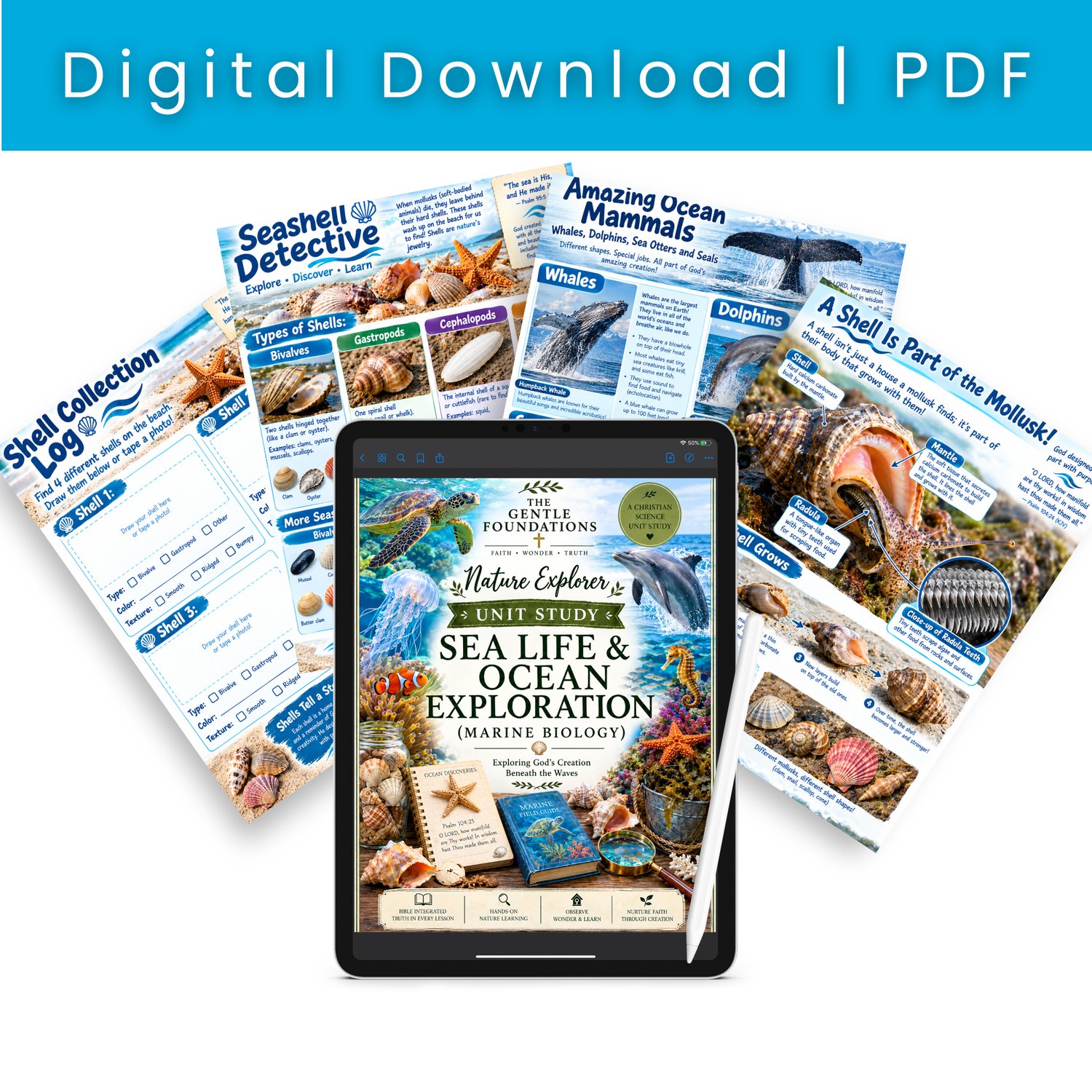
That's why we created The Gentle Foundations Nature Explorer Unit Study: Sea Life & Ocean Exploration Study (Marine Biology).
🌊 The Ocean Is a Giant Classroom
Even if your family doesn't live near the coast, children can still explore marine biology through books, videos, aquariums, nature centers, observations, models, experiments, and nature journaling.
The ocean gives children opportunities to study:
- Biology
- Ecology
- Habitats
- Animal adaptations
- Food webs
- Water
- Weather
- Geography
- Conservation
Marine biology naturally connects many areas of science together.
🐚 What Will Young Explorers Discover?
This 21-lesson unit takes children on a journey through the underwater world.
Students begin with the basics by learning about ocean zones and different types of sea creatures.
Then they explore fascinating marine habitats and animals including:
🐚 Tide pools
🪸 Coral reefs
🦈 Sharks
🐬 Dolphins
🐋 Whales
🪼 Jellyfish
🐢 Sea turtles
🐙 Octopuses
🦀 Crabs
⭐ Sea stars
🌿 Kelp forests
🐟 Salmon
And much more!
🌊 Understanding Ocean Processes
Marine biology isn't only about studying animals.
Children also investigate the ocean itself.
They learn about:
🌙 Tides
🌊 Waves
🌀 Ocean currents
💧 Salt water
🦠 Plankton
🐟 Ocean food webs
These lessons help children understand how interconnected marine ecosystems really are.
🪸 Exploring Coral Reefs
Coral reefs provide an especially interesting opportunity to discuss habitats and biodiversity.
Children can discover how many different organisms interact within a reef ecosystem and why these habitats are important.
This makes coral reefs a wonderful starting point for conversations about ecosystems and stewardship.
🐋 From Tiny Plankton to Giant Whales
One of the most fascinating concepts in marine biology is the ocean food web.
Tiny organisms can play an enormous role.
Plankton help form the foundation of many marine food webs, connecting microscopic life with some of the largest animals on Earth.
Children can begin to see how every part of an ecosystem can be connected.
🌎 Learning to Be Stewards of the Sea
The unit also includes a lesson on Stewards of the Sea.
Children are encouraged to think about how people interact with oceans and why caring for natural resources matters.
The goal isn't simply to memorize names of sea creatures.
It's to help children become thoughtful observers who understand that the natural world is interconnected and worth caring for.
📓 Nature Journaling Meets Marine Biology
The unit includes blank nature journal pages so children can record:
- Marine animals they study
- Questions they have
- Interesting facts
- Drawings and observations
- Ocean habitats
- Personal reflections
Nature journaling gives children a place to slow down and process what they are learning.
⭐ Activities for Older Students
Older students can use the Ocean Explorer: Level Up activities to extend their learning and explore marine biology concepts at a deeper level.
This makes the unit useful for families who teach multiple ages together.
🌊 Bring the Ocean Home
Whether you're planning a beach trip, visiting an aquarium, studying marine biology during the summer, or simply looking for an engaging science topic, the ocean provides endless opportunities for discovery.
The next time your child sees a seashell, watches a documentary about whales, or visits an aquarium, they'll have a growing scientific framework for understanding what they're seeing.
Explore. Observe. Discover.
Become a Nature Explorer.