

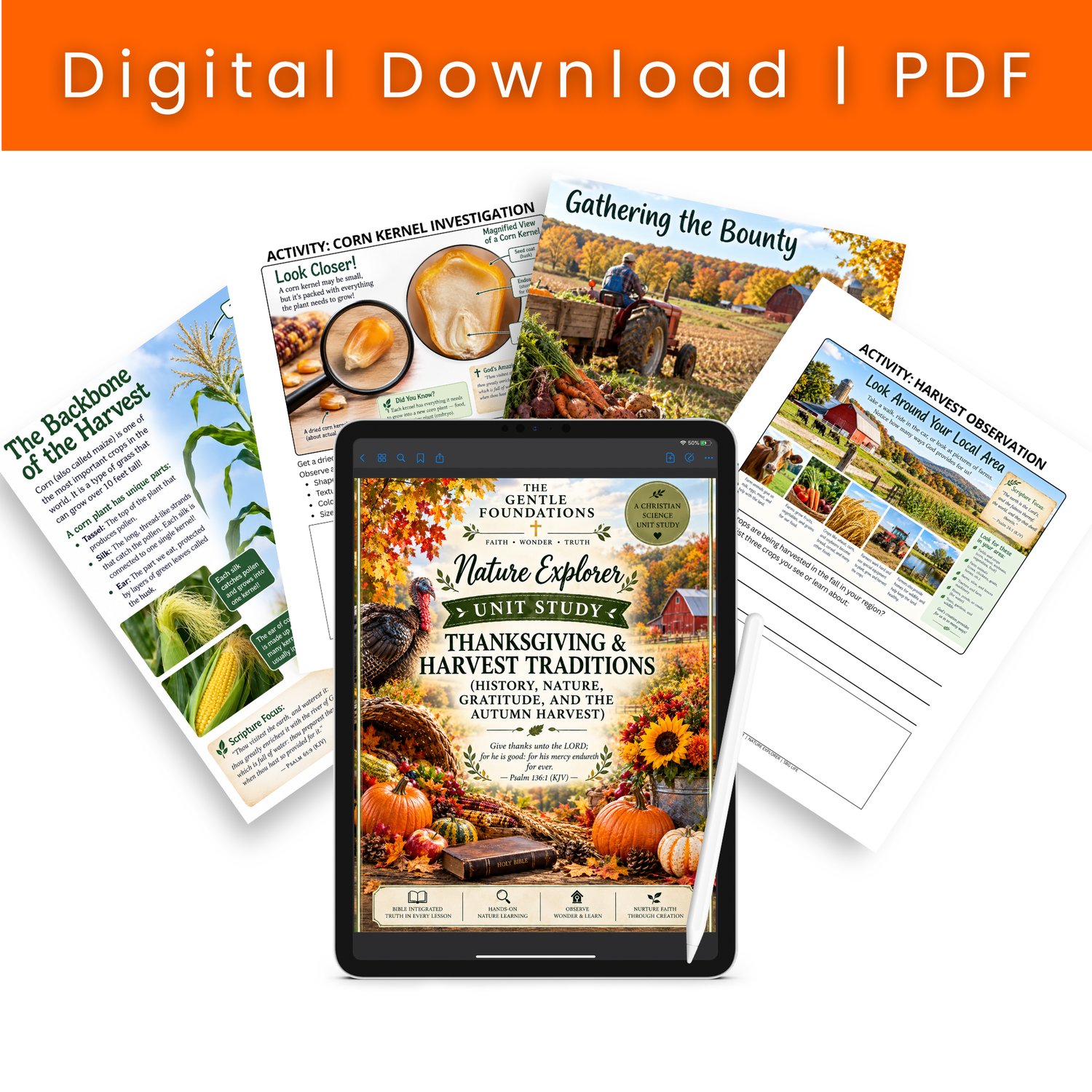
Thanksgiving is more than a day on the calendar.
For homeschool families, it can become an opportunity to slow down, explore the season, study the harvest, learn about animals and plants, explore history, and intentionally practice gratitude.
Autumn gives us a beautiful classroom.
The fields are changing. Gardens are producing their final crops. Pumpkins and squash fill farm stands.
Cranberries are harvested. Wild turkeys move through the woods. Trees lose their leaves as the forest prepares for winter.
There is so much to discover.
That's the inspiration behind The Gentle Foundations Nature Explorer: Thanksgiving & Harvest Traditions.
🍂 Thanksgiving Begins With the Harvest
Before Thanksgiving became the holiday many families know today, harvest seasons played an important role in communities.
People depended on crops, gardens, forests, animals, and seasonal preparation.
Studying harvest traditions gives children an opportunity to think about where food comes from and how much work goes into growing, gathering, preparing, and preserving it.
It also provides a natural opportunity to talk about gratitude.
🌽 Explore Remarkable Plants
One of the lessons in this unit focuses on corn.
Children can investigate the structure of a corn plant, how it grows, and the many ways people have used corn throughout history.
Pumpkins and squash provide another opportunity to study plant life cycles, seeds, flowers, fruits, and seasonal harvests.
These familiar Thanksgiving foods become science lessons right before your eyes.
🎃 Pumpkins, Squash & Fall Fruits
Thanksgiving provides an excellent opportunity to explore seasonal foods.
Children can investigate pumpkins and squash, compare different varieties, examine seeds, and think about how plants provide food.
The unit also explores cranberries and fall fruits, connecting familiar foods with the plants and growing conditions that produce them.
A Thanksgiving meal can become a science lesson!
🦃 Meet the Wild Turkey
What better animal to study during Thanksgiving season than the wild turkey?
Children explore the characteristics, habitat, behavior, and adaptations of North America's wild turkeys.
A nature walk may even become an opportunity to look for signs of birds and other wildlife preparing for the changing season.
🌳 The Late-Autumn Forest
One of the most important parts of seasonal nature study is simply noticing change.
By late autumn, many deciduous trees have lost their leaves.
The forest looks different.
The ground is covered with fallen leaves.
Seeds and nuts can be found beneath trees.
Animals are preparing for winter.
Studying these changes helps children understand that nature is constantly changing with the seasons.
❤️ Gratitude in Nature
The unit includes a special lesson called Gratitude in Nature.
Children are encouraged to pause and consider the many ways they experience provision through the natural world.
Food.
Water.
Shelter.
Trees.
Plants.
Animals.
Beauty.
The changing seasons.
These observations can become opportunities for meaningful conversations about gratitude and God's provision.
📜 Thanksgiving Traditions Then & Now
Thanksgiving is also a history lesson.
Children can explore how Thanksgiving traditions have changed over time and compare historical celebrations with the ways families celebrate today.
This creates opportunities to discuss:
- Family traditions
- Community celebrations
- Harvest customs
- Historical events
- Food traditions
- Gratitude
Children can even interview family members about their own Thanksgiving traditions.
🍁 Create a Harvest Celebration Day
The final lesson brings everything together with Harvest Celebration Day.
After studying plants, animals, harvests, nature, gratitude, and traditions, children can celebrate what they have learned.
This could include:
🍎 A seasonal nature walk
🌽 A harvest-themed snack
🍂 Nature journaling
🦃 A turkey observation activity
🎃 Pumpkin or squash investigation
❤️ A gratitude list
📖 Reading together
The goal is to turn learning into a meaningful experience.
📓 Don't Forget the Nature Journal
The unit includes blank nature journal pages so children can record what they observe during the season.
They might draw:
- A pumpkin
- A corn plant
- A wild turkey
- A fallen leaf
- An acorn
- A cranberry
- A late-autumn tree
- A harvest scene
They can also write what they notice, wonder, and appreciate.
⭐ Learning for Multiple Ages
The Thanksgiving Level Up section provides additional activities for older students.
This makes the unit especially useful for families teaching multiple children together.
Younger students can focus on observation, vocabulary, drawing, and simple science concepts while older students extend their learning through additional research, writing, comparison, and investigation.
🦃 A Thanksgiving Learning Adventure
Thanksgiving doesn't have to mean putting school aside.
Instead, it can become one of the richest seasonal learning opportunities of the year.
Study the harvest.
Explore the forest.
Observe animals.
Investigate plants.
Learn history.
Practice gratitude.
And remember that even ordinary autumn treasures can become invitations to stop, observe, and give thanks.
Explore. Observe. Discover.
Become a Nature Explorer.