


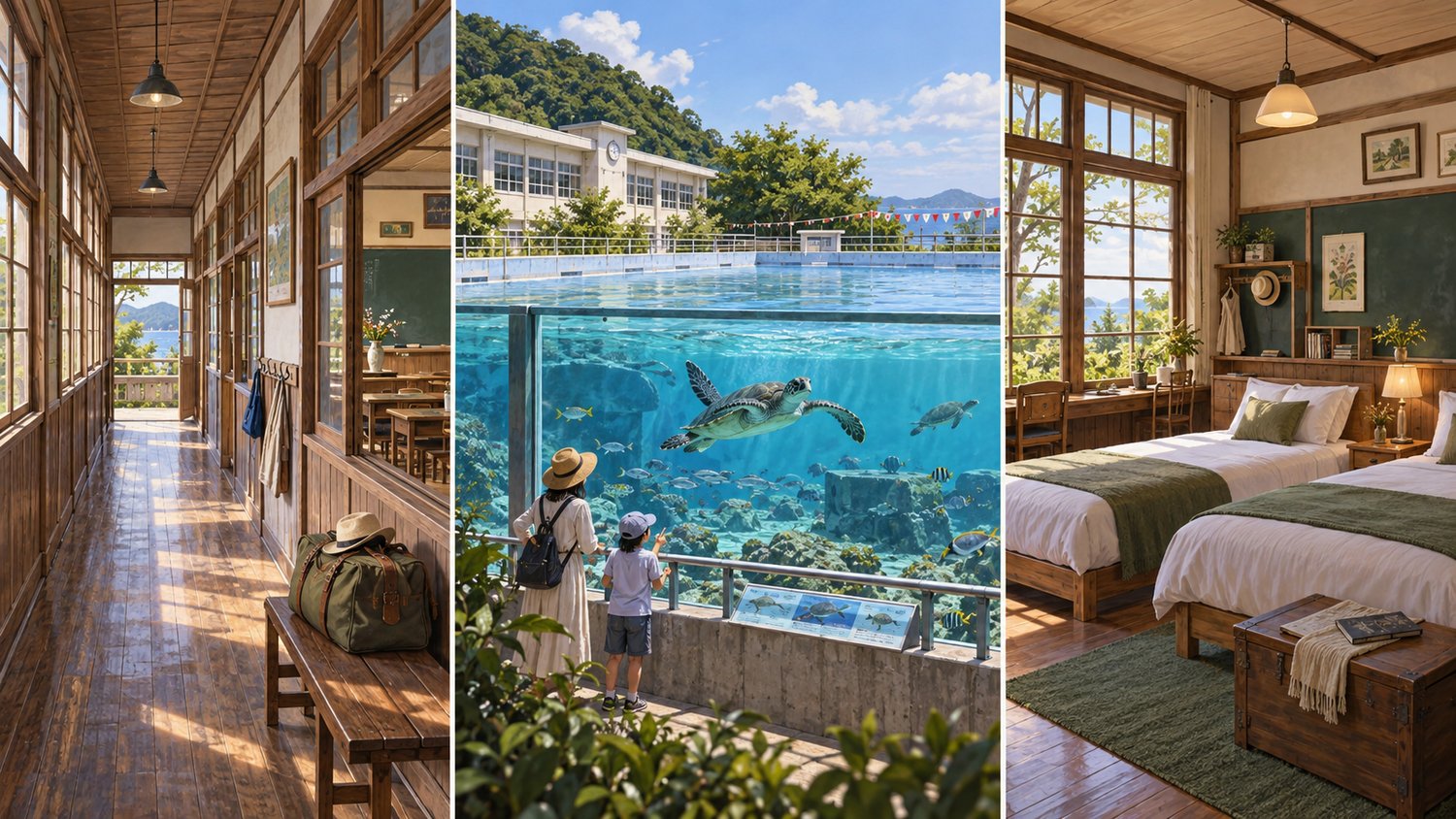
An abandoned school in Japan does not always disappear. Some return as places where travelers can sleep, eat, learn or meet local marine life. The interesting part is not nostalgia alone: each project keeps a different part of the original school experience alive.
This guide compares four verified examples so you can choose between an easy day visit, a group stay near Tokyo, a whole-classroom retreat in Chiba, or a slow island stay in the Seto Inland Sea.
Information was checked against municipal and facility-operated websites on 28 September 2026.
QUICK DECISION
Best day visit: Muroto Schoolhouse Aquarium, Kochi — a former elementary school where the swimming pool and classrooms now hold local marine life.
Best for a private group near Tokyo: Fujikura Schoolhouse Lodge, Tokyo — a wooden former schoolhouse rented as one building for overnight learning and nature stays.
Best for a large self-contained stay: MUJI BASE OIKAWA, Chiba — former classrooms converted into two accommodation houses, each sleeping up to ten guests.
Best for a quiet island trip: NOTEL, Shodoshima — seven private rooms inside a former elementary school in a working farming village.
1. MUROTO SCHOOLHOUSE AQUARIUM — THE SCHOOL POOL HAS FISH AGAIN
Muroto City converted the former Shiina Elementary School into an aquarium that opened on 26 April 2018. The outdoor pool and indoor tanks hold sea turtles and fish caught in local set nets. The school setting is not decorative wallpaper: the pool, classrooms and corridors are part of the visit.
PRACTICAL DETAILS CHECKED FOR 2026
• April–September: 9:00 a.m.–6:00 p.m.
• October–March: 9:00 a.m.–5:00 p.m.
• Open year-round
• Adults and high-school students: ¥600
• Elementary and junior-high students: ¥300
• Preschool children: free
• Kochi Tobu Kotsu bus: get off at Muroto Haikou Suizokukan-mae, then walk about one minute
• By car: about 1 hour 40 minutes from Kochi Ryoma Airport; about two hours from Nankoku Interchange
The long road journey is the main planning issue. Do not treat this as a quick add-on to central Kochi. Combine it with Cape Muroto or an overnight stay in eastern Kochi.
Official Muroto City page:https://www.city.muroto.kochi.jp/pages/page0343.php
Google Maps:https://www.google.com/maps/search/?api=1&query=Muroto+Schoolhouse+Aquarium
2. FUJIKURA SCHOOLHOUSE LODGE — A WOODEN SCHOOL AT THE END OF TOKYO
Fujikura Schoolhouse Lodge stands deep in Hinohara Village, still within Tokyo but far from the city's familiar rail network. The former elementary school was built by villagers in 1954 and renovated in 2022 as accommodation for workshops, nature programs and group learning.
The official site describes overnight use as a whole-building rental. That makes it better suited to families, friends, student groups or company retreats than to a solo traveler looking for a conventional hotel room.
ACCESS REALITY
• About 70 minutes by car from Hachioji
• From Shinjuku, the official estimate is about 90 minutes to Musashi-Itsukaichi Station, followed by roughly 50 minutes by local bus
• Address: 4814 Fujiwara, Hinohara Village, Nishitama District, Tokyo
This is a destination, not a late-night fallback. Check the bus timetable, reservation calendar and meal arrangements before committing to the journey.
Official site and reservation calendar:https://fujikura-kosha.com/
Google Maps:https://www.google.com/maps/search/?api=1&query=Fujikura+Schoolhouse+Lodge+Hinohara
3. MUJI BASE OIKAWA — FORMER CLASSROOMS BECOME WHOLE ACCOMMODATION HOUSES
The former Oikawa Elementary School in Otaki, Chiba, closed in 2013. After operating as a community site from 2017, it was relaunched in October 2024 with accommodation and local-community functions.
Two former-classroom accommodation units serve different group layouts:
• House A: 141 m², five single beds plus five futons, up to ten guests
• House B: 151 m², ten single beds across two bedrooms, up to ten guests; offered as a whole-building rental
• Check-in: 2:00–5:00 p.m.
• Check-out: 10:00 a.m.
• Non-smoking throughout
• Rates vary by season; use the official reservation screen for the current total
The school identity continues beyond the rooms. The site lists a former staff room used as coworking space, a music room, library, schoolyard, courtyard, kiosk and guided school tour. Some food and activity options cost extra, so distinguish what is included in the stay from optional BBQ, pizza-oven or catering services.
Official English page and reservation link:https://stay.muji.com/en/base/oikawa/
Google Maps:https://www.google.com/maps/search/?api=1&query=MUJI+BASE+OIKAWA
4. NOTEL, SHODOSHIMA — A SEVEN-ROOM SCHOOL HOTEL IN A FARMING VILLAGE
NOTEL occupies the former Otaku Elementary School, which closed in 2005, in Hitoyama on Shodoshima. It opened as a small hotel in August 2024. The second floor has seven private rooms—two triples, four twins and one single—plus a shared dining kitchen. HOMEMAKERS FARM & CAFE operates on the first floor with seasonal local produce.
This is the most conventional hotel-style choice in the group, but the surrounding village is part of the experience. Hitoyama is a living farming community, not a staged theme park. Walk quietly, do not treat homes or fields as unrestricted photo sets, and use the hotel as a base for a slower island itinerary.
Official English overview and booking:https://notel-hitoyama.jp/en/about-en/
Google Maps:https://www.google.com/maps/search/?api=1&query=NOTEL+Hitoyama+Shodoshima
HOW TO CHOOSE WITHOUT BEING DISAPPOINTED
Choose Muroto if you want an unusual attraction and can accept the long surface journey. Choose Fujikura for a private group that values the wooden schoolhouse itself. Choose Oikawa for a larger, more self-contained stay with modern facilities. Choose NOTEL for private rooms, local food and a wider Shodoshima trip.
Before booking any former school, check four things:
1. Whether the price is per person, per room or for the whole building.
2. Whether meals are included, optional or self-catered.
3. The final public-transport connection and its last departure.
4. Which school spaces are guest areas and which remain staff, community or event spaces.
These projects work because they are still connected to their communities. Visit them as living places, not abandoned-property attractions.
SOURCE AND IMAGE NOTE
The accompanying image is a generic editorial illustration showing the idea of school reuse. It does not depict the exact architecture, pool, rooms or animals of any named facility and must not be used as documentary evidence.
Verified: 28 September 2026. Admission, accommodation rates, transport, opening hours and reservation conditions can change. The linked official pages and booking screens provide the current operating information.