


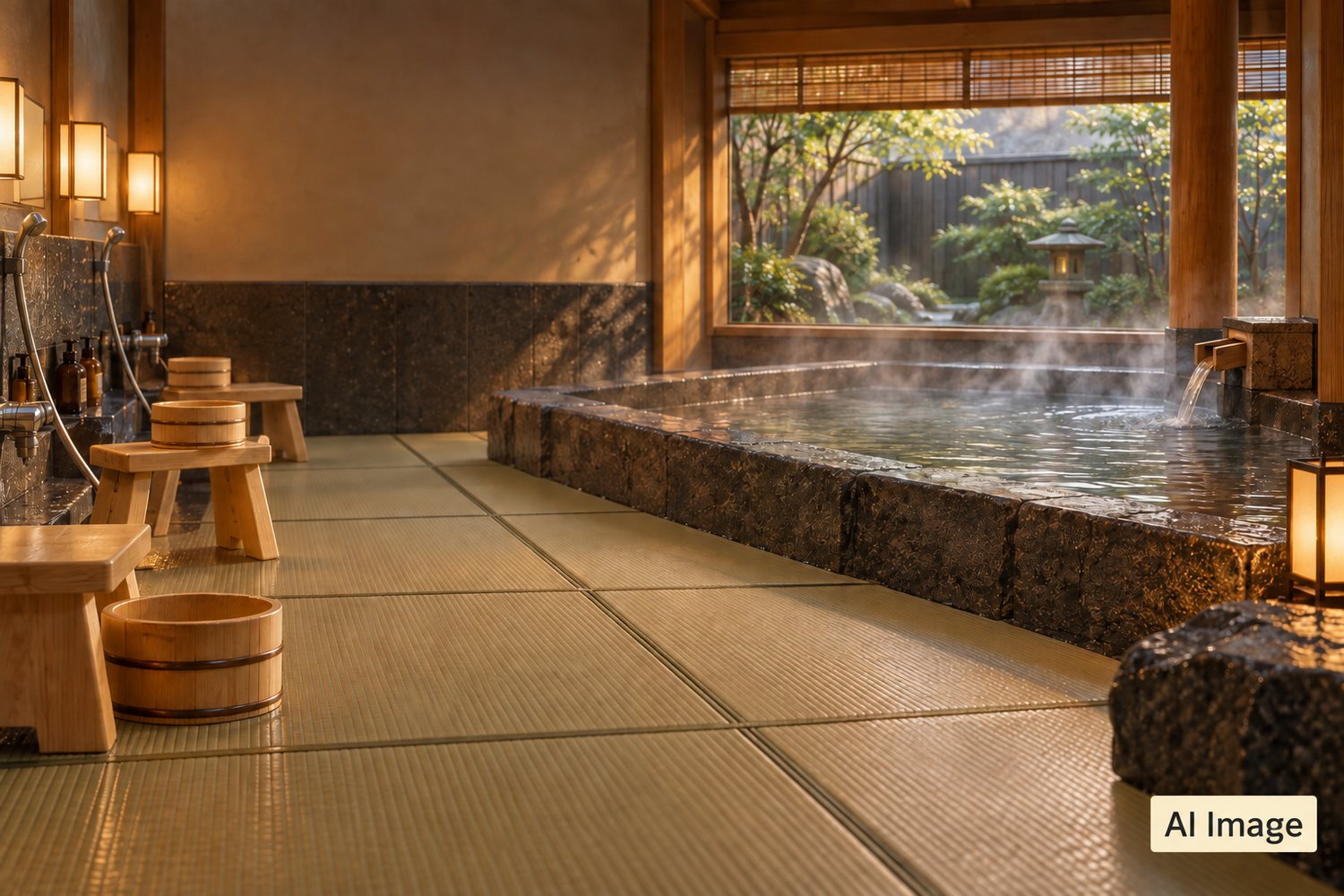
AI-generated concept illustration, labelled AI Image. The pictured bath is not a photograph or a reconstruction of Wakatake, Tateshina Shinyu Onsen or Yunohanatei. Use their official pages to see the real facilities.
Before booking: ask three questions
Can I enter as a day visitor on my date? Which bath is available during my stay? Does the complete route from the changing room to the water suit my needs? A soft floor does not establish step-free access, private use or permission for tattoos. Confirm each point with the named property.
Update checked 3 October 2026: Wakatake still lists day bathing from 10:00 to 14:00, a narrower window than its general bath hours. Tateshina Shinyu still displays conflicting tatami-bath hours on its English page. Confirm the exact bath and your arrival time before booking. The September details below remain dated snapshots.
Tatami on the floor of a hot-spring bath sounds impossible—until you see what these Japanese inns have built. These are not ordinary dry-room straw mats. They are bath-area flooring systems designed to stay softer underfoot than tile and to reduce the anxiety of walking across a wet washing area.
This guide compares three real places: a straightforward day-use bath in Niigata, a pioneering hotel bath in Nagano, and an immersive tatami inn in western Izu. The practical details below were checked against each facility’s official website on 28 September 2026.
QUICK DECISION
Choose Wakatake in Niigata if you want the simplest day-use visit.
Choose Tateshina Shinyu Onsen in Nagano if you want a mountain-hotel stay and a purpose-built tatami bath with a documented history.
Choose Yunohanatei in Toi Onsen if you want the most immersive tatami-themed overnight stay. Day-use bathing is currently suspended.
1. ECHIGO NO OYADO WAKATAKE — THE EASIEST DAY-USE OPTION
Wakatake stands in Yutagami Onsen, Niigata Prefecture. Its official hot-spring page describes a spacious tatami-floored communal bath intended to feel soft and less slippery for children and older guests. The floor changes the experience immediately: instead of stepping from hard tile into the bath, visitors move across a warmer-looking, lightly cushioned surface.
Day-use information checked on 28 September 2026:
• Bathing hours: 10:00 a.m.–2:00 p.m.
• Adult: ¥900
• Child: ¥450
• Adult bathing tax: ¥150 extra
• Face towel: ¥200
The property is about three minutes from Tagami Station by car. A complimentary pickup from Tagami Station is available by advance reservation. From Tokyo, the official access page suggests the Joetsu Shinkansen to Tsubamesanjo Station followed by approximately 25 minutes by taxi.
Wakatake also has a designated drinking-spring facility. This does not mean that water from any bath or any Japanese onsen is safe to drink. Only use a clearly designated drinking fountain and follow the facility’s instructions.
Official hot-spring information:https://www.oyado-wakatake.co.jp/en/hot_spring
Official access information:https://www.oyado-wakatake.co.jp/en/access
Google Maps:https://www.google.com/maps/search/?api=1&query=Echigo+no+Oyado+Wakatake+Yutagami+Onsen
2. TATESHINA SHINYU ONSEN — THE PIONEERING MOUNTAIN STAY
Tateshina Shinyu Onsen in Nagano says it introduced its tatami-floored hot spring in 2001. According to the hotel, special antibacterial and anti-mold materials were developed to suit the composition of its spring water. The design was created so that children and guests who have difficulty walking could approach the bath with greater confidence.
This is the strongest choice for travelers who want the bath to be part of a mountain-hotel stay rather than a short stop. The property also operates a free shuttle from the east exit of JR Chino Station. Advance contact is required, and the official timetable should be checked when booking.
Important timing warning: the hotel’s current English hot-spring page displays internally conflicting hours for the tatami bath. One line reads “2:00 p.m. to 1:00 p.m.” while another lists morning hours. The adjacent public-bath section uses 2:00 p.m. to 1:00 a.m., but this guide will not silently assume that the same closing time applies. Confirm the tatami bath’s operating hours directly with the hotel before relying on a late arrival.
Official hot-spring information:https://www.tateshina-shinyu.com/en/hotspring/
Official access and shuttle information:https://www.tateshina-shinyu.com/en/access/
Google Maps:https://www.google.com/maps/search/?api=1&query=Tateshina+Shinyu+Onsen
3. TATAMI NO YADO YUNOHANATEI — THE FULL TATAMI EXPERIENCE
Yunohanatei is in Toi Onsen on the western coast of the Izu Peninsula. Its official website presents a much broader tatami concept: guest rooms, corridors, toilets, open-air bath areas and the interior of the bath are covered with tatami-style flooring. This is the option for travelers who want the unusual surface to shape the atmosphere of the entire stay, not only the washing area.
The critical booking point is simple: the property currently states that day-use bathing is suspended. Do not travel to Toi expecting to walk in for a bath. Treat Yunohanatei as an overnight accommodation experience and reserve before making the journey.
From Tokyo, the official access page shows several routes. One option is the Shinkansen to Mishima, a train to Shuzenji, and then a bus toward Toi. Another is the direct Odoriko service to Shuzenji followed by the bus. Travelers coming through Shimizu can also consider the Suruga Bay Ferry to Toi Port, subject to the ferry’s current operating conditions.
Official property information:https://www.toi-yunohanatei.com/
Official access information:https://www.toi-yunohanatei.com/access.html
Google Maps:https://www.google.com/maps/search/?api=1&query=Tatami+no+Yado+Yunohanatei+Toi+Onsen
WHAT THE FLOOR CHANGES—AND WHAT IT DOES NOT
A tatami-style bath floor can feel less cold and less intimidating than hard tile, and the softer surface is one reason the first two properties explicitly discuss children and older guests. It does not make a public bath barrier-free by itself. Steps, handrails, changing-room access and assistance policies still vary. Ask the property directly if a traveler has specific mobility needs.
The image accompanying this article is an editorial illustration of a generic bath-area tatami system. It is not documentary evidence of any named facility. Use the official pages above to see the current appearance of each real bath.
BEFORE YOU GO
• Recheck day-use availability on the day of travel.
• Bring or rent a towel according to the facility’s rules.
• Wash before entering the communal bath.
• Do not place a large towel in the bath water.
• Tattoo policies vary by property; ask before arrival rather than assuming.
• Never drink hot-spring water unless a marked drinking facility specifically permits it.
• If exact bath access is essential, contact the property because maintenance and private-use periods can change availability.
For a wider comparison of volcanic landscapes and unusual onsen experiences—including Owakudani, Beppu and Toyotomi’s distinctive oil-bearing spring—continue with the illustrated Japan Volcano & Unusual Onsen 2026 guide:https://payhip.com/b/YVyqa
Verification date: 28 September 2026. Prices, day-use access, shuttle schedules and bathing hours can change. The official links above are the correct place to obtain the latest operating and reservation information.