

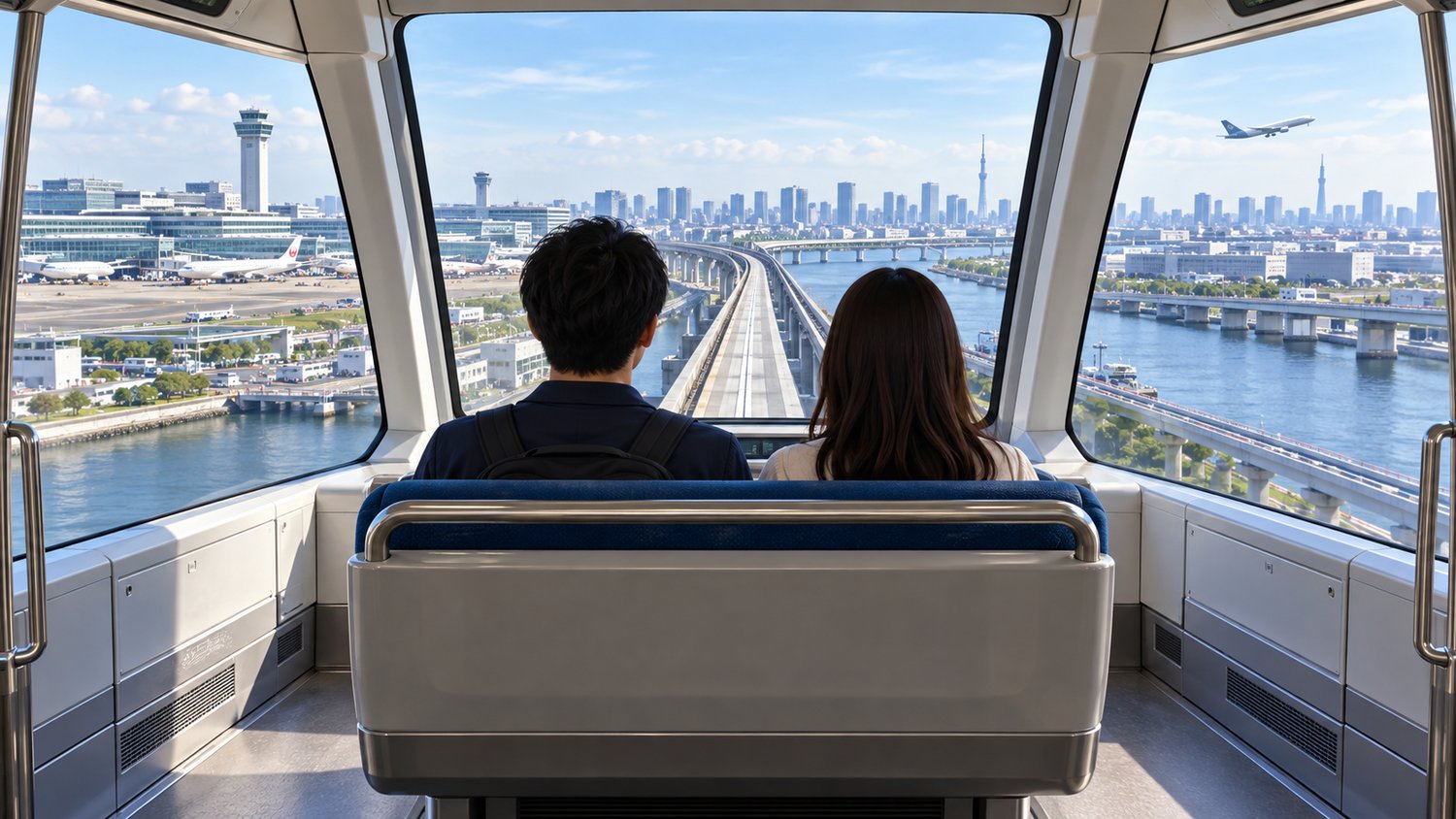
The Tokyo Monorail is not only an airport transfer. From the front of the train, Haneda’s runways, canals, warehouses, expressways and the Tokyo skyline arrive in one continuous panorama. Since November 2025, the operator has also used the route nickname “Tokyo Panorama Line” to emphasize these views.
Unlike the driverless Yurikamome, Tokyo Monorail trains have an operating cab. The front panorama therefore depends on the vehicle, seat and window layout. On the applicable front-view layout, the forward-facing passenger seat is a two-person bench in the middle. It is not reserved, and the view still depends on the operating vehicle and availability.
WHICH DIRECTION IS BETTER?
Haneda Airport → Monorail Hamamatsucho: the stronger arrival story. Aircraft facilities and open water gradually turn into canals, elevated roads and dense central Tokyo. It works especially well for a first-time visitor arriving in daylight.
Monorail Hamamatsucho → Haneda Airport: the better farewell ride. The city loosens into the waterfront before the airport infrastructure appears. Leave enough airport buffer; do not let sightseeing or waiting for a front position risk your flight.
Google Maps — Monorail Hamamatsucho Stationhttps://www.google.com/maps/search/?api=1&query=Tokyo+Monorail+Hamamatsucho+Station
Google Maps — Haneda Airport Terminal 3 Stationhttps://www.google.com/maps/search/?api=1&query=Tokyo+Monorail+Haneda+Airport+Terminal+3+Station
HOW TO TRY FOR THE FRONT
1. Board at a terminal station where possible: Monorail Hamamatsucho or Haneda Airport Terminal 2.
2. Check the direction of travel before choosing an end of the train. “Front” changes when the train reverses direction.
3. Let passengers leave and priority users board without obstruction.
4. If the best position is occupied, use a side window or the next train only when your schedule allows. The operator says trains run on average every five minutes.
5. Keep large luggage secure and away from doors. Airport passengers need space to move.
The front area is shared public space. Do not reserve multiple seats, place a suitcase on a seat, lean over another passenger or hold a camera in someone’s line of sight. Avoid flash and prevent identifiable passengers from appearing in your images.
AIRPORT RAPID OR LOCAL?
Airport Rapid is best when you need the fastest transfer. The operator lists approximately 13 minutes from Monorail Hamamatsucho to Terminal 3, 17 minutes to Terminal 1 and 19 minutes to Terminal 2.
Local trains take longer and stop at intermediate stations. For a sightseeing ride, the slower rhythm can make the waterfront easier to follow, but journey time and passing waits vary. Choose by your actual flight schedule, not only by the view.
Official Haneda access guide and live timetablehttps://www.tokyo-monorail.co.jp/english/
Official quick-transfer guidehttps://www.tokyo-monorail.co.jp/english/haneda-tokyo-access/index.html
WHAT TO WATCH FOR
Haneda terminals and maintenance areas: aircraft tails, hangars, taxiways and service vehicles appear in quick layers.
Tenkubashi and Seibijo area: airport engineering and the edge of the city become visible.
Showajima and Ryutsu Center: logistics districts, canals and industrial Tokyo replace the tourist postcard with a working landscape.
Oi area: elevated track, rail yards, highways and waterways overlap.
Tennozu Isle to Hamamatsucho: towers close in and Tokyo’s central skyline becomes the final act.
The exact view changes with track, direction, weather and train type. Side windows can be better than the front for aircraft, water or sunset, so do not treat the leading seat as the only good choice.
BEST TIME
Late morning or mid-afternoon generally avoids the sharpest airport and commuter peaks, but flight banks, holidays and disruptions can change crowds. Sunrise light can be beautiful from Haneda; evening brings reflections, so lower screen brightness and shoot without flash.
For a dedicated aircraft stop, Showajima is associated by the operator with access toward Keihinjima Tsubasa Park, a known aircraft-viewing area. The walk is not a quick airport transfer activity; check route, weather and daylight before going.
Official Showajima area guidehttps://www.tokyo-monorail.co.jp/english/guidance/syowajima/index.html
TICKET CHECK
IC cards and regular tickets are available. Ticket machines can be switched to English. Current fares, platforms and service patterns should be checked through the official timetable on the travel day.
Official ticket guidehttps://www.tokyo-monorail.co.jp/english/tickets/purchase.html
QUICK DECISION
Choose Airport Rapid when your priority is the plane. Choose Local when you have time and want a longer look at the waterfront. For the best low-stress front-view attempt, start at a terminus, avoid peak periods and accept that the next available train or a side window may be the better choice.
Checked against official Tokyo Monorail information on 28 September 2026. Times and operating patterns can change because of timetable revisions or disruption; use the official links above for live information.