

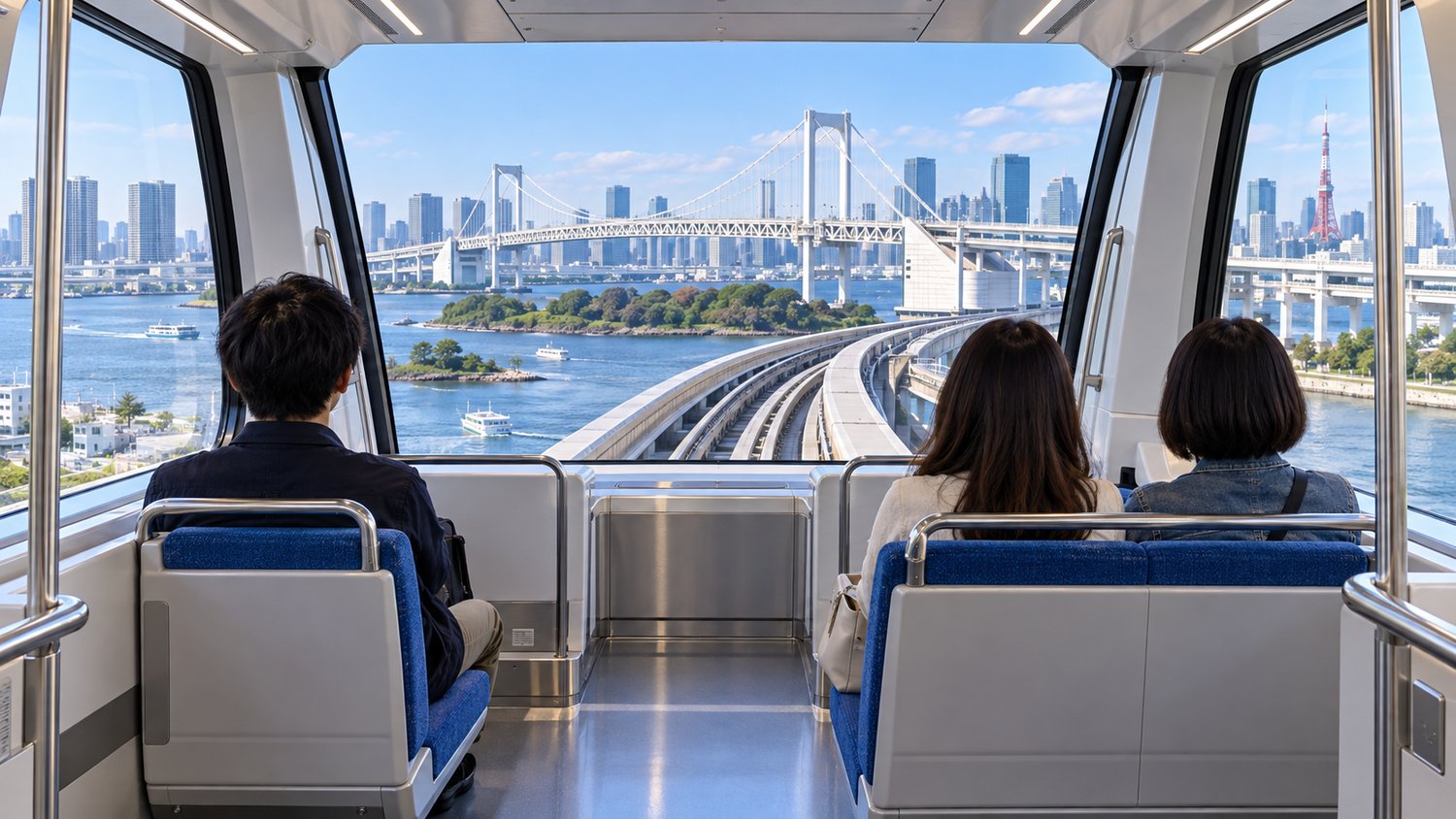
official operator information on 28 September 2026. Operating patterns, fares and access restrictions can change during events or service disruption. Use the official links above for the latest departure and fare.</p>Tokyo has a sightseeing ride hidden inside an ordinary transit ticket. The Yurikamome is fully automated, so there is no driver’s cab blocking the forward view. From the leading end, the elevated guideway bends through towers, docks and the approach to Rainbow Bridge like a slow-moving city film.
This is not a reserved observation car. On the current front-row layout, the forward view is shared by a separate one-person seat and a two-person seat. These are ordinary, first-come seats—not a reserved observation area. If they are occupied, do not crowd the seated passengers or block the aisle. At a terminus, waiting for the next departure is usually the calmest way to try again.
WHY START AT SHIMBASHI
For a first ride, travel from Shimbashi toward Toyosu. The early section climbs away from the business district, passes Shiodome and the waterfront, then makes the broad approach to Rainbow Bridge before reaching Odaiba. It gives the journey a clear reveal: city first, bay second, islands third.
Shimbashi is a terminus, so boarding there gives you a better chance of reaching the leading end before through-passengers fill the seats. Follow signs for Yurikamome rather than JR. The Yurikamome station is elevated and separate from the JR platforms.
Google Maps — Yurikamome Shimbashi Stationhttps://www.google.com/maps/search/?api=1&query=Yurikamome+Shimbashi+Station
Official Shimbashi station guidehttps://www.yurikamome.co.jp/en/station-timetable/u-01.html
THE FRONT-ROW STRATEGY
1. Check the destination display. For the classic first ride from Shimbashi, choose a train toward Toyosu.
2. Enter the platform and identify the leading end in the direction of travel. Do not assume the same physical end will be “front” on the return journey.
3. Let exiting passengers clear first. Never run, hold doors or push past families.
4. If the front seat is occupied, use the rear-facing panorama or take the next train. The official guide says trains normally run about every five minutes on weekdays and about every four minutes on weekends.
5. Keep bags off adjacent seats and keep the front window clear for other passengers.
WHEN TO GO
The operator identifies 07:00–09:00 and 17:00–20:00 as crowded periods. For a relaxed sightseeing ride, aim for a weekday late morning or mid-afternoon, avoiding major events at Tokyo Big Sight and Ariake. Event days can change the crowd pattern dramatically.
Sunset and the first hour after dark are visually strong, but window reflections increase. Dim your phone screen, avoid flash and hold the camera close to the glass without touching or obstructing it. Do not photograph identifiable passengers without permission.
WHAT YOU WILL SEE
Shimbashi to Shiodome: elevated city canyons and close-up curves.
Takeshiba to Shibaura-futo: piers, warehouses, ferries and working waterfront infrastructure.
Rainbow Bridge approach: the guideway curves and gains height before entering the bridge structure. This is the signature forward-view sequence.
Odaiba: broad roads, geometric buildings and Tokyo Bay open around the track.
Ariake to Toyosu: exhibition halls, sports facilities, new towers and canal views show how rapidly Tokyo’s waterfront continues to change.
The official route is 15 kilometres with 16 stations. A full Shimbashi–Toyosu ride takes about 30 minutes. You do not need to complete the whole route: Daiba and Odaiba-kaihinkoen are practical stops for the waterfront.
BEST DIRECTION
Shimbashi → Toyosu: best for a dramatic build-up to Rainbow Bridge and a first-time Odaiba arrival.
Toyosu → Shimbashi: best for watching the bay give way to central Tokyo and for ending near JR, Ginza and Shiodome.
If your priority is the forward window rather than a destination, ride one direction, take a break at the terminus and return from the other leading end. Never remain aboard against instructions when the train is being checked or turned around.
TICKETS AND ACCESS
Regular tickets and compatible IC transport cards can be used. Fares and timetables can change, so use the operator’s live search before travel.
Official timetable and fare search
https://www.yurikamome.co.jp/en/
Official riding guidehttps://www.yurikamome.co.jp/en/ride-guidance/guide.html
Official automated-operation explanationhttps://www.yurikamome.co.jp/en/feature/comfortable/system.html
Google Maps — Toyosu Stationhttps://www.google.com/maps/search/?api=1&query=Yurikamome+Toyosu+Station
QUICK DECISION
Choose Yurikamome if the ride itself is part of the day. Choose the Rinkai Line when speed and a direct connection to western Tokyo matter more. The front-row Yurikamome experience is strongest when you treat the 30-minute journey as a moving observation deck, not merely transport.
Checked against official operator information on 28 September 2026. Operating patterns, fares and access restrictions can change during events or service disruption. Use the official links above for the latest departure and fare.