
1.Intro (Problem):
Many students struggle with Geometry because they try to memorize formulas without understanding the 'why'. The Pythagorean Theorem is the foundation of high school math, but it doesn't have to be confusing.
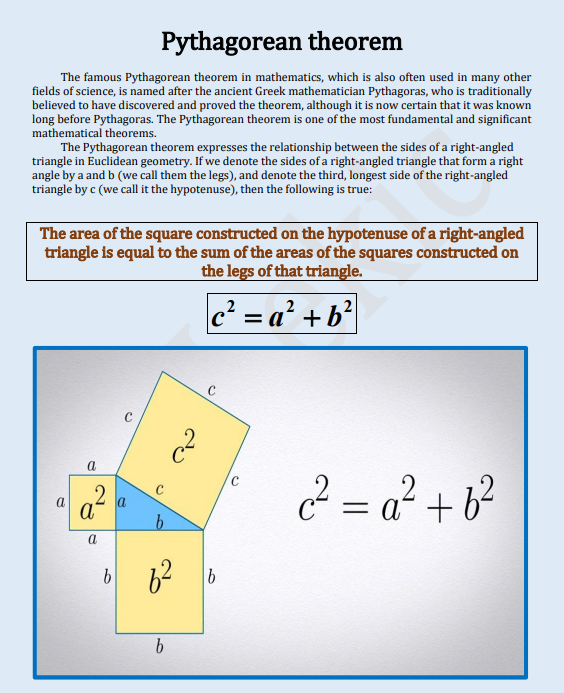
2. Tip #1: Visualize the Squares:
In the Pythagorean theorem, the side lengths of the triangle a, b, and c are used for ease of notation. It is very important to learn the Pythagorean theorem in a general form, without any specific letter labels, as these side labels often change in later problems and can cause confusion, since different geometric figures use different labels for heights, diagonals, mid-sides, and so on. Therefore, we adopt the Pythagorean theorem as: “The square on the hypotenuse of a right-angled triangle is equal to the sum of the squares on the two legs”, regardless of which symbols are used for the legs and hypotenuse in a specific example.
3. Tip #2: Real-World Examples:
The Pythagorean theorem is often used in real life, in building, construction, in measuring diagonals, for example. tv and the like.
4. Tip #3: Identify the Hypotenuse First:
According to the Pythagorean theorem, we can check for any triangle whether it is a right-angled triangle, simply by substituting the lengths of its sides into the expression and if we get an exact equality, that means the triangle is right-angled. Of course, we take care to substitute the longest side of the triangle for c if the sides are not labelled, whereas for the sides a and b the order is not important.
5. The "Pitch":
If your student needs more help, I’ve created a complete Pythagorean theorem an its Application
Study Guide. It includes step-by-step solutions, visual cheat sheets, and practice problems designed to boost confidence.