

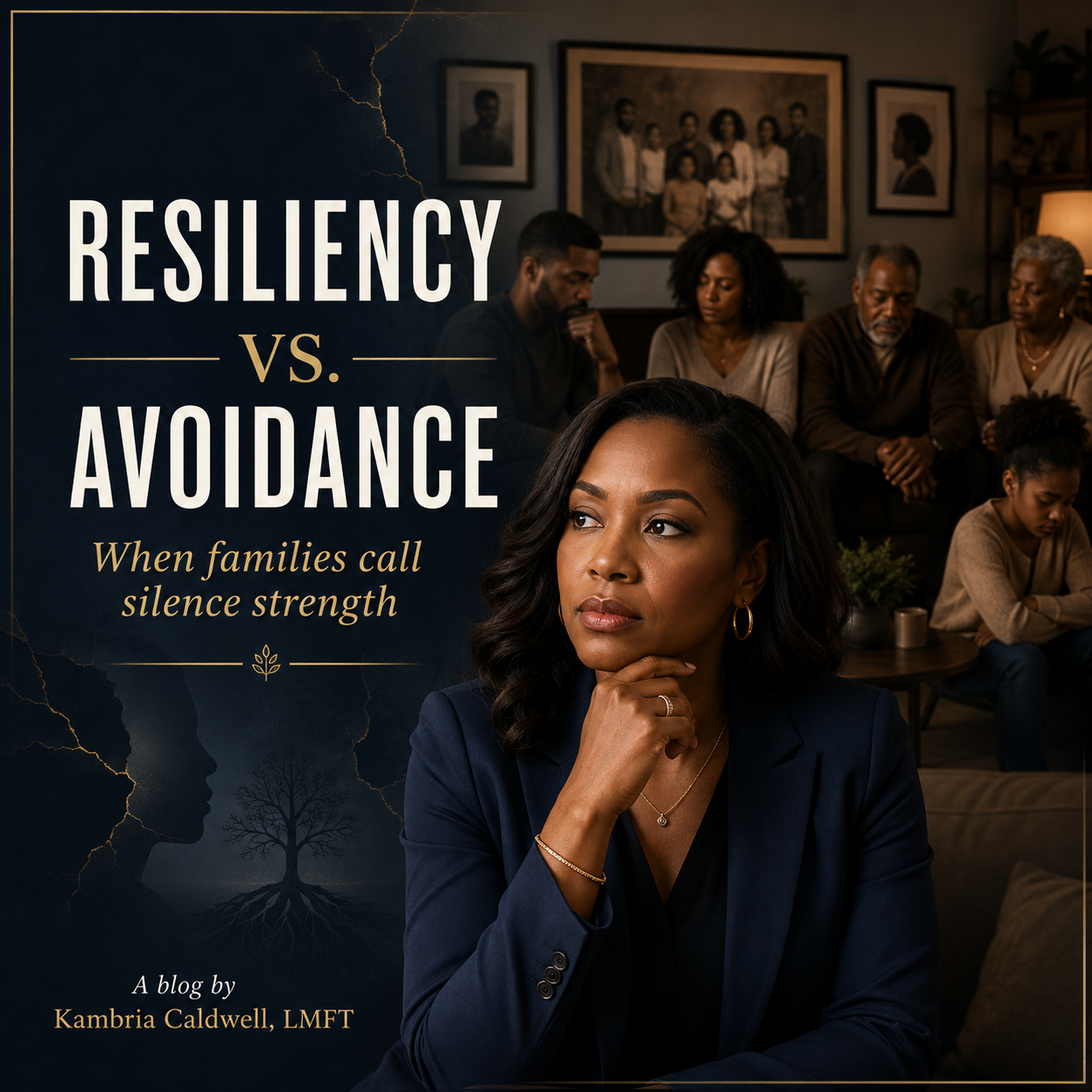
Some families call it resilience because nobody fell apart.
Everybody kept going.
Grandma still cooked Sunday dinner.
Mama still went to work.
The kids still went to school.
The family still showed up at church.
Birthdays were celebrated. Holidays came and went.
And nobody ever talked about what happened.
The betrayal.
The addiction.
The abuse.
The family member everybody knew was inappropriate but nobody protected the children from.
The parent who disappeared.
The violence inside the home.
The secret child.
The mental illness nobody was allowed to name.
The person who hurt everybody but was still expected to get a plate at the cookout.
Years pass, and the family tells the story like this:
“We been through a lot, but we’re strong.”
And maybe you are.
But I need us to have an honest conversation about the difference between Resilience and Avoidance.
Sometimes we are not moving through pain.
We are simply moving past it as quickly as possible.
Survival Is Not the Same Thing as Healing
Black families have survived things that required an incredible amount of emotional strength.
We have survived racism, displacement, poverty, violence, family separation, addiction, incarceration, medical neglect, and generations of being expected to function while carrying unimaginable grief.
There were times when survival had to come first.
Sometimes our ancestors did not have the privilege of stopping to process every emotion.
They had children to feed.
Bills to pay.
Jobs they could not afford to lose.
Lives they were trying to protect.
So they learned to keep moving.
Get up. Go to work. Pray about it. Handle your business. Don't let them see you break.
Those survival skills kept many of our families alive.
We can honor that.
And we can also admit that some of those same survival skills are hurting us now.
Because what protects you in a crisis can become a prison when the crisis is over.
Avoidance Often Looks Strong From the Outside
Avoidance does not always look like someone hiding under the covers.
Sometimes avoidance is the person who never misses a day of work.
The mother who takes care of everybody but refuses to talk about her own childhood.
The man who says, “That was years ago. Why are you still talking about it?”
The family that laughs about traumatic events because humor feels safer than grief.
The aunties who change the subject when somebody starts asking questions.
The parent who says, “I did the best I could,” and believes that sentence should end the entire conversation.
Avoidance can look productive.
Responsible.
Faithful.
Independent.
Strong.
That is why it can be so hard to recognize.
But resilience is not pretending something did not affect you.
Resilience is having the capacity to face what affected you and still build a life beyond it.
There is a difference.
“That's Just How Our Family Is”
Family secrets have a way of becoming family culture.
Everybody knows what happened, but nobody says it out loud.
You learn who not to sit next to.
Who not to leave the kids alone with.
What questions not to ask.
Which years are missing from the family story.
Whose addiction we call “having a hard time.”
Whose rage we call “a bad temper.”
Whose emotional neglect we call “they just weren't affectionate.”
Whose abuse gets reduced to “they made some mistakes.”
And eventually, the silence becomes normal.
The person who finally speaks up is often treated like the problem.
“Why would you bring that up?”
“You're trying to divide the family.”
“That's still your mother.”
“You know how he is.”
“We already moved past that.”
But did we move past it?
Or did everybody just agree to stop talking about it?
Because silence is not resolution.
Time passing is not accountability.
And sitting at the same Thanksgiving table does not mean a family has healed.
Sometimes “Forgiveness” Is Used to Rush the Wounded Person
One thing I notice, particularly in some Black families, is how quickly the person who was hurt can be pressured to demonstrate strength.
"Be the bigger person."
"Forgive."
"Pray."
"Let it go."
"Stop holding grudges."
Meanwhile, the person who caused the harm may have never fully acknowledged what they did.
That is not resilience.
Sometimes that is a family system protecting itself from discomfort.
Because if the wounded person keeps talking, everybody may have to confront something.
People may have to admit they knew.
Someone may have to apologize.
A parent may have to accept that good intentions did not prevent harm.
A respected family member may have to be seen differently.
And family roles may have to change.
That is uncomfortable.
So instead, families sometimes rush the hurting person toward forgiveness because their pain is disrupting the family illusion.
“We are a strong family.”
But strong families should be able to tell the truth.
Real Resilience Requires Emotional Honesty
Real resilience sounds different.
It sounds like:
“Yes, that happened in our family.”
“We should have protected you.”
“I understand why that still affects you.”
“I didn't know how to deal with it then, but I want to understand now.”
“We survived it, but survival came with a cost.”
That is strength.
It takes courage to look at the family story without editing out the painful chapters.
It takes strength to admit that somebody you love also caused harm.
It takes emotional maturity to stop defending yourself long enough to understand another person's experience.
And it takes resilience to grieve the family you needed while learning how to create something healthier.
You Are Not Weak Because You Want to Talk About It
Maybe you come from a family where nobody processes anything.
They just move on.
And now you're the one asking questions.
You're the one noticing patterns.
You're the one saying, “Wait. That actually hurt me.”
You may be labeled sensitive.
Dramatic.
Disrespectful.
Stuck in the past.
But Guess What?
Sometimes the person accused of being stuck in the past is actually the first person brave enough to stop the past from controlling the future.
Read that again. Sometimes the person accused of being stuck in the past is actually the first person brave enough to stop the past from controlling the future.
You are not creating dysfunction by naming it.
You are exposing dysfunction that was already there.
Healing may require you to sit with emotions your family taught you to outrun.
Anger.
Grief.
Confusion.
Betrayal.
Disappointment.
You may have to accept apologies you will never receive.
You may have to create boundaries people do not understand.
You may have to stop participating in family traditions built around pretending.
That does not mean you do not love your family.
Sometimes love tells the truth.
We Can Be Resilient and Still Admit We Were Hurt
Black resilience is real.
It is powerful.
It is part of how many of us are still here.
But I do not believe we honor our strength by pretending pain did not happen.
I believe we honor ourselves by creating a version of resilience that includes rest.
Truth.
Accountability.
Boundaries.
Therapy.
Grief.
Repair.
And emotional safety.
You do not have to choose between being strong and being affected.
You can be resilient and still say, “That changed me.”
You can love your family and still acknowledge what happened inside of it.
You can honor the people who raised you while deciding that certain patterns end with you.
Maybe resilience is not how quickly you move on.
Maybe resilience is finally feeling safe enough to stop running.
To look back.
To tell the truth.
And to heal what your family only knew how to survive.
Because surviving the family secret kept the family functioning.
Healing it may be what finally sets the family free.
Want more Blog posts like this?
Return here every week or Subscribe to my substack at: https://kambriacaldwell.substack.com/
— Kambria Caldwell, LMFT Self Love Is The Key
Comments ()