

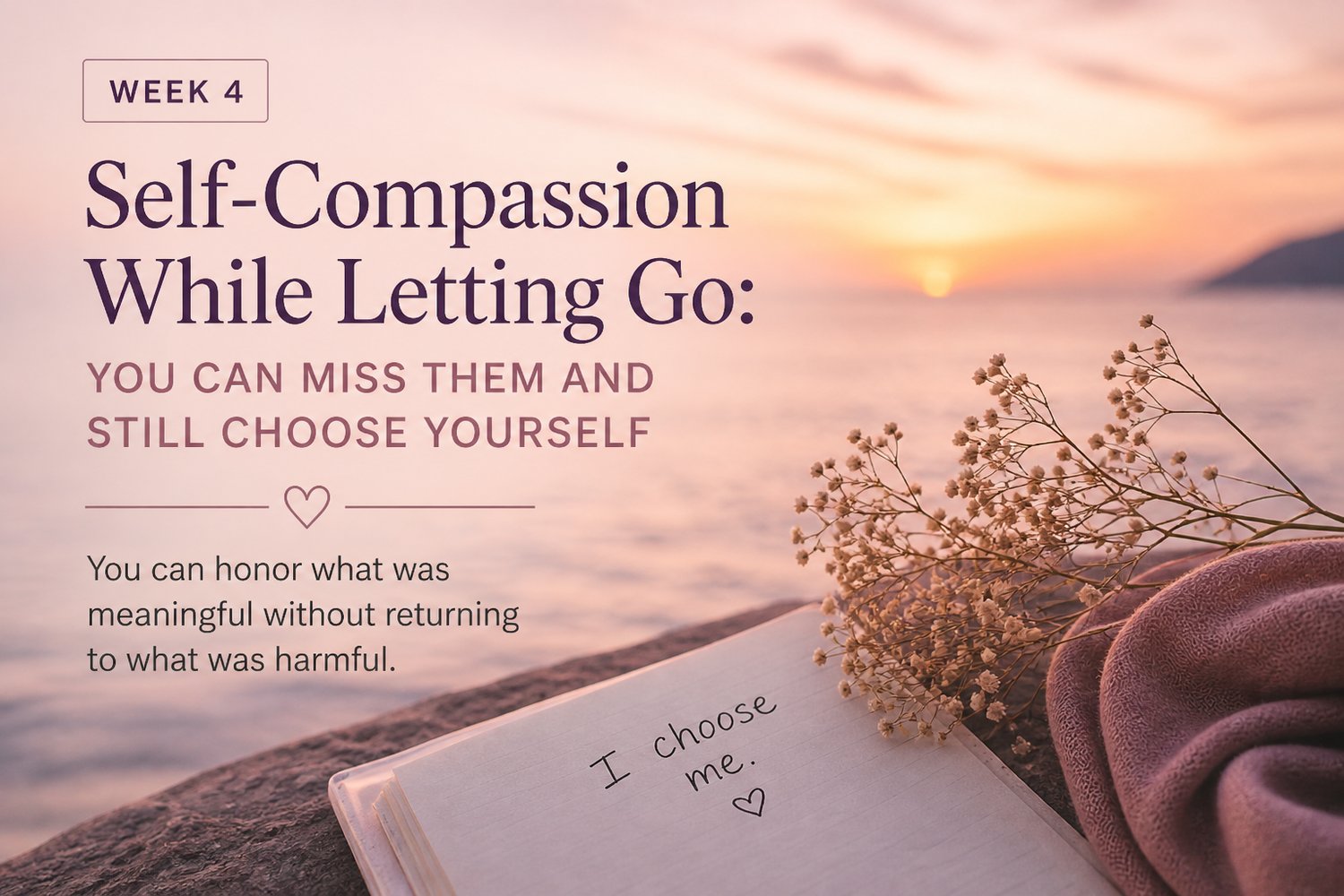
Self-Compassion While Letting Go: You Can Miss Them and Still Choose Yourself
Letting go is not always clean.
Sometimes you know someone is not good for your peace, but your heart still reaches for them.
You miss the good moments.
You miss the version of them that felt safe.
You miss who you were hoping they would become.
You miss the fantasy, the routine, the attachment, the possibility.
And then you judge yourself for missing them.
But self-compassion says:
You can miss someone and still know they are not aligned with the life you are trying to build.
You can love someone and still choose distance.
You can grieve the connection and still honor the truth.
Missing Someone Does Not Mean You Made the Wrong Decision
One of the hardest parts of letting go is that grief can make you question yourself.
You start thinking:
“Maybe I overreacted.”
“Maybe it wasn’t that bad.”
“Maybe I should reach out.”
“Maybe I’ll never find this again.”
“Maybe I was asking for too much.”
But missing someone is not always a sign that you should return.
Its a sign that you are human.
Attachment does not disappear just because you finally told yourself the truth.
Your nervous system may still crave what was familiar, even if what was familiar was inconsistent, confusing, or painful.
That does not mean you are weak.
It means your heart is adjusting to the absence of something that was supposed to feel like home.
Self-Compassion Helps You Hold the Grief Without Romanticizing the Pattern
When you are letting go, self-compassion helps you tell the whole truth.
There may have been moments that felt real.
There may have been love, chemistry, laughter, comfort, or hope.
There may have also been inconsistency, emotional confusion, unmet needs, broken trust, or patterns that made you feel small.
Self-compassion allows you to grieve without gaslighting yourself.
It gives you permission to say:
“I miss them, but I do not miss how I felt when I was begging to be considered.”
“I love them, but I am learning to love myself too.”
“I can honor what was meaningful without returning to what was harmful.”
“My sadness does not cancel out my clarity.”
That's healing.
Choosing Yourself May Feel Unfamiliar at First
If you are used to overgiving, overexplaining, or waiting for someone to finally see your worth, choosing yourself may feel uncomfortable.
It may even feel selfish.
But choosing yourself does not mean you stopped caring.
It means you stopped abandoning yourself in the name of being chosen.
You are learning that love should not require you to disappear.
You are no longer available for connections that only feel safe when you are asking for less.
Self-compassion gives you the strength to hold your own hand through the withdrawal of old patterns.
Because sometimes the hardest part is not letting go of the person, but letting go of who you kept trying to be in order to keep them.
A Journal Prompt for This Week
Reflect on this:
What am I grieving, and what am I also being invited to reclaim?
Then write this affirmation:
I can miss what was meaningful and still choose what is healthy. I don't need to abandon myself to prove that I loved someone.
Letting go doesn't mean you are cold.
It means you are listening to the part of you that was feeling neglected.
You are allowed to require love that feels safe.
You are allowed to require consistency.
You are allowed to require effort.
You are allowed to require peace.
And you are allowed to give yourself compassion while you learn how to stop reaching for what keeps hurting you.
Want More Support?
My Self-Compassion Workbook was created for the tender, healing parts of you that are learning how to stop self-abandoning and start choosing yourself with more care.
Inside, you will find therapist-guided prompts, emotional reflections, thought reframes, and healing practices to support your relationship with yourself.
Because you do not have to be fully healed to start treating yourself with love.
Digital Download: https://payhip.com/b/xpuoH
Also Available on Amazon and Kindle
Comments ()