

One day, we will have to answer for this.
Not just for what has been destroyed in Gaza, the homes, the hospitals, the schools, tens of thousands of lives, but for the way we watched it happen. Live. On our screens. Between notifications. We will have to answer for our desensitization, for this strange ability we’ve developed to watch the annihilation of a people as if we were watching the weather: with a vague concern that quickly fades.
This book was written to challenge that desensitization. And it is to challenge it that I ask you to read it.
Since October 2023, the Gaza Strip has been enduring one of the most devastating military campaigns of this century. On this forty-kilometer-long strip of land (one of the most densely populated on the planet) more than two million people have been trapped.
Because in Gaza, there is no escape: the borders are sealed. People can only move from one bombed-out neighborhood to another that will soon be bombed, from one tent to another, carrying their lives on their backs. Entire families have been wiped off the face of the earth. Children have starved to death in a world that produces enough food for everyone. And all of this has unfolded not in the shadows, not hidden from view like so many atrocities of the past, but in broad daylight, documented, filmed, broadcast, and yet, largely tolerated.
I choose my words carefully. Tolerated. For the horror here is not only that of the bombs. It is also that of the indifference of the powerful, of the cowardice of rhetoric, of that obscene accounting that weighs lives according to their passports. In recent years, we have learned to distinguish between the dead who deserve our tears and our flags and those who receive nothing more than a cautious press release. Gaza has been the most merciless mirror of this shameful hierarchy of compassion.
So what can a book do in the face of this? What can a mother’s testimony do against armies, governments, and complicit silences?
It can do this: make it impossible to abstract the crime.
For the great weapon of indifference is the number. A number does not bleed. It doesn’t cry at night. It doesn’t ask for milk at two in the morning. As long as Gaza remains a tally, so many dead, so many displaced, so many metric tons of aid blocked, our conscience can sleep soundly. Statistics numb us. That is precisely what they’re for, for those who are disturbed by reality.
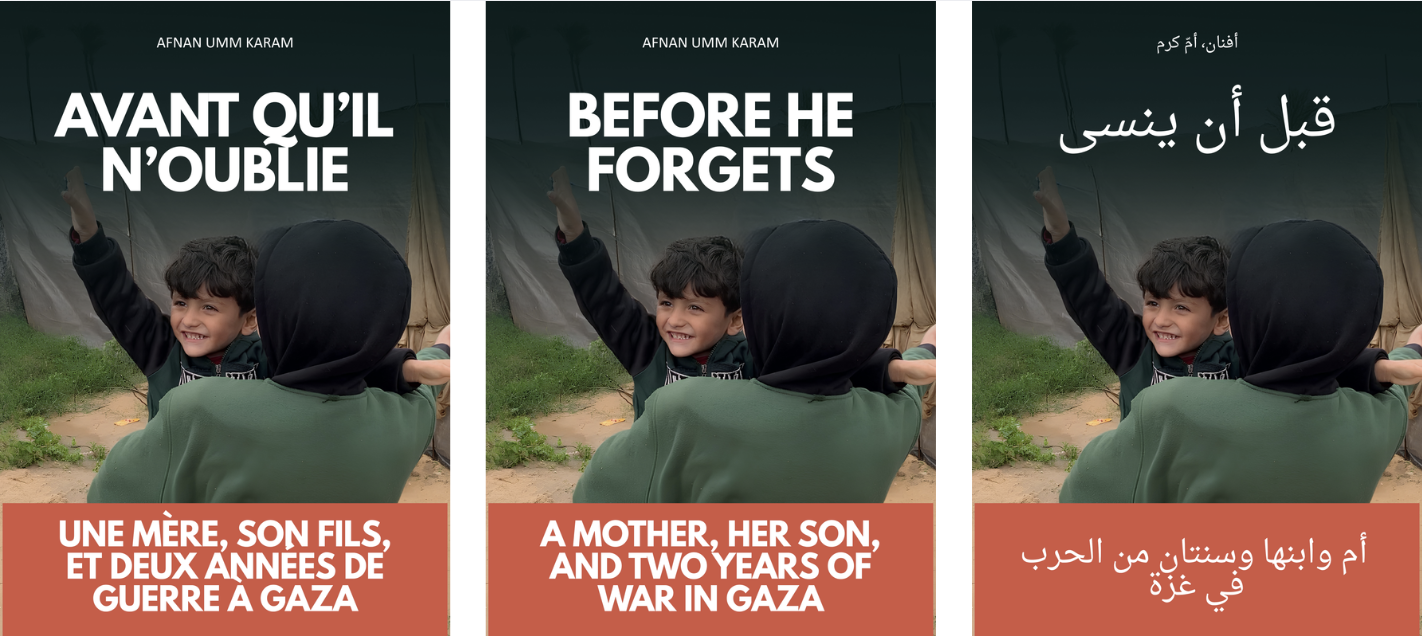
This book does the opposite. It takes just one of those numbers: a young woman named Afnan, working on her master’s degree, and her son Karam, barely a year old when the massacres began, and it restores to him everything that abstraction had stolen from him: a face, the smell of warm bread, a room with blue walls, a diaper that couldn’t be found, half a loaf of bread hidden under a pillow so that a child might still believe, upon waking, that breakfast exists. It forces you to see what the statistics allowed you to ignore.
And that is its unbearable power. After reading these pages, you will no longer be able to hear the word “Gaza” on the news without thinking of a little boy licking a phone screen in an attempt to taste food he no longer knows. You will no longer be able to read “child died of malnutrition” without seeing Karam’s cheeks hollow out again, his little arms growing thinner. Afnan will have accomplished what neither reports nor resolutions have been able to do: she will have made these lives impossible to forget. Impossible to trivialize. Impossible to excuse.
It’s important to highlight what she doesn’t do. Afnan doesn’t accuse anyone by name. She doesn’t analyze causes or assign blame. She doesn’t speak of armies, borders, or treaties. This silence isn’t ignorance; it’s a form of sovereignty. A mother who must find water before nightfall has no time for debates. She survives. And this very simplicity is a political act more powerful than any indictment: by refusing to take sides, Afnan leaves the reader no escape. She does not ask you to choose a side. She simply places you in the presence of a hungry child and leaves you alone with your conscience.
Let the reader make no mistake, then: if this story remains silent on politics, it is up to us, its readers, not to remain silent. To read this book and then close our eyes would be to betray it. Afnan writes “before he forgets” before her son forgets that he once had a home, a childhood, a life of dignity. But there is another kind of forgetting that threatens it, one that is vaster and more culpable: our own. That of a world in a hurry to turn the page, to move on, to file Gaza away among the tragedies we’ve already heard too much about.
This book is a bulwark against that kind of forgetting.
In it, you’ll encounter a truth that those in power would have us lose sight of: behind every statistic, there is a child; behind every child, a mother; and behind every mother, a life that was, one day, as ordinary and precious as your own. Every mother will recognize her own motherhood in these pages. Every human being will rediscover the child they once were the one who believed the world was safe because their mother smiled. And that is precisely why this testimony is dangerous to those who prefer to view Gaza as an abstraction: because it restores the one truth that indifference cannot tolerate, that of our shared humanity.
So read. Not out of curiosity, not out of pity (pity is yet another way of looking down on others). Read to stand, for a moment, on equal footing with Afnan and Karam. To step inside that tent. To carry, in turn, a fragment of this memory that a mother, alone, should not have to bear.
And when you close this book, remember. Not her name, she asks you for that herself on the last page, but a child named Karam, the childhood that a mother refused to let disappear, and all the Karams without a book, without a name, without a voice, whose stories have never been written down anywhere.
Remembering them, from now on, is the least we can do.
It is also the beginning of everything else.