

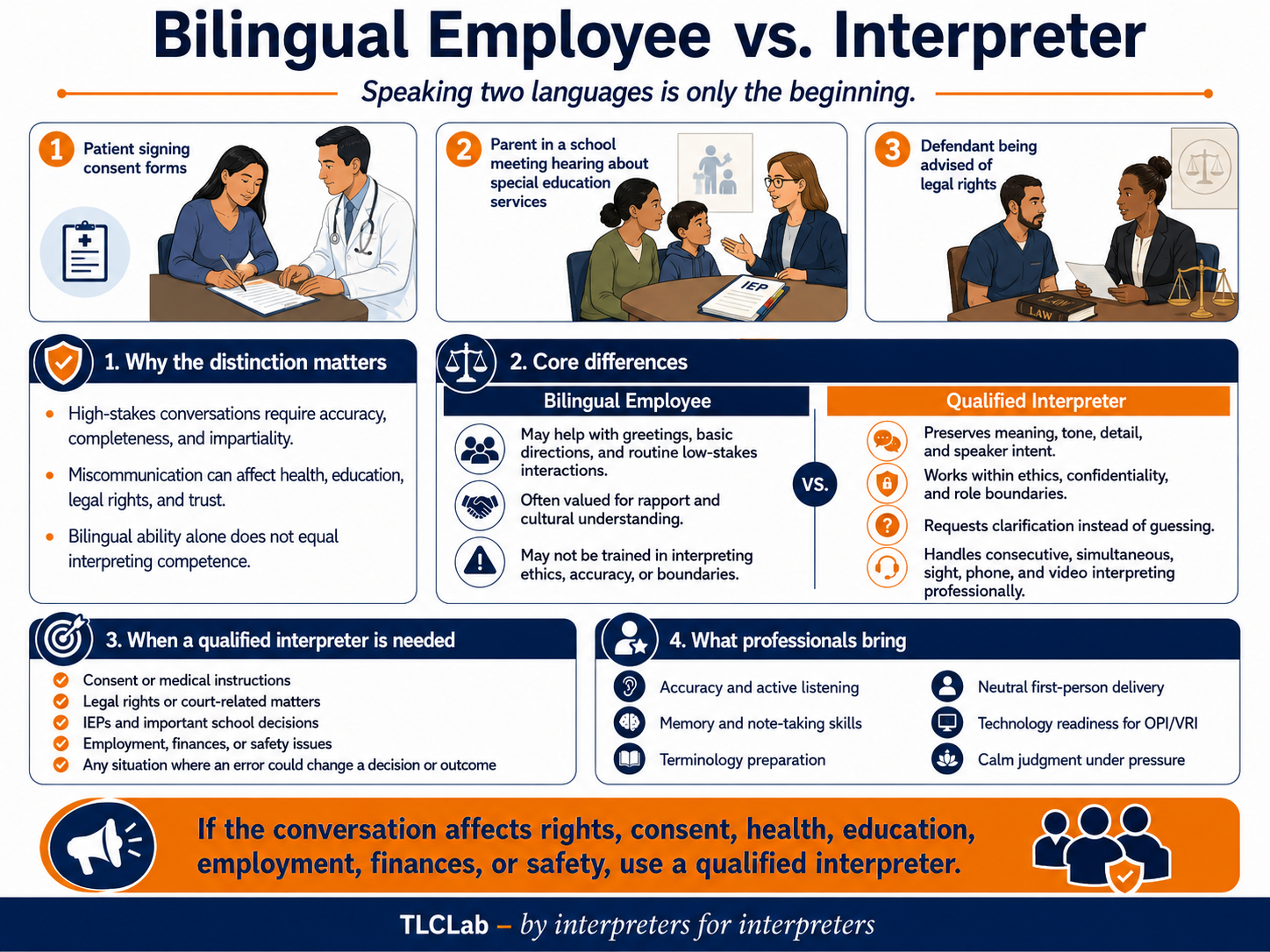
A patient is signing consent forms. A parent is hearing that their child may need special education services. A defendant is being advised of legal rights. In these moments, the bilingual employee versus interpreter question is not about who speaks two languages most comfortably. It is about who can carry another person’s meaning accurately, completely, impartially, and under pressure.
Speaking two languages is only the beginning. Professional interpreting requires a separate set of skills and decisions that protect everyone in the conversation. When an organization treats bilingual ability as interchangeable with interpreting ability, the risk is not merely an awkward exchange. It can be a missed diagnosis, an uninformed decision, a damaged working relationship, or a challenge to due process.
Why the Distinction Matters
A bilingual employee may be exceptionally valuable. They may build rapport with customers, understand cultural context, translate a brief written notice, or help a colleague locate the right resource. Those strengths matter. But being asked to interpret a consequential conversation can place that employee in a role they were never trained, hired, or prepared to perform.
The distinction matters because interpreting is a professional service with defined responsibilities. The interpreter is not there to explain, persuade, summarize, soften difficult news, or solve the client’s problem. The interpreter’s work is to facilitate communication between parties who do not share a language while preserving the speaker’s intent, tone, and level of detail.
That sounds straightforward until real people are speaking quickly, interrupting one another, using unfamiliar terminology, becoming emotional, or communicating over a poor video connection. A professional interpreter needs more than vocabulary to manage those conditions without changing the message.
Bilingual Employee Versus Interpreter: The Core Difference
The central difference is not intelligence, goodwill, or cultural connection. It is professional competence in the act of interpreting.
Fluency is not interpreting accuracy
A bilingual speaker can understand a message in one language and explain its general idea in another. Interpreting requires something more precise. The interpreter must listen, analyze meaning, retain information, and render it into the other language without adding, omitting, rearranging, or editorializing.
Consider a provider who says, “Take this medication twice daily as needed for severe pain, but do not drive after taking it.” A bilingual employee might convey the basic instruction correctly. A trained interpreter is prepared to preserve each condition: frequency, the meaning of “as needed,” the severity threshold, and the driving restriction. If the message is unclear, the interpreter knows how to request clarification rather than guess.
Professional interpreters also work in different modes. They may interpret consecutively during an appointment, simultaneously in a meeting, or by sight when a short document must be read aloud in another language. Each mode requires practiced listening, memory, note-taking, pacing, and delivery skills.
The role has boundaries
Bilingual employees are often known to clients or coworkers. That familiarity can be helpful in many roles, but it can complicate an interpreting assignment. A client may assume the employee is an advocate, confidant, decision-maker, or personal helper. The employee may feel pressure to offer advice or protect someone from difficult information.
A qualified interpreter understands professional boundaries. They introduce their role, manage the flow of communication when necessary, and remain within the limits of that role. They do not answer questions for the client, make appointments unless that is explicitly part of an assigned task, or privately coach either party on what to say.
Boundaries are not cold or impersonal. They are what allow the client to speak for themselves and allow the provider, attorney, teacher, or manager to communicate directly with the person they are serving.
Confidentiality and ethics require judgment
Many bilingual employees understand that private information should stay private. Interpreters must apply confidentiality and ethics in situations that are rarely simple. What should happen when the interpreter knows a family member in the room? What if a speaker asks the interpreter to leave out an embarrassing detail? What if the interpreter recognizes a conflict of interest or lacks the vocabulary needed for a specialized assignment?
There is no substitute for sound judgment. A professional interpreter recognizes the issue, follows applicable policy and professional standards, and addresses it transparently. They do not improvise because the conversation feels urgent.
When a Bilingual Employee Can Help
Organizations should not treat bilingual staff as if they cannot contribute to language access. They can be a meaningful resource when the task falls within their job description, language ability, and organizational policy.
For routine, low-stakes interactions, a bilingual employee may appropriately greet a visitor, provide basic directions, or help someone understand where to check in. They may also serve in a designated bilingual position where language duties are clearly defined and they have received relevant training.
The line changes when communication affects rights, consent, health, education, employment status, legal obligations, finances, or safety. It also changes when the employee is personally involved in the situation or has a relationship with the client. In those circumstances, relying on an untrained bilingual person can create avoidable pressure for both the employee and the person who needs language access.
A practical question is this: If a detail is interpreted incorrectly, could the person make a different decision, lose access to a service, suffer harm, or be unable to exercise a right? If the answer is yes, the assignment calls for a qualified interpreter.
What a Qualified Interpreter Brings to the Room
Professional interpreters prepare for the setting rather than assuming language ability will carry them through. They research terminology, confirm the assignment details, test the phone or video platform, and understand the expectations of the setting. Preparation does not eliminate surprises, but it improves the interpreter’s ability to respond calmly when surprises arrive.
During the encounter, the interpreter manages competing demands at once. They listen for meaning, register, intent, and cultural references. They track numbers, dates, medication names, names of people, and procedural terms. They monitor their own delivery so each party can understand. They recognize when clarification, repetition, or a slower pace is necessary.
They also know that professional presence affects trust. A clear introduction, accurate first-person delivery, appropriate positioning, careful turn management, and respectful demeanor help the conversation stay between the people who need to communicate. The interpreter is visible as a professional, but does not become the center of the interaction.
Remote work adds another layer. Telephone and video interpreting require technology fluency, audio discipline, privacy awareness, and the ability to manage a conversation without the benefit of being physically present. A bilingual employee who is comfortable speaking on the phone may still need training to deliver accurate remote interpreting under real assignment conditions.
The Cost of Asking Someone to “Just Interpret”
The phrase “just interpret” minimizes work that requires concentration and accountability. It can also place bilingual employees in uncomfortable situations. They may worry about making a mistake, fear disappointing a supervisor, or feel unable to decline because the request comes from someone in authority.
For the organization, informal interpreting can produce inconsistent service. One employee may summarize. Another may insert opinions. Another may be highly skilled but unavailable when needed. The person with limited English proficiency receives a different standard of communication depending on who happens to be nearby.
For aspiring interpreters, this is a useful professional lesson: being asked to interpret does not automatically mean you are ready for every assignment. Responsible practitioners assess their competence, disclose limitations, seek support when needed, and continue building specialized knowledge. Professionalism includes knowing when to accept an assignment and when to decline it.
Building the Skills That Close the Gap
The move from bilingual speaker to working interpreter is a learnable transition, but it requires deliberate practice. Language proficiency provides the foundation. From there, interpreters need training in accuracy, memory development, active listening, terminology research, ethics, confidentiality, role boundaries, and delivery.
They need realistic practice as well. Reading definitions or memorizing word lists cannot fully prepare someone for a distressed parent, a fast-speaking attorney, a provider explaining discharge instructions, or a remote call with poor audio. Practice should include feedback on omissions, additions, pacing, register, and decision-making, not simply whether the speaker “got the idea.”
At TLCLab, that is the standard behind career-focused, practical instruction shaped by working professionals with experience across medical, legal, education, government, business, military, onsite, telephone, and video settings. The goal is not completion for its own sake. It is stronger judgment when a real person is relying on your voice.
If you are bilingual and considering this career, do not underestimate what you already bring. Your languages, cultural knowledge, and commitment can become powerful professional assets. Respect the gap, train for the work, and let your preparation match the responsibility of the assignments you accept.