

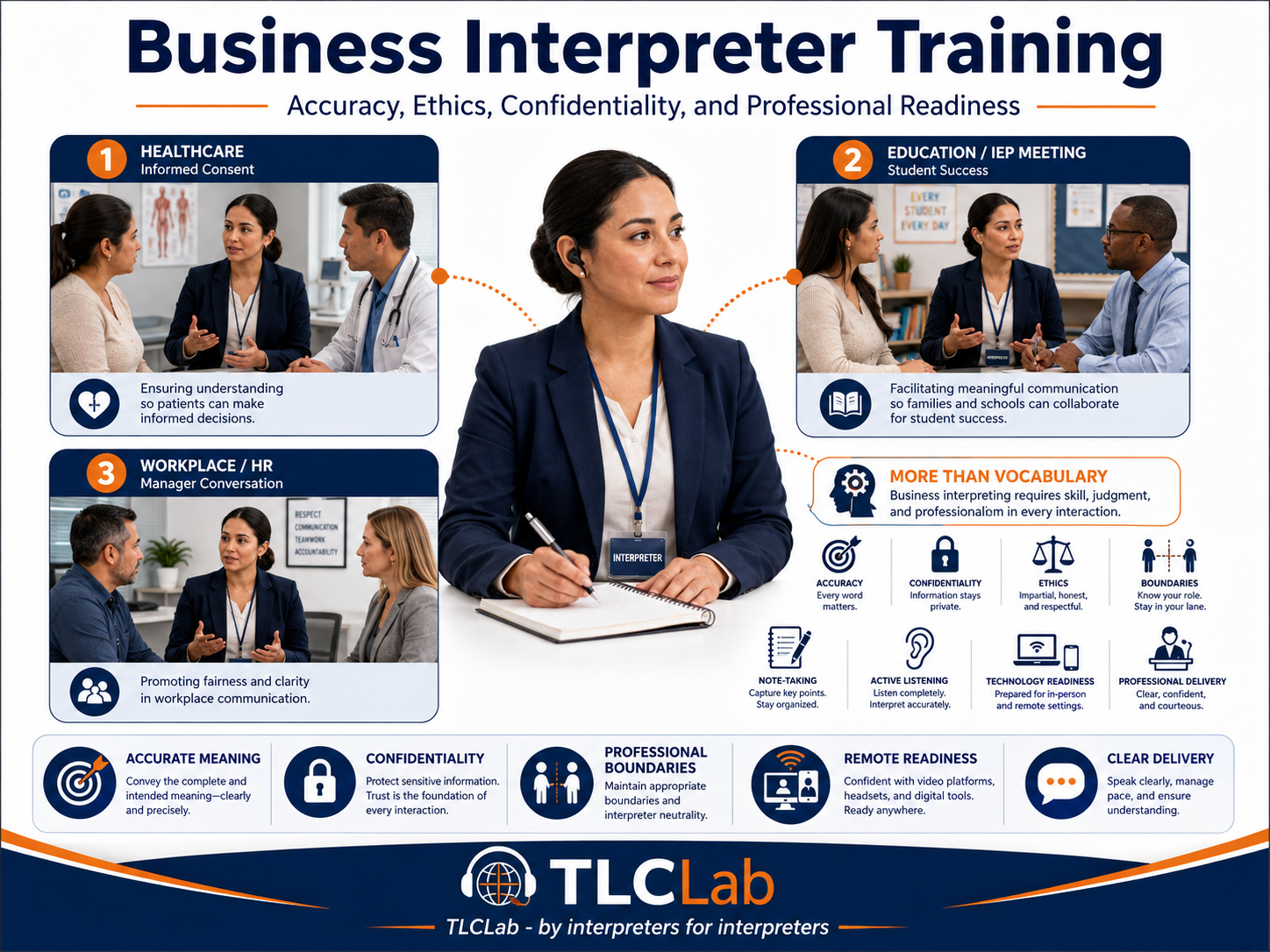
A patient is waiting for informed consent. A parent is trying to understand an IEP meeting. A manager is explaining a disciplinary decision. In each situation, the interpreter is not simply converting words. The interpreter is responsible for conveying meaning accurately while protecting confidentiality, maintaining boundaries, and keeping the conversation moving. That is why business interpreter training must prepare bilingual professionals for more than vocabulary.
Speaking two languages is only the beginning. Paid interpreting work asks you to make fast, defensible decisions while other people are depending on you to be precise. The pressure can be quiet, but it is real. A missed negation, an added explanation, an informal side conversation, or a poorly handled technology issue can change what a client understands and how much trust they place in the process.
What Business Interpreter Training Should Actually Teach
A useful program does not treat interpreting as an advanced language class. It treats it as professional practice. Language proficiency matters, but proficiency alone does not tell you how to manage a speaker who talks for three minutes without pausing, a provider who asks you to summarize, or a client who wants your personal advice.
Strong training develops the habits that allow an interpreter to work responsibly across different settings. Those habits include accuracy, active listening, memory support, note-taking when appropriate, terminology research, ethical decision-making, professional delivery, and clear boundaries. They also include knowing when to ask for clarification, when to disclose a limitation, and when a request falls outside the interpreter's role.
This distinction matters because real assignments rarely arrive in neat textbook segments. People interrupt each other. Emotions rise. Technical language appears without warning. A video platform freezes just as someone gives a critical instruction. Training should help you respond calmly without pretending that every situation has a one-size-fits-all answer.
Accuracy Is More Than Word Substitution
Accuracy means delivering the speaker's message as faithfully as possible in the other language. That includes the content, intent, register, tone, and level of certainty. If a speaker says, “We may need to,” the interpretation cannot become “We will.” If a client expresses confusion, the interpreter should not smooth it over to make the exchange sound more comfortable.
Interpreters also need the discipline to preserve first person. “I have pain here” should remain “I have pain here,” not “She says she has pain here.” This may sound basic, but consistent first-person interpreting supports direct communication between the parties. It keeps the interpreter from becoming the center of an interaction that belongs to the client and the professional.
Training should include deliberate practice with omissions, additions, false cognates, numbers, dates, medication names, and culturally loaded phrases. It should also teach self-monitoring. Everyone makes mistakes. A professional recognizes an error, corrects it promptly when possible, and continues without becoming defensive or visibly unraveling.
Ethics and Confidentiality Are Working Skills
Ethics are often presented as a list to memorize. In practice, ethics are decisions made in real time. Confidentiality, impartiality, accuracy, role boundaries, and respect for all participants must guide the interpreter when the circumstances are uncomfortable, rushed, or unclear.
Consider a client who asks, “What do you think I should do?” A well-meaning bilingual person may feel pressure to answer. A trained interpreter understands that giving advice can interfere with the professional relationship and place the client at greater risk. The appropriate response depends on the setting and the applicable policy, but the interpreter's role must remain clear.
The same applies when someone asks you to explain a procedure, complete paperwork, persuade a client, or carry a message outside the interpreted encounter. Some settings have specific protocols for these requests. Training should prepare you to identify the request, state your role professionally, and seek direction when needed rather than improvising beyond your authority.
Confidentiality is equally practical. It affects where you take remote calls, what you discuss after an assignment, how you secure notes, and how you respond when someone recognizes a client in public. Trust is not a marketing phrase in this profession. It is part of the working conditions.
Business Interpreter Training Must Reflect the Assignment
“Business” can describe many types of work: employee meetings, human resources conversations, insurance calls, vendor negotiations, financial discussions, training sessions, and customer service interactions. The language and stakes vary, but the professional standard does not. The interpreter must accurately represent each party without inserting personal opinion or changing the power dynamic in the room.
A business assignment can demand a different register than a medical appointment or a court hearing. It may involve organizational terminology, performance expectations, contracts, benefits, workplace policy, or sensitive employment decisions. Preparation begins before the appointment. When information is available, review names, agenda items, acronyms, product terms, and organization-specific language. Build a glossary, but do not assume a glossary will solve every problem.
The trade-off is that preparation must never become assumption. If a term is unclear during the meeting, ask for clarification in a concise, transparent way. Guessing can sound confident, but confidence without accuracy is not professionalism.
Delivery Is Part of Professional Credibility
Clients and employers notice how an interpreter carries the assignment. Your voice, pacing, posture, introductions, turn management, and remote-work setup affect whether people can participate effectively.
Professional delivery does not mean becoming invisible in a literal sense. You may need to intervene briefly to request repetition, ask a speaker to pause, address poor audio, or clarify who is speaking on a conference call. The goal is not silence at all costs. The goal is to make the communication process work while intervening as little as necessary.
For remote interpreting, technology fluency is no longer optional. You need a dependable headset, a private workspace, stable connectivity, familiarity with common call and video controls, and a plan for an interruption. You also need the judgment to say when audio quality prevents accurate interpreting. Continuing through inaudible speech is not a sign of toughness. It is a threat to accuracy.
How to Choose Training That Supports Career Readiness
Look closely at what a course asks you to do. A completion certificate may show that you watched lessons, but it does not automatically demonstrate that you can perform under pressure. The more useful question is whether the training gives you opportunities to practice decisions you will face on assignments.
Career-focused instruction should address realistic scenarios, not just definitions. It should explain why a response is appropriate, where the boundaries are, and what can change depending on the setting. Healthcare, legal, education, government, business, onsite, telephone, and video assignments share core standards, yet each brings different expectations and risks.
Instructor experience also matters. People who actively interpret understand the gap between knowing a code of ethics and applying it while a conversation moves quickly. At TLCLab, training is shaped by working practitioners with more than 26 years of combined industry experience and over 23,000 hours in the field. That perspective helps connect instruction to the conditions interpreters actually face.
Before investing in a program, consider whether it addresses the areas employers and evaluators often notice: accurate rendition, role boundaries, terminology management, confidentiality, professional communication, remote readiness, and sound judgment. If your goal includes certification preparation, make sure you understand the difference between training for the profession and qualifying for a specific credential. Requirements vary by state, language pair, setting, and certifying body.
Practice Until Your Decisions Become Steadier
Confidence in interpreting is not built by waiting until you feel completely ready. It is built through repeated, honest practice. Record yourself interpreting short passages. Listen for omissions, additions, awkward phrasing, shifts in register, and places where you sounded uncertain. Practice sight translation, consecutive interpreting, and terminology recall, but also practice professional interventions: asking a speaker to pause, correcting an error, and declining a request outside your role.
Feedback is most valuable when it is specific. “You need more confidence” is not enough. Better feedback identifies what happened: you omitted a condition, changed a question into a statement, used third person, spoke over the client, or failed to address an audio problem. Specific feedback gives you something you can improve on the next attempt.
Do not measure your readiness only by how smoothly you speak. Measure it by whether people can rely on your judgment when the conversation matters. Every well-prepared assignment is an opportunity to protect a person's voice, preserve the integrity of the interaction, and become the professional others can trust beside them.