

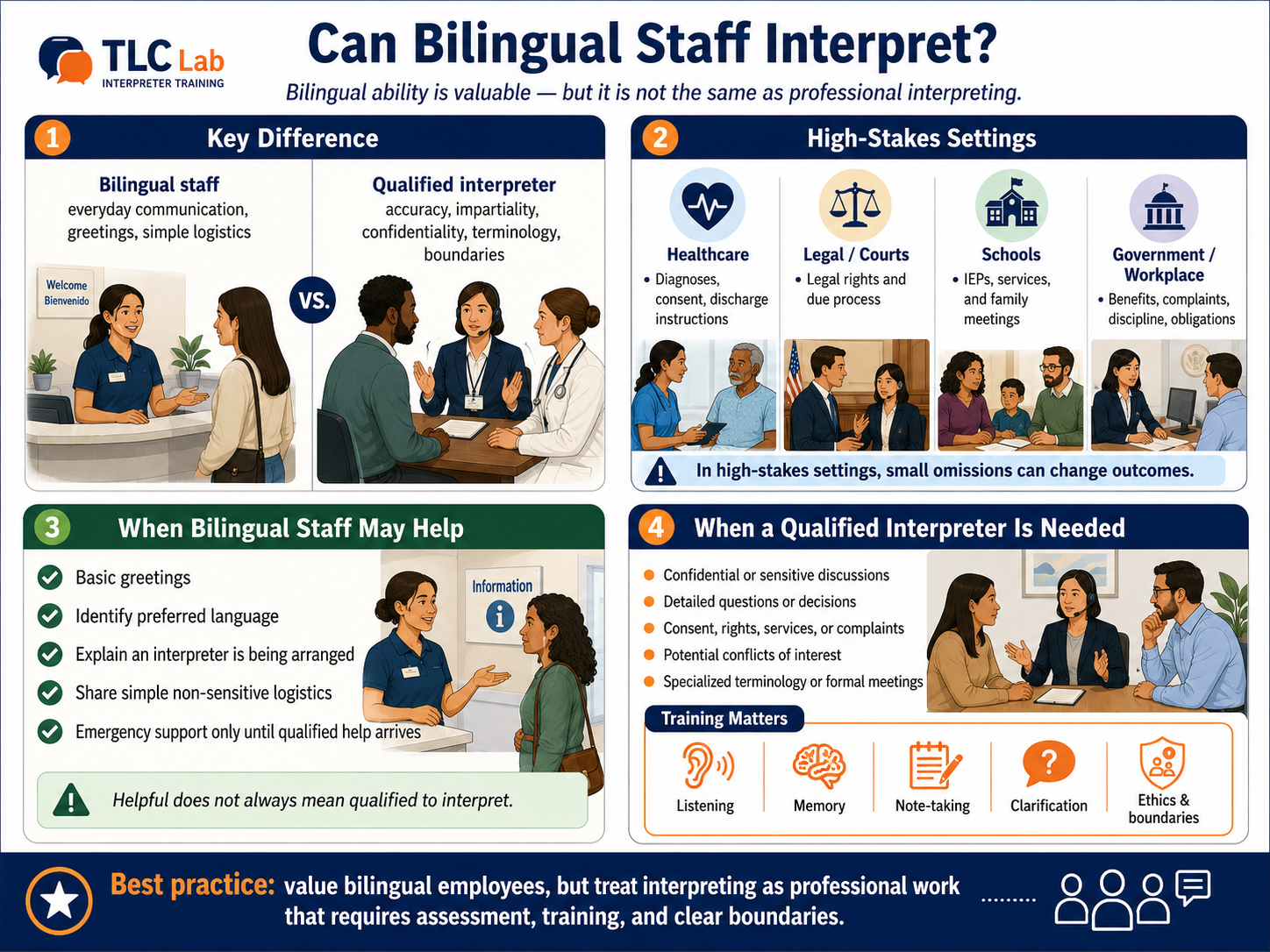
A bilingual employee may be the first person a client turns to when communication breaks down. That response is understandable. The familiar face is nearby, the conversation feels urgent, and the employee wants to help. But can bilingual staff interpret safely and accurately when the message involves a diagnosis, a legal right, a school service, a workplace complaint, or a government benefit?
Sometimes they can support communication in limited ways. That does not automatically mean they are prepared to serve as interpreters. Speaking two languages is only the beginning. Professional interpreting requires a person to receive a message, understand its intended meaning, and render it completely and impartially in another language while managing confidentiality, boundaries, terminology, and the pressure of the moment.
Bilingual Ability and Interpreting Are Different Skills
A bilingual person can move between languages in everyday conversation. They may explain directions to a visitor, greet a customer, or help a colleague find the right word. Those are useful language skills, and organizations should value them.
Interpreting is a separate professional task. The interpreter must listen for meaning rather than isolated words, retain information, identify ambiguity, reproduce the speaker's register, and avoid adding, omitting, softening, or correcting content. They must do this in real time, often while people are upset, confused, ill, afraid, or under scrutiny.
Consider the difference between telling a Spanish-speaking parent that a meeting is scheduled for Thursday and interpreting a special education meeting. In the second situation, terms, rights, recommendations, concerns, and decisions may affect a child's services. A well-meaning employee who summarizes instead of interpreting every participant's message can change the outcome without realizing it.
The same issue appears in healthcare. Knowing that a patient says they feel dizzy is not the same as accurately interpreting onset, severity, medication names, prior conditions, warnings, consent discussions, and discharge instructions. A bilingual staff member may understand both languages well and still lack the interpreting techniques needed to handle the exchange reliably.
Why High-Stakes Settings Raise the Standard
The risk is not simply that someone chooses an imperfect word. In consequential settings, a small omission can alter a decision, undermine informed consent, compromise a person's rights, or damage trust.
Healthcare organizations must consider patient safety, privacy, and meaningful access. Courts and legal offices must protect due process, confidentiality, and the integrity of the record. Schools must communicate clearly with families about educational opportunities and services. Government agencies and employers may be discussing eligibility, complaints, discipline, benefits, or obligations.
In each setting, the bilingual employee may also hold another role. A receptionist, caseworker, teacher's aide, nurse, supervisor, or HR representative has duties that can conflict with the interpreter's duty to remain impartial. If the employee is expected to interpret a complaint about their manager, explain a decision they helped make, or interpret for a relative or close community member, the boundary problem is obvious. Other conflicts are less visible but still real.
A professional interpreter does not decide what information is worth passing along. They do not coach one party, answer questions for the provider, or turn a difficult message into an easier one. Their discipline protects everyone in the conversation.
When Bilingual Staff May Be an Appropriate Resource
There is no responsible one-word answer to whether bilingual staff should interpret. Context matters, as do applicable laws, organizational policies, the employee's demonstrated qualifications, and the nature of the interaction.
For routine, low-risk communication, a bilingual staff member may be able to help without functioning as a formal interpreter. They might provide a basic greeting, identify a client's preferred language, explain that an interpreter is being arranged, or share simple non-sensitive logistical information. Even then, the organization should be clear about the limits of the interaction.
For planned or high-stakes encounters, relying on a qualified interpreter is generally the sounder choice. The interpreter should have verified language proficiency, interpreter-specific training, knowledge appropriate to the setting, and the ability to follow ethical standards under pressure. Some assignments may also require credentialing, certification, or compliance with specific agency, court, healthcare, or state requirements.
Emergencies require judgment. If no qualified interpreter is immediately available and a person's safety is at risk, bilingual staff may need to communicate essential information until appropriate language access can be secured. That is not a reason to treat emergency improvisation as a standard operating model. Once the immediate danger has passed, the organization should bring in qualified language support and address any information that needs to be clarified.
How Organizations Can Decide Who Should Interpret
A job title or self-report is not enough. “I speak both languages” does not tell an employer whether a person can interpret accurately in a sensitive meeting. A responsible decision begins with the assignment itself.
Ask what is at stake. Is the conversation about health, rights, services, money, safety, discipline, immigration, or legal consequences? Is the information confidential? Could the employee's existing role create a conflict of interest? Will participants need to ask detailed questions, give informed consent, or make decisions based on the exchange?
Then assess the language task honestly. Does it require consecutive interpreting, sight translation of a document, remote video delivery, or terminology that is unfamiliar outside the field? Can the staff member preserve tone and complete meaning without taking over the conversation? Has anyone assessed those skills through performance, rather than assuming them from bilingual identity or fluency?
Organizations also need a clear process before the urgent moment arrives. That process should identify how staff request an interpreter, when bilingual employees may provide limited language assistance, who documents language needs, and how concerns are escalated. It should protect employees from being pressured into assignments beyond their preparation.
Training Changes What a Bilingual Employee Can Do
Interpreter training is not a formality. It teaches repeatable methods for listening, memory, note-taking, clarification, turn management, terminology preparation, and accurate delivery. Just as importantly, it teaches the professional judgment behind those methods.
A trained interpreter learns what to do when a speaker talks too fast, uses an unfamiliar term, makes a cultural reference with no direct equivalent, or asks the interpreter for personal advice. They learn how to request repetition without embarrassment, disclose a conflict, maintain confidentiality in remote settings, and avoid the common habit of summarizing.
These skills are developed through practice and feedback. They cannot be assumed because someone grew up speaking another language, communicates easily with family, or has translated documents before. Written translation, bilingual customer service, and interpreting overlap, but they are not interchangeable disciplines.
At TLCLab, that distinction is central to practical interpreter development. Working interpreters need more than vocabulary lists. They need the composure and decision-making to serve as the voice beside clients when the conversation carries real consequences.
A Better Message for Bilingual Employees
Organizations should avoid treating bilingual employees as free, automatic language access. That practice can place an unfair burden on staff and expose clients to avoidable risk. It can also create resentment when employees are asked to perform skilled work without training, role clarity, compensation, or support.
The better approach is respectful and direct: bilingual ability is valuable, and interpreting competence deserves recognition, assessment, training, and appropriate boundaries. Employees who want to pursue interpreting should be encouraged to build the skills deliberately. Those who do not want that responsibility should be able to decline without being made to feel unhelpful.
A client who cannot fully understand a conversation is not receiving equal participation merely because someone nearby shares their language. They deserve communication handled with care. When organizations treat interpreting as professional work, bilingual staff are better protected, clients are better served, and trust has a stronger place to stand.