

A patient says she has been taking her medication "when the pain is bad."
The prescription is for twice daily, every day.
The provider has already moved on to the next question.
You are the only person in the room who noticed.
Most interpreter training answers the question "what should I not do?" This is the harder question: when is doing something the right call, and what exactly are you allowed to do?
At TLCLab, this sits at the advanced end of the ethics curriculum, because getting it right requires judgment that cannot be reduced to a rule.
First, a Correction Worth Making
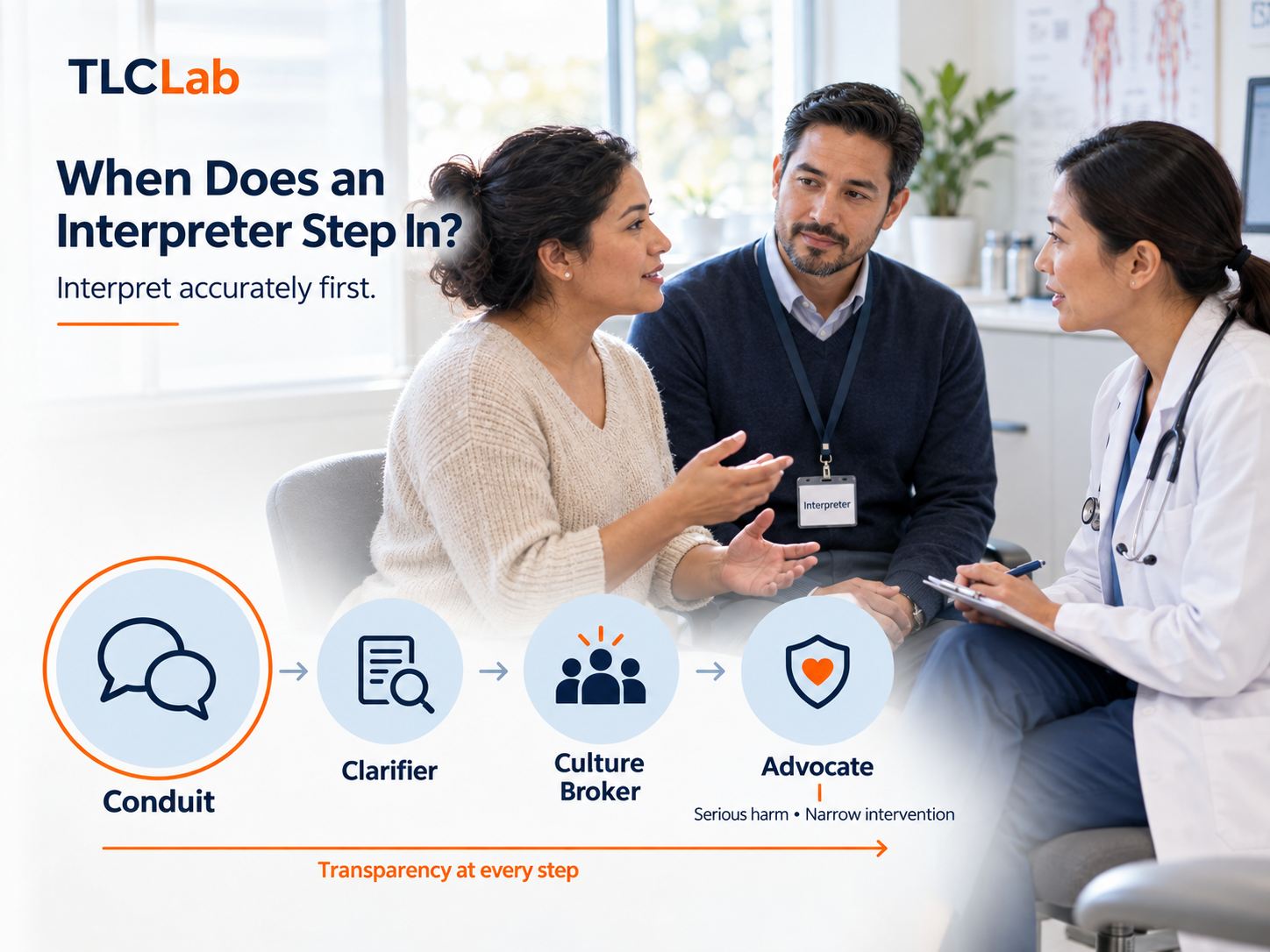
Interpreters are commonly taught four roles arranged from least to most intrusive: conduit, clarifier, culture broker, and advocate. The framework comes out of NCIHC's 2001 working paper The Role of the Health Care Interpreter: An Evolving Dialogue, and it draws on the work of Cynthia Roat, which also underpins the
Bridging the Gap training model.
It is a useful framework. But NCIHC has since revisited the word "role."
In its 2021 paper Interpreter Advocacy in Healthcare Encounters: A Closer Look, NCIHC acknowledges that using "role" for these four was imprecise, and that "task," "act," "duty," or "intervention" would have been more accurate. The imprecision led many people to conclude that an interpreter who advocates has stepped out of the interpreter role into a different one. NCIHC states plainly that this view misrepresents the scope of the healthcare interpreter role as their own Code of Ethics and Standards of Practice describe it.
This matters practically, not just semantically.
If clarifying or advocating means abandoning your role, then every intervention feels like a violation you have to justify. If they are interventions within one role, the question changes from "am I allowed to leave my lane?" to "which action does this situation call for, and can I defend it?"
That is a better question, and a professional one.
The Four Interventions, and What Triggers Each
Conduit is the baseline. You render what was said, completely and accurately, adding nothing and removing nothing. This is where interpreters spend the overwhelming majority of their working time. Niska's role pyramid makes the same point visually: the interpreter is a conduit nearly always, and moves along the range only when something requires it.
Clarifier is triggered by a message that cannot be rendered accurately as it stands, or that the listener plainly cannot process. A term with no equivalent. A question built on an assumption the patient does not share. An explanation pitched several registers above the listener.
The clarifier intervention is not explaining on the speaker's behalf. It is surfacing the problem so the speaker can address it: "Interpreter note: the term used has no direct equivalent. May the provider explain it?"
Culture broker is triggered when a cultural frame is producing a misunderstanding that language alone will not resolve. A patient nodding continuously as a sign of respect, not comprehension. A family structure that shapes who answers questions. A description of symptoms in an idiom the provider will read literally.
The culture broker intervention alerts both parties that a cultural factor may be at work. It does not consist of the interpreter explaining the patient's culture to the provider as fact, or speaking for the patient. Cultures are not monolithic, and the person in the room is an individual, not a representative.
Advocate is different in kind, not just degree. Here the interpreter speaks in their own voice to support a specific outcome. The NCIHC Code of Ethics describes advocacy as action taken on behalf of an individual that goes beyond facilitating communication, with the intention of supporting good health outcomes — and says it may be justified when the patient's health, well-being, or dignity is at risk.
The Standards of Practice put it into two provisions. Standard 31 allows the interpreter to speak out to protect an individual from serious harm; the published example is intervening for a patient whose life-threatening allergy has been overlooked. Standard 32 addresses advocating on behalf of a party or group to correct mistreatment or abuse.
Note how narrow standard 31 is. Serious harm. Not confusion, not inconvenience, not a decision you disagree with.
Transparency Is the Price of Every Move
One requirement runs through all of this, and it is non-negotiable.
Whenever the interpreter does anything other than render the message — asks for clarification, checks understanding, raises a cultural factor — they are obligated to make each party aware of what was said to the other. NCIHC's own working paper stresses that transparency is essential to maintaining trust within the triad.
In practice this means no side agreements, no quiet fixes, and no private exchanges with one party that the other cannot hear.
"Interpreter note:" is not a formality. It is the mechanism that keeps an intervention legitimate. An intervention performed invisibly is not an intervention — it is the interpreter running the conversation.
What Is Not Advocacy
A distinction from NCIHC's 2021 paper is worth holding onto, because it resolves a lot of unnecessary hand-wringing.
Providing relevant institutional information is not an act of advocacy. When an interpreter offers objective information that helps a patient or provider accomplish what they are already trying to do — where the financial counseling office is, that the facility provides interpreters at no cost — the interpreter is simply offering information.
Advocacy, by contrast, involves persuasion toward a course of action. NCIHC's draft revision of the Code of Ethics describes it as going beyond informing those in authority that a problem exists.
Many interpreters agonize over an act of ordinary helpfulness while under-recognizing the moment that actually calls for advocacy. Knowing which is which frees you to do both correctly.
The Test for Advocacy
NCIHC's draft Code of Ethics sets out criteria that are worth studying even though the document is still in draft. It describes advocacy during an encounter as appropriate to protect an individual when there is objective and verifiable evidence of risk of serious, imminent, avoidable physical or emotional harm that remains unaddressed even after it has been brought to the attention of the person who could correct it.
Take that apart, because each element is doing work.
Objective and verifiable. Something you can point to, not a feeling that something is off.
Serious. Real harm, not inconvenience or suboptimal care.
Imminent. Now, not hypothetically down the line.
Avoidable. Speaking up can actually change it.
Unaddressed after being raised. This is the element most often skipped. Advocacy is not the first move. The first move is making sure the person who can fix the problem knows it exists — which is usually a clarifier intervention, not advocacy at all.
Return to the medication example. The correct first step is not to advocate. It is to make sure the mismatch is visible: interpret exactly what the patient said, including "when the pain is bad." If the provider does not register it, a transparent note that the patient's description may not match the prescribed schedule puts the information in front of the person qualified to act on it.
Most situations resolve at that step. The ones that do not are the small set where advocacy is genuinely on the table.
Why Advocacy Carries Real Risk
Three risks deserve naming, because training programs often present advocacy as straightforwardly heroic.
You can override the patient. Acting on someone's behalf without their knowledge can take a decision away from them. The patient may have reasons you do not know for how they want their situation handled. Advocacy done without consulting the patient risks substituting your judgment for theirs.
You may be wrong. You have partial information. You did not read the chart. Something that looks like an error may be a decision made for reasons that were never spoken aloud in the room.
It can cost you. NCIHC raises this directly: an interpreter's language company or facility may prohibit advocacy, and an interpreter who advocates may face professional consequences. This is a real tension the field has not resolved, and it is better to know about it before you are standing in it.
For these reasons, NCIHC treats patient advocacy as an optional intervention for each individual interpreter, given the skill it requires and the potential risk to both patient and interpreter. No one is obligated to advocate. Everyone is obligated to interpret accurately.
A Working Order of Operations
When something feels wrong in an encounter, work down this sequence rather than jumping to the end.
- Interpret it accurately first. A great deal of what looks like a problem is information the other party needs to hear exactly as it was said. Do not solve it before they have heard it.
- Ask whether the barrier is linguistic. If so, clarify — transparently, routing the answer to the speaker.
- Ask whether the barrier is cultural. If so, raise it as a possible factor, to both parties, without speaking for anyone.
- Ask whether anyone with authority to fix this knows it exists. Usually the answer is no, and making it visible resolves the situation.
- Only then, ask whether the harm test is met. Objective, serious, imminent, avoidable, and still unaddressed after being raised.
Most encounters never get past step one. That is not passivity. That is the work.
How TLCLab Teaches This
At TLCLab, students work through scenarios built specifically so the easy answer is wrong — where staying a conduit would cause harm, and where intervening would overstep. Both failure modes are trained against, because interpreters who fear intervening and interpreters who intervene reflexively produce different problems of equal seriousness.
The judgment being built is not "how do I know when to break the rule?"
It is "which action does this moment call for, can I state my reason, and can I do it transparently?"
An interpreter who can answer those three questions is not stepping out of the role. They are performing it fully.