

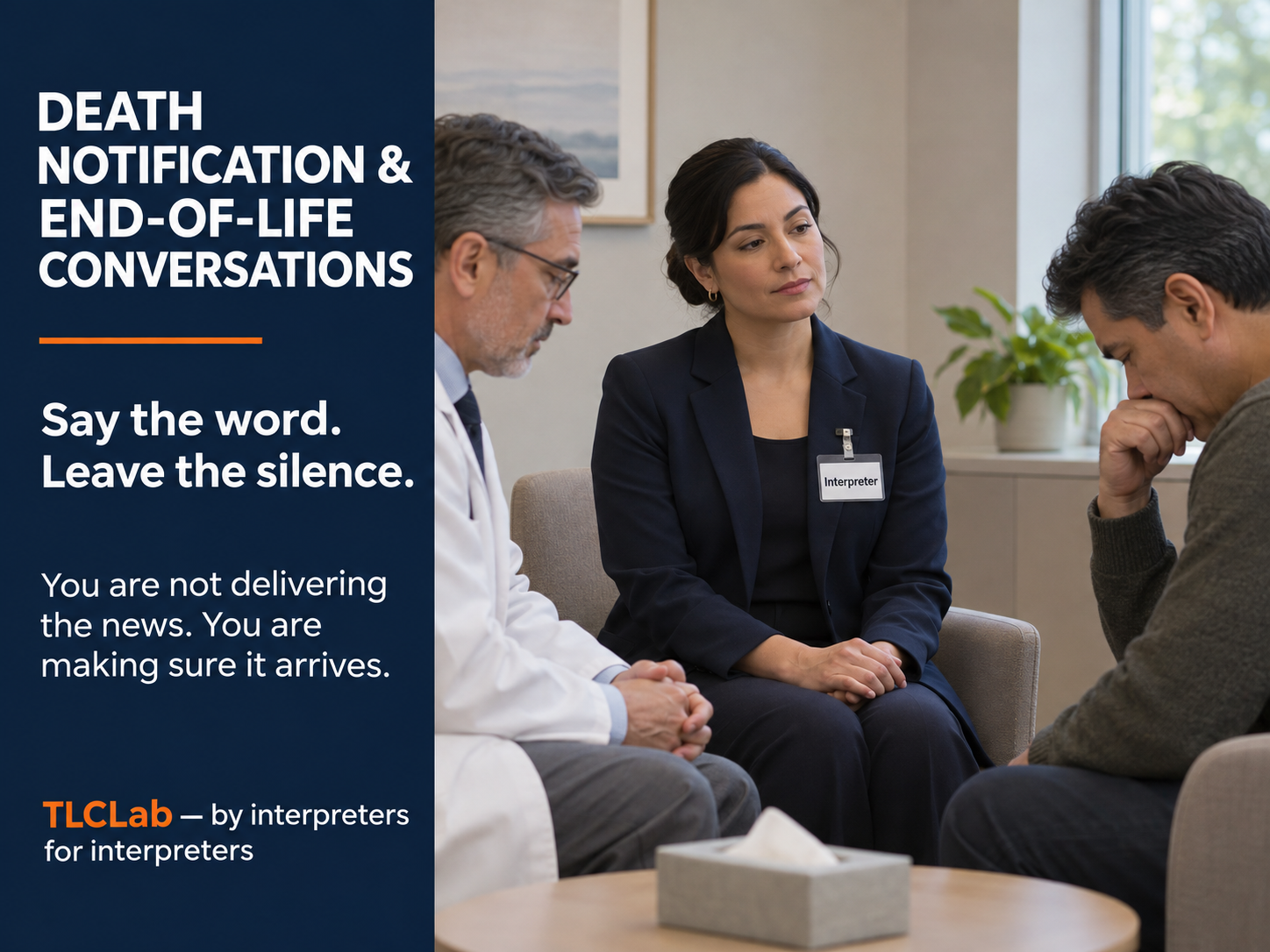
The physician says: "I'm very sorry. Your father died."
Everything now depends on what you say next.
This is the hardest category in medical interpreting, and the thing most interpreters do wrong in it comes from kindness.
The Words Were Chosen on Purpose
Emergency physicians are trained to deliver death notifications using a structured protocol. The most widely taught is GRIEV_ING, developed by Hobgood and colleagues and validated as both a teaching framework and an assessment tool.
Two of its nine steps matter enormously to interpreters.
V is for Verify. The clinician states that the patient has died using clear, direct language — "death," "died," "dead" — and avoids euphemisms. This is not bluntness. It is deliberate. Ambiguity at this moment produces families who leave the hospital not fully understanding that their relative is dead, and the research links well-delivered notification to reduced rates of PTSD and complicated grief among survivors.
The underscore is for Space. After delivering the news, the clinician stops talking and lets the family process it.
Both steps pass through you. A protocol designed around unambiguous words and deliberate silence survives only if the interpreter preserves both.
Worth knowing: GRIEV_ING's "Resources" step names the interpreter explicitly, alongside the chaplain, as support to bring into the room. You are not incidental to this protocol. You are in it.
Do Not Soften It
The instinct is powerful and it is wrong.
A grieving family in front of you, a brutal sentence to deliver, and the thought arrives: I can say this more gently.
If you render "your father died" as something closer to "your father is no longer with us," you have substituted your judgment for a clinician's deliberate choice, and you may have left the family uncertain about what actually happened.
Some will not ask for clarification. Some will leave believing their relative is in critical condition. That is the specific harm the protocol exists to prevent.
Your job is to deliver the sentence that was said, with the same directness, in the same register.
When Your Language Resists the Word
This is the genuine difficulty, and it deserves more than "just say it directly."
Some languages and communities have strong conventions against stating death plainly. The direct equivalent may land as shockingly harsh, or the natural way to say it may be an expression that is less direct than the English.
The resolution is the same as everywhere else in this profession: render the meaning at the level of directness the speaker used, and if the languages genuinely do not map, make it visible rather than deciding alone.
"Interpreter note: the direct equivalent of that phrase is unusually blunt in this language. May the provider confirm how they want it conveyed?"
That puts the choice back with the clinician, who is accountable for it. What you do not do is quietly select a softer phrase and let everyone assume the message landed as sent.
Interpret the Preparation Too
Before the news itself, trained clinicians use what the protocol calls preparatory phrases — "I have very bad news," "I'm afraid what I'm about to tell you is very serious." These are deliberate warning shots that give a family a few seconds to brace.
Interpret them fully and at the same pace. Compressing them to get to the news faster removes the cushion that was built in on purpose.
Honor the Silence
After the news, the clinician stops.
So do you.
The silence will feel unbearable, and interpreters fill it — with a repetition, a softened restatement, a word of comfort. All three are errors. The pause is part of the intervention, and the family is using it.
If someone speaks in the silence — a sound, a few words, a prayer — interpret it when there is a turn to take, not over the top of it.
When Grief Arrives Mid-Sentence
A family member may begin weeping, wailing, or speaking rapidly while the clinician is still talking.
Manage the flow rather than racing it. If you cannot interpret accurately over what is happening, say so plainly and let the clinician pause: "Interpreter note: the interpreter is unable to hear. May we pause?"
And interpret grief as grief. If a daughter is repeating her father's name, that is what is happening in the room, and the clinician needs to know it rather than hearing a summary.
Keep your own delivery steady. Not flat — steady. Rendering a family's anguish in a clinical monotone strips it of meaning; performing your own emotion on top of theirs puts you in the center of a moment that belongs to them.
"Don't Tell Him"
A family asks the clinician — or asks you directly — not to tell the patient the diagnosis or the prognosis.
This is common and it is not obstruction. In many families and communities, protecting a seriously ill person from devastating news is what love looks like. The SPIKES protocol for breaking bad news builds in a related step called Invitation, in which the clinician asks how much the patient wants to know.
Your role when this arrives: interpret the request. Do not implement it.
If the family asks you privately, make it transparent: "Interpreter note: the family is asking the interpreter not to tell the patient the diagnosis."
Then the clinician handles it — which may involve asking the patient directly how much they want to know. That conversation is clinical and ethical and is not yours to resolve by quietly omitting.
When Religion Enters the Room
Prayer, ritual washing, specific people who must be present or notified first, requirements about the body, objections to autopsy or organ donation — any of this may arrive, sometimes urgently.
Interpret it accurately and completely, including the parts that sound like logistics. "We need to call my uncle before anything else happens" may be a religious obligation rather than a preference, and the clinician cannot accommodate what they do not hear.
Two cautions. Do not become the family's spokesperson by explaining their tradition on their behalf — interpret what they say and let them speak for themselves. And do not become the clinician's cultural authority. You may share a background with this family and still have no idea what this family believes. If a cultural factor seems to be operating, name it as a possibility, briefly, to both parties.
What It Does to You
Interpreting a death notification is not a neutral professional act.
The research on physicians delivering this news describes emotional exhaustion, sadness, and insomnia — and physicians have training, a team, and a debrief. Interpreters usually have none of those, and you said the words in the first person.
Take the reset if your schedule allows it. Decline the next assignment if you need to. And if these encounters are accumulating, that is an occupational exposure with a name and a literature, not a personal weakness.
How TLCLab Covers It
At TLCLab, end-of-life work is taught with the protocols attached, because knowing that the clinician chose that word deliberately is what makes it possible to say it.
You are not delivering the news. You are making sure it arrives.
Say the word. Leave the silence. Then take care of yourself.