

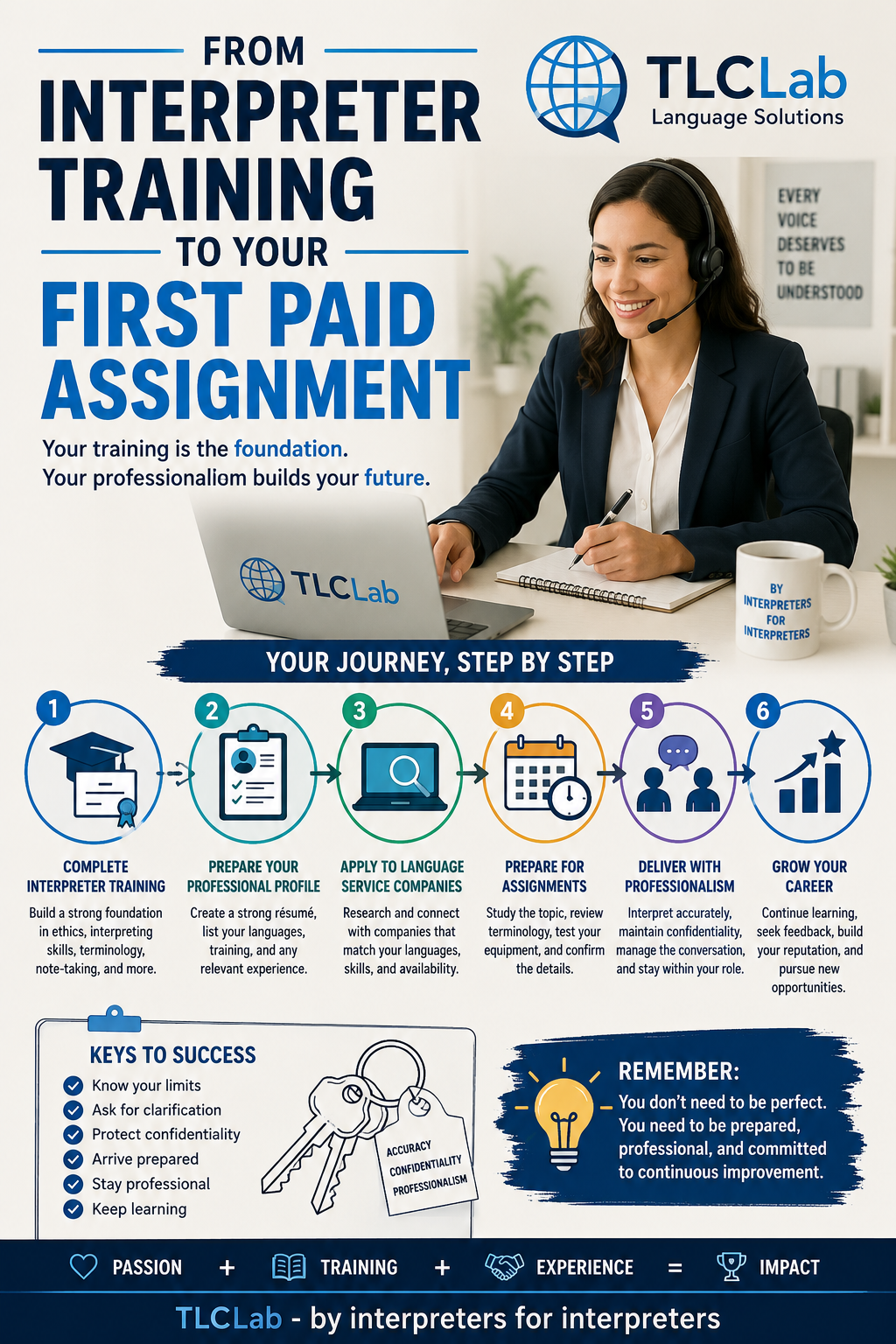
Completing interpreter training is an important milestone, but for many new interpreters it also creates a new question:
What happens next?
You may understand interpreting ethics, professional boundaries, consecutive interpreting, simultaneous interpreting, sight translation, note-taking, confidentiality, and terminology. You may have practiced in training and completed your coursework successfully.
Now you want to turn that preparation into actual professional experience.
Moving from interpreter training to your first paid interpreting assignment can feel exciting and intimidating at the same time. The good news is that you do not need to know everything before you begin. You do, however, need to approach the profession carefully, honestly, and professionally.
At TLCLab, interpreter training is designed to help students build the foundation needed to begin taking those next steps. Training is the beginning of the professional journey, not the end of it.
Start by Understanding What You Are Qualified to Do
One of the first responsibilities of a new interpreter is understanding your own level of preparation.
Completing professional interpreter training does not automatically mean you should accept every assignment that becomes available.
Different assignments may require different levels of experience, terminology knowledge, certification, or specialized preparation.
For example, a routine community appointment may be very different from:
* A complex surgical consultation
* A criminal court proceeding
* A psychiatric evaluation
* A high-level business negotiation
* An immigration hearing
* A specialized educational meeting
Before accepting an assignment, ask yourself whether you have the language ability, training, subject knowledge, and interpreting skills necessary to perform it accurately.
Professionalism sometimes means saying yes.
It also sometimes means saying, "This assignment is outside my current qualifications."
Build a Professional Interpreter Résumé
Your interpreter résumé should clearly communicate what you bring to the profession.
If you are new, you may not have years of paid interpreting experience yet. That does not mean you have nothing to include.
Your résumé can highlight:
* Languages spoken
* Interpreter training completed
* Relevant certificates of completion
* Specialized terminology training
* Consecutive interpreting skills
* Simultaneous interpreting exposure
* Sight translation training
* OPI or VRI preparation
* Industry experience
* Customer service experience
* Healthcare, education, legal, or social service experience
* Technology skills
If you have experience working in bilingual environments, that may also be relevant, but be careful not to describe ordinary bilingual work as professional interpreting experience unless that is what you actually performed.
Accurate representation of your qualifications builds credibility.
Create a Professional Online Presence
Many language service companies and clients will search for interpreters online.
A simple professional LinkedIn profile can help establish your presence.
Your profile should make it easy to understand:
* What languages you work in
* What interpreter training you completed
* What types of interpreting interest you
* Your geographic area
* Whether you are available for onsite, OPI, or VRI assignments
* Any relevant professional credentials
Keep your profile professional and focused.
Avoid exaggerating your experience or using the title certified interpreter unless you have earned a certification that permits you to use that designation.
You can accurately describe yourself as a trained interpreter if you have completed professional interpreter training.
Begin Applying to Language Service Companies
Language service companies are one of the most common entry points for new interpreters.
These companies connect interpreters with hospitals, schools, government organizations, businesses, social service agencies, and other clients.
You may find opportunities for:
* Onsite interpreting
* Over-the-phone interpreting
* Video remote interpreting
* Scheduled remote appointments
* Community interpreting
When applying, expect companies to ask about your training, language proficiency, availability, experience, and sometimes your equipment or internet connection.
Some companies may conduct their own language assessments or interpreter evaluations before offering assignments.
Do not become discouraged if every company does not immediately offer work.
Building an interpreting career often involves applying to multiple organizations and gradually building relationships.
Understand Employee vs. Independent Contractor Work
Many interpreters begin working as independent contractors.
That means you may not be an employee of the language company even though the company sends you assignments.
Independent contractors may be responsible for things such as:
* Tracking assignments
* Submitting invoices
* Managing availability
* Maintaining records
* Paying their own taxes
* Maintaining appropriate insurance when required
* Managing travel expenses
* Providing their own technology for remote work
Before accepting work, understand the company's payment structure.
Ask or review:
* Hourly or per-minute rates
* Minimum assignment charges
* Travel reimbursement
* Cancellation policies
* Payment schedules
* Invoice procedures
* No-show policies
Professional interpreting is both a language profession and, for many interpreters, a small business activity.
Prepare Before Your First Assignment
Your first paid assignment should not begin when you walk through the door or answer the video call.
Preparation starts beforehand.
Learn what you appropriately can about the type of assignment.
If you are interpreting for a medical appointment, review relevant medical terminology.
If it involves education, review school terminology.
If it is remote, test your:
* Internet connection
* Headset
* Microphone
* Camera
* Lighting
* Background
* Platform access
For onsite assignments, confirm:
* Location
* Start time
* Parking
* Travel time
* Contact instructions
Arriving late to your first assignment because you did not account for traffic or parking can create unnecessary stress.
Preparation helps you begin the encounter focused on interpreting rather than logistics.
Introduce Your Role Professionally
The beginning of an assignment establishes expectations.
Depending on the setting and organization, you may provide a brief interpreter introduction.
This may include explaining that you will interpret everything that is said, maintain confidentiality, and request clarification when necessary.
Keep the introduction short.
You are not there to deliver a speech.
The purpose is to make sure participants understand your role and how the communication process will work.
Professional boundaries should be established from the beginning.
Do Not Be Afraid to Ask for Clarification
New interpreters sometimes believe they have to appear completely confident during their first paid assignment.
That can create dangerous pressure.
If you do not understand something, ask for clarification.
If the speaker talks too quickly, request a slower pace.
If someone speaks for too long during consecutive interpreting, ask for shorter segments.
If you miss a number, ask for repetition.
Do not guess simply because someone is paying you.
Professional interpreting does not require pretending to understand information you did not understand.
It requires protecting accuracy.
Your First Assignment May Not Feel Perfect
You may leave your first assignment remembering every sentence you wish you had handled differently.
That is normal professional development.
Instead of asking only:
"Was I good?"
ask more useful questions:
Did I remain accurate?
Did I omit information?
Did I add anything?
Did I maintain professional boundaries?
Did I use first-person interpreting appropriately?
Did I manage turn-taking effectively?
Did I request clarification when necessary?
What terminology should I study before my next assignment?
This type of reflection turns experience into improvement.
Protect Confidentiality After the Assignment
Your professional responsibility does not end when the appointment is over.
Do not discuss confidential details with friends, family members, or other people who do not have an appropriate professional reason to know them.
Do not post assignment details on social media.
Even if you remove names, other details may identify the person or organization involved.
Confidentiality is one of the foundations of professional interpreting.
What you hear during an assignment should remain protected according to the ethical standards and policies governing your work.
Continue Training After You Start Working
Receiving your first paycheck does not mean your education is complete.
The strongest interpreters continue practicing and studying throughout their careers.
You may decide to strengthen your:
* Medical terminology
* Legal terminology
* Note-taking
* Simultaneous interpreting
* Sight translation
* Memory
* Remote interpreting skills
* Professional vocabulary
You may also eventually decide to pursue an appropriate professional certification.
Experience helps you identify the areas where you are strongest and the areas where additional preparation is needed.
Let Your Reputation Grow Assignment by Assignment
Interpreting is a profession where reliability matters.
Language companies and clients remember interpreters who:
* Arrive on time
* Respond professionally
* Follow instructions
* Maintain confidentiality
* Dress appropriately
* Interpret accurately
* Communicate clearly
* Avoid unnecessary cancellations
* Submit required paperwork properly
* Remain within professional boundaries
You do not need hundreds of assignments to begin building a strong reputation.
Your reputation starts with the first one.
Treat every assignment as an opportunity to demonstrate reliability and professionalism.
How TLCLab Helps You Take the Next Step
At TLCLab, the goal is not simply to teach vocabulary or provide information about interpreting.
We help students build the professional foundation needed to begin understanding how real interpreting assignments work.
TLCLab training introduces students to areas such as ethics, confidentiality, professional boundaries, consecutive interpreting, simultaneous interpreting, sight translation, terminology, note-taking, remote interpreting, cultural awareness, and practical situations interpreters may encounter on the job.
Completing training is an important first step.
From there, you can continue practicing, building your résumé, applying to language service companies, developing experience, expanding your terminology, and eventually exploring professional certification opportunities that fit your career goals.
Your first paid assignment may feel like a major leap, but every experienced interpreter once had a first assignment too.
Prepare carefully. Know your limits. Protect accuracy. Stay within your role. Learn from every experience.
Training gives you the foundation.
Your first assignment gives you experience.
Every assignment after that gives you another opportunity to grow.