

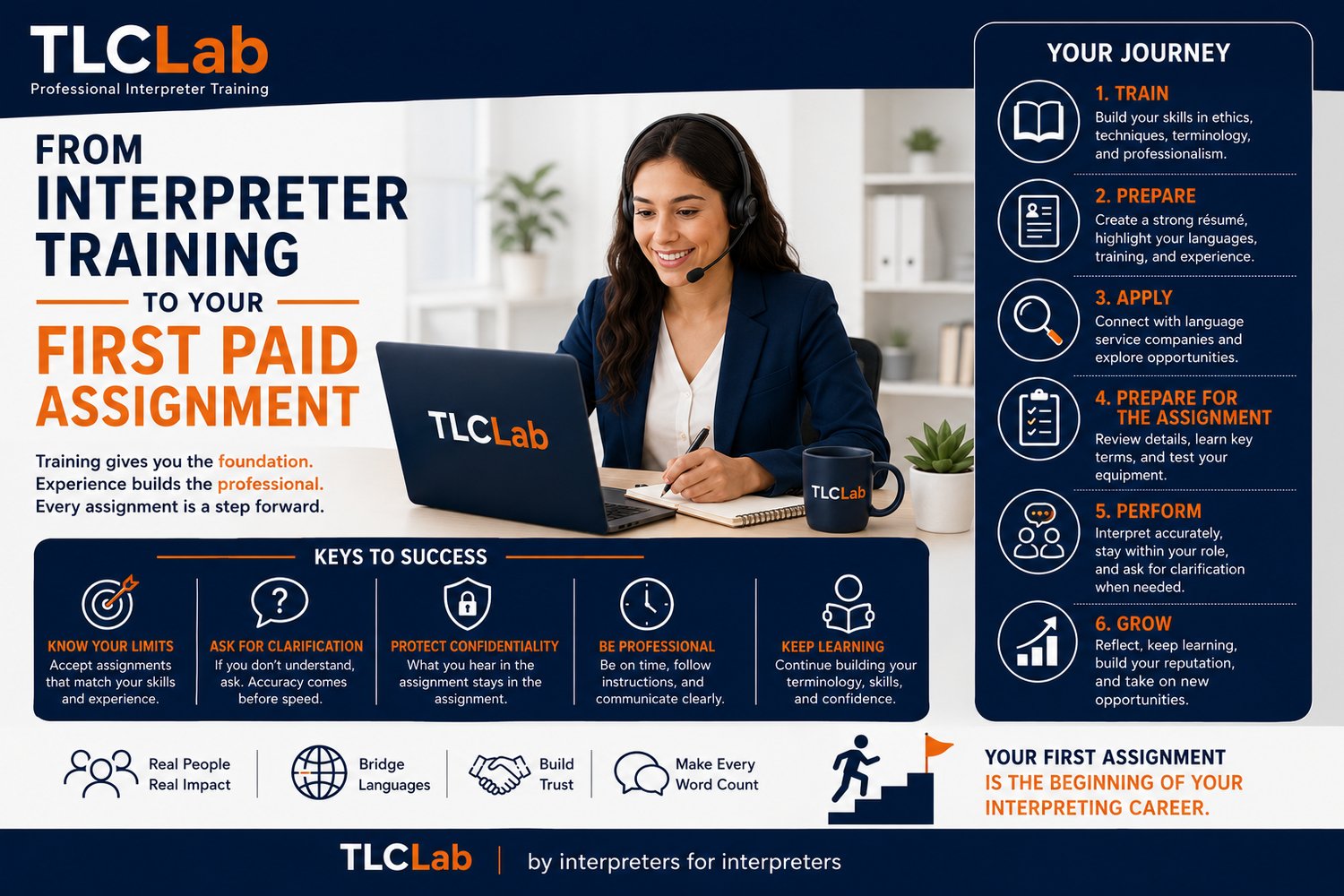
Completing interpreter training is an exciting milestone. You have studied ethics, confidentiality, professional boundaries, interpreting techniques, terminology, note-taking, and the responsibilities that come with helping people communicate across languages.
Then comes the next question:
How do I turn my training into my first paid interpreting assignment?
For many new interpreters, this transition can feel intimidating. Training provides the foundation, but working with real clients introduces new responsibilities. You are no longer practicing with classmates or recordings. A patient, parent, attorney, customer, or professional is now depending on you to communicate accurately.
At TLCLab, we believe interpreter training should prepare students not only to understand the profession but also to begin taking practical steps toward entering it.
Your first paid assignment does not require you to know everything. It requires preparation, professionalism, honesty about your abilities, and a willingness to keep learning.
Start With the Right Foundation
Before accepting professional assignments, make sure you understand what an interpreter is expected to do.
Professional interpreting requires much more than bilingual ability. An interpreter must be able to:
* Listen carefully
* Preserve the complete meaning
* Maintain confidentiality
* Remain impartial
* Follow professional boundaries
* Request clarification when necessary
* Manage turn-taking
* Interpret without adding or omitting information
* Recognize when an assignment exceeds their qualifications
Interpreter training helps transform bilingual ability into professional interpreting skills.
That distinction matters.
At TLCLab, training introduces students to the standards, techniques, and real-world situations they may encounter once they begin working.
Know What You Are Ready to Accept
One of the most professional things a new interpreter can do is recognize their current level of experience.
Not every assignment is appropriate for a beginner.
A routine community appointment may require very different skills from a complex criminal proceeding, psychiatric evaluation, surgical consultation, or highly technical business meeting.
Before accepting an assignment, ask yourself:
Do I understand the setting?
Am I comfortable with the terminology?
Can I interpret accurately in the mode required?
Does this assignment require a certification or qualification I do not have?
Being eager to work is understandable, but professional growth does not mean accepting every opportunity immediately.
Sometimes the correct answer is:
“I am not yet qualified for this particular assignment.”
Knowing your limits protects you, the language company, and most importantly, the people depending on the interpretation.
Prepare a Professional Interpreter Résumé
Your résumé is often the first thing a language service company will see.
Even if you have not completed a paid assignment yet, you can still present your qualifications professionally.
Include information such as:
* Your working languages
* Interpreter training completed
* Relevant certificates of completion
* Specialized terminology training
* Consecutive interpreting preparation
* Simultaneous interpreting preparation
* Sight translation skills
* OPI and VRI experience or training
* Relevant professional background
* Technology skills
* Customer service experience
If you previously worked in healthcare, education, legal services, social services, customer service, or another relevant industry, that experience may help demonstrate familiarity with professional environments.
Always describe your experience accurately.
If you completed interpreter training, you can identify yourself as a trained interpreter.
Do not describe yourself as a certified interpreter unless you have actually earned the certification required to use that title.
Start Applying to Language Service Companies
Language service companies are a common way for new interpreters to begin finding assignments.
These organizations may provide interpreting services for:
* Hospitals
* Clinics
* Schools
* Courts
* Government agencies
* Social service organizations
* Businesses
* Insurance companies
Opportunities may include onsite interpreting, over-the-phone interpreting, and video remote interpreting.
When applying, companies may request information about your languages, training, availability, experience, location, and equipment.
Some may also require a language proficiency assessment or interpreting evaluation.
Do not become discouraged if one company does not immediately offer assignments.
Many professional interpreters work with several agencies and gradually develop their schedules and reputations.
Understand How You Will Be Paid
Many interpreters work as independent contractors rather than traditional employees.
Before accepting assignments, understand the company's payment policies.
Find out:
* Your hourly or per-minute rate
* Whether there is a minimum assignment time
* Whether travel is reimbursed
* How cancellations are handled
* How no-shows are handled
* When invoices must be submitted
* When payments are issued
You may also be responsible for tracking assignments, maintaining records, handling taxes, and managing your own schedule.
Professional interpreting is a communication profession, but independent interpreters must also develop basic business habits.
Prepare for the Assignment Before It Begins
Preparation creates confidence.
If you know the general type of appointment, review terminology that may be relevant.
For a medical assignment, review healthcare vocabulary.
For a school appointment, review educational terminology.
For remote interpreting, test:
* Your computer
* Internet connection
* Camera
* Microphone
* Headset
* Lighting
* Interpreting platform
For an onsite assignment, confirm:
* The address
* Appointment time
* Travel time
* Parking
* Check-in procedures
Arriving rushed, unprepared, or experiencing preventable technical problems can affect your concentration before the interpreting even begins.
At TLCLab, preparation is treated as part of professional performance.
Remember Your Role During the Assignment
Once the assignment begins, focus on communication.
Your job is not to become the doctor, teacher, attorney, caseworker, or advisor.
Your responsibility is to facilitate accurate communication between the participants.
If someone asks:
“What do you think I should do?”
do not provide personal advice.
Interpret the question to the appropriate professional.
If you do not understand something, ask for clarification.
If someone talks too fast, request a slower pace.
If the segment becomes too long, request a pause.
If several people speak simultaneously, professionally manage the turn-taking.
A new interpreter may worry that intervening makes them appear inexperienced.
In reality, appropriate intervention demonstrates professional judgment.
Do Not Guess
Your first paid assignment may create pressure to appear confident.
Never allow that pressure to make you guess.
If you miss a number, request repetition.
If you do not recognize a term, ask for clarification.
If you cannot hear the speaker clearly, address the problem.
A brief clarification request is far more professional than an incorrect interpretation delivered confidently.
The purpose of professional interpreting is not to move the conversation as quickly as possible.
The purpose is to preserve the message.
Review Your Performance Afterwards
Your first assignment probably will not feel perfect.
That is normal.
Instead of focusing only on whether you were nervous, evaluate your actual performance.
Ask yourself:
Did I interpret everything completely?
Did I add or omit anything?
Did I remain within my role?
Did I handle terminology effectively?
Did I request clarification when necessary?
Was my note-taking helpful?
What should I study before the next assignment?
This reflection is how professional experience turns into professional development.
Your first assignment teaches you something.
Your tenth assignment teaches you more.
Over time, the situations that once felt intimidating become increasingly familiar.
Build Your Reputation One Assignment at a Time
Language companies value interpreters they can depend on.
Professional reputation is built through small actions:
* Arriving on time
* Responding promptly
* Dressing appropriately
* Maintaining confidentiality
* Following instructions
* Interpreting accurately
* Respecting professional boundaries
* Avoiding unnecessary cancellations
* Completing required paperwork
* Continuing to improve
Your first assignment is not simply your first paycheck.
It is the beginning of your professional reputation.
Treat it accordingly.
Keep Learning After You Begin Working
Professional development should continue after you start accepting assignments.
You may want to strengthen your:
* Medical terminology
* Legal terminology
* Educational terminology
* Consecutive interpreting
* Simultaneous interpreting
* Sight translation
* Note-taking
* Memory
* Remote interpreting skills
As your experience grows, you may also decide to pursue an appropriate professional certification.
Training provides the foundation.
Experience develops judgment.
Continuing education strengthens your skills.
Certification may become another important milestone in your professional career.
How TLCLab Helps You Take the First Step
At TLCLab, our goal is to help bilingual individuals begin developing the skills and professional understanding required to move toward real interpreting opportunities.
TLCLab training covers important areas including ethics, confidentiality, professional boundaries, consecutive interpreting, simultaneous interpreting, sight translation, terminology, note-taking, cultural awareness, remote interpreting, clarification, and practical situations interpreters may encounter on the job.
Completing training does not mean that your professional development is finished.
It means you have taken an important first step.
From there, you can build your résumé, practice your skills, apply to language service companies, gain experience, continue learning, and eventually explore certification opportunities appropriate for your language and career goals.
Every experienced interpreter once accepted a first assignment.
Prepare for it.
Respect your limits.
Protect accuracy.
Stay within your role.
Learn from the experience.
And then prepare for the next one.
Training gives you the foundation. Experience builds the professional.