

“I have a bad memory.”
It is the most common self-diagnosis in interpreter training, and it is usually wrong. The capacity is normal. What is missing is a method.
Start With the Ceiling
George Miller’s 1956 paper put immediate memory at about seven items, plus or minus two — and his real point was that the limit is measured in chunks, not raw items.
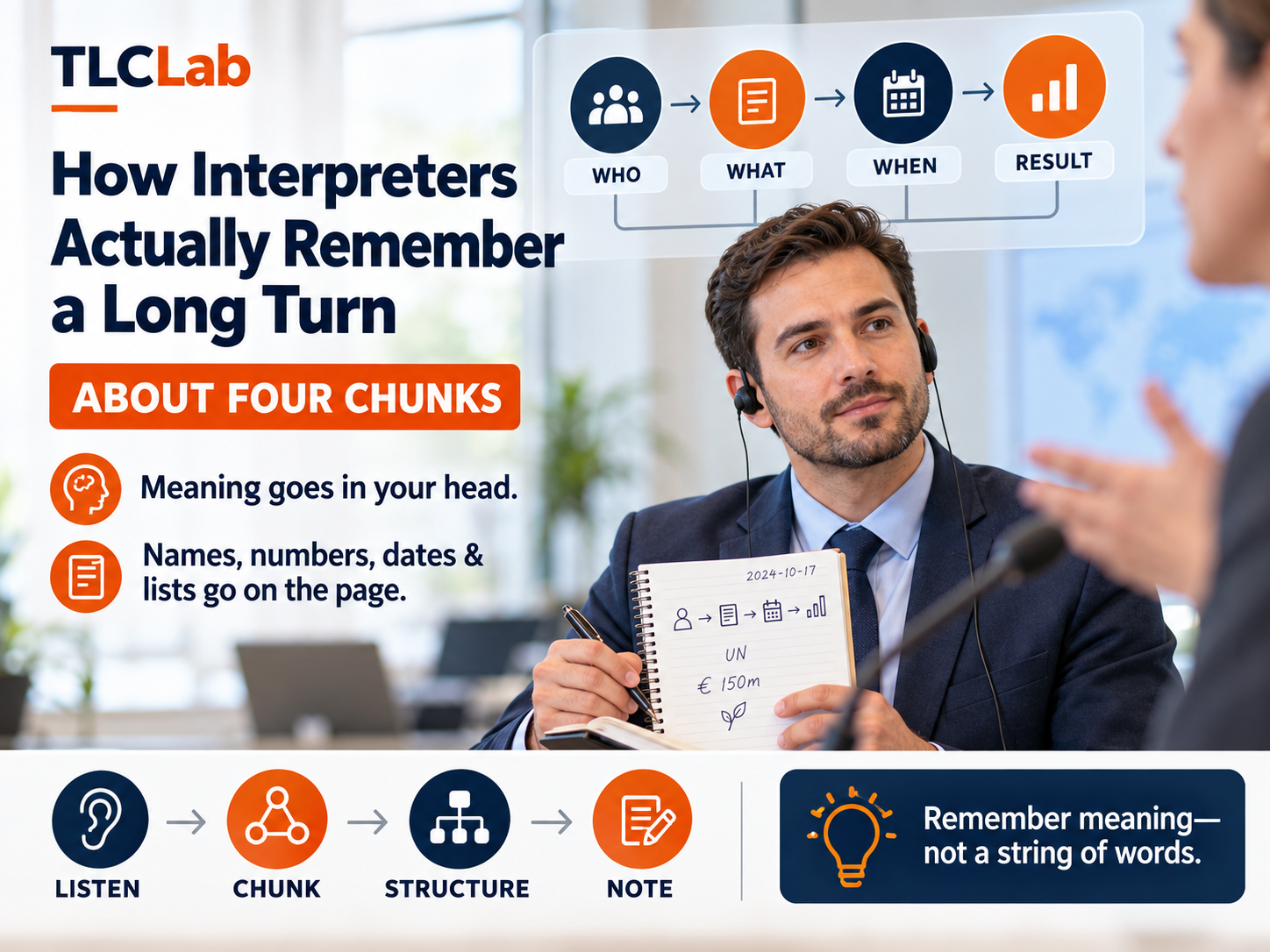
Nelson Cowan’s 2001 review revised it downward. When rehearsal and prior-knowledge grouping are controlled, capacity sits closer to four chunks, typically between three and five.
You will not train your way past that. No interpreter holds a ninety-second utterance as a string of words.
What expertise changes is not the number of slots. It is what fits in one.
A Chunk Is Whatever You Already Know
A chess master looking at a board does not see thirty-two pieces. They see a few familiar configurations, each occupying one slot. Same capacity, far more retained.
Interpreting works the same way. “Blood pressure one-forty over ninety” is several separate items to a newcomer and one familiar pattern to an experienced medical interpreter. A standard discharge sequence or consent explanation collapses into a single chunk once you know its shape.
This is why terminology preparation improves memory — not because you recall more words, but because known material arrives pre-packaged. It is also why an unfamiliar specialty feels like memory failure. It isn’t. Nothing in the input can be grouped, so every element takes a slot of its own.
Retain Meaning, Not Form
The largest shift from untrained to trained performance is giving up on words.
Untrained bilinguals try to hold the sentence. Trained interpreters hold what it asserts — who did what, to whom, when, why, with what result — and rebuild it in the other language.
This is more efficient, because a proposition is one chunk regardless of how many words expressed it. “The patient says the chest pain started three days ago and worsens on stairs” is one event with three details attached, not seventeen words.
It is also more accurate. Word-level retention produces renditions that drift toward the source language’s structure and sound wrong in the target.
While listening, ask what is being asserted — not what is being said.
Listening and Note-Taking Compete
Listening, analyzing, remembering and writing all draw on one limited pool of attention. Because writing is slower than speech, every bit of attention spent producing notes is attention taken from listening.
This is the most common error trainers see. The student writes more, understands less, and ends up with a page of fragments representing a speech they never fully processed.
Notes support analysis. They cannot replace it.
What Resists All of This
Names, numbers, and enumerations fail disproportionately, for two reasons: they carry no internal logic to compress, and they cannot be reconstructed from context if lost.
So the division of labor is settled. Meaning goes in your head. Names, figures, dates and list items go on the page the moment you hear them.
Structure and Visualization
Hold the skeleton. Most content has a shape — a sequence, a comparison, a cause and effect, a problem and solution. Capture the shape and the content hangs on it.
See it. Converting a narrative into a mental scene survives better than a verbal string and makes details relational rather than isolated.
Neither raises your capacity. Both increase what each slot holds.
Manage Length Instead of Straining
Past a certain point no technique saves the segment. Asking a speaker to pause is not weakness:
“Interpreter requests that you pause after each point.”
Interpreters who absorb long segments to avoid interrupting trade accuracy for smoothness. The listener cannot detect that trade. You can.
Drills That Build It
Listen and retell with no notes. Thirty seconds, same language first, then the other. Lengthen to forty-five, sixty, ninety.
Retell by proposition before producing anything polished.
Practice number strings separately, so you learn exactly where your unaided limit sits.
Record and compare. The useful question is not whether you remembered everything, but what type of material you lost — names, figures, qualifiers, or sequence. The pattern tells you which drill you need.
What “Bad Memory” Usually Means
Retaining words instead of meaning. Writing instead of listening. Letting segments run too long. Or working in content so unfamiliar that nothing can be chunked.
All four are trainable. The underlying capacity, mostly, is not.
You have about four slots. Everyone does. The work is making each one carry more.