

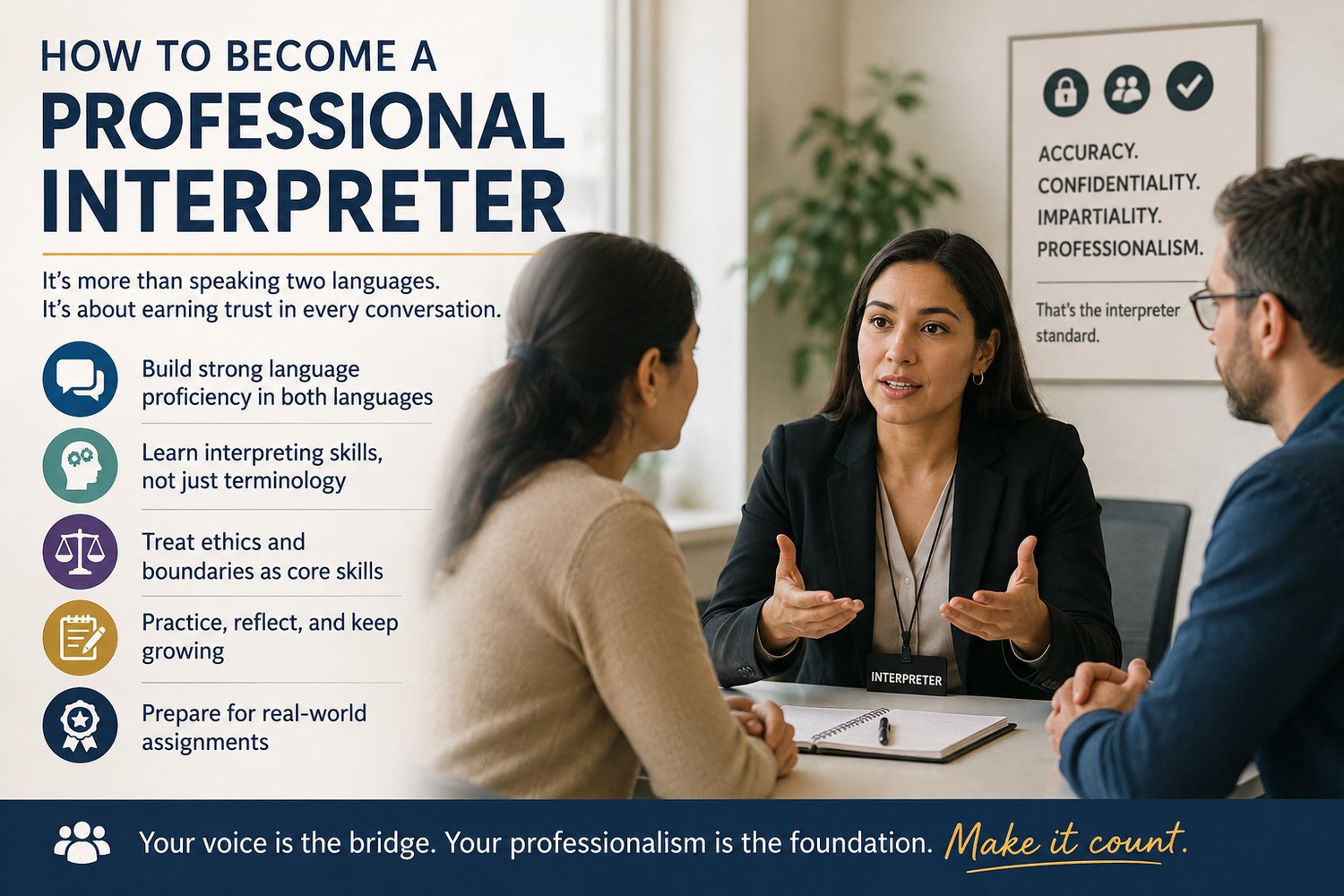
A patient is deciding whether to consent to a procedure. A parent is meeting with a school team about their child. A defendant is hearing information that may affect their freedom. In moments like these, an interpreter is not simply helping people “get the gist.” The interpreter is responsible for carrying meaning accurately, protecting confidentiality, and maintaining professional boundaries while people make consequential decisions.
That is why speaking two languages is only the beginning. If you are asking how to become a professional interpreter, the path is less about proving that you are bilingual and more about building the judgment, skills, and habits that let others trust your work.
How to Become a Professional Interpreter: Start With the Real Job
Professional interpreting is an active, high-attention task. You listen in one language, process the speaker’s intended meaning, and deliver that meaning in another language with appropriate accuracy, tone, and register. You may do this consecutively, after a speaker pauses, or simultaneously, while the speaker continues.
The work also requires you to manage what is happening around the conversation. A provider may use technical terminology. A client may speak quickly, become emotional, or ask you for advice. A lawyer may challenge an interpretation. A video platform may fail in the middle of an appointment. Professional readiness means knowing what to do without becoming the center of the interaction.
This is why bilingual adults sometimes feel surprised in their first assignments. Everyday fluency does not automatically prepare someone to interpret a medical diagnosis, a disciplinary hearing, an intake interview, or a workplace investigation. The gap is trainable, but it must be taken seriously.
Build Language Proficiency in Both Languages
Interpreters need strong command of both working languages, including the language that may feel less dominant. That includes grammar, pronunciation, vocabulary, regional variation, formal and informal registers, and the ability to understand different accents and speaking styles.
More importantly, you need to express complex ideas clearly under pressure. Someone may be fluent in casual conversation and still struggle to interpret a detailed explanation of medication risks or legal rights without omissions, additions, or vague substitutions.
Assess yourself honestly. Can you summarize a news report accurately in each language? Can you explain a process without drifting into the other language? Can you understand an older speaker, a fast speaker, or someone using unfamiliar regional expressions? If the answer is not consistently yes, language development should remain part of your professional plan.
Reading quality material, listening to professional discussions, maintaining a terminology notebook, and practicing oral reformulation can help. Avoid treating vocabulary as a list of isolated word pairs. Terms gain meaning from context. The right equivalent in a courtroom may not be the right equivalent in a clinic, classroom, or business meeting.
Learn Interpreting Skills, Not Just Terminology
A professional interpreter needs a method for handling information in real time. Training should cover consecutive interpreting, simultaneous interpreting, sight translation, note-taking, memory development, active listening, and message analysis.
Consecutive interpreting is common in community settings, but it is not simply waiting for a pause and repeating what you heard. You must retain key details, relationships, numbers, timelines, qualifiers, and emotional tone. A missing “not,” dosage, date, or condition can change the meaning of an entire statement.
Sight translation requires a different skill set. You may be asked to orally render a written document, such as an instruction sheet or a consent form. This calls for quick reading comprehension, careful pacing, and the discipline to recognize when a document should be formally translated rather than interpreted aloud.
Practice with realistic material. Work from short recorded segments, then review yourself for omissions, additions, unclear phrasing, and changes in register. Recordings can be uncomfortable to hear, but they reveal patterns that memory often misses. The goal is not perfection on day one. It is deliberate improvement and a reliable process for self-correction.
Treat Ethics and Boundaries as Core Skills
Accuracy is inseparable from ethics. Professional interpreters do not edit a speaker’s message to make it sound more polished, agreeable, or culturally comfortable. They do not omit sensitive remarks because the conversation feels tense. They interpret what is said as faithfully as possible.
Confidentiality is equally central. You may hear private health information, family conflict, financial details, immigration concerns, or legal strategy. Professional conduct means safeguarding that information during and after the assignment. It also means using appropriate privacy practices when working remotely, including a private workspace, secure equipment, and careful handling of any notes.
Boundaries can be difficult because clients may naturally turn to the interpreter for help. They may ask, “What do you think I should do?” or ask you to explain a professional’s decision in your own words. You can respectfully clarify your role, interpret the question to the appropriate party, and support communication without becoming an advocate, advisor, or decision-maker.
There are exceptions and setting-specific protocols, which is why ethics training matters. A qualified interpreter learns to recognize conflicts of interest, request clarification, disclose limitations, and seek guidance when a situation falls outside normal practice.
Choose a Setting and Understand Its Requirements
There is no single credential that qualifies an interpreter for every assignment in the United States. Requirements depend on the language pair, state, employer, and specialty.
Healthcare interpreters may be expected to complete interpreter training and demonstrate knowledge of medical terminology, ethics, and standards of practice. Court interpreting often has formal state-administered testing, strict procedures, and demanding performance expectations. Educational interpreting may involve district-specific requirements, while government, business, and remote interpreting companies may use language assessments, interviews, skills tests, or prior experience requirements.
Start by researching the work you want to pursue in your area. Read job postings closely. Notice whether employers request training certificates, background checks, immunization records, professional liability coverage, remote platform experience, or specific certification. Do not assume a certificate from one course is the same as national certification or a state court credential. Those are different things, and employers may distinguish between them.
Specializing can make your development more focused. Healthcare, legal, education, government, business, and military-related work each have distinct terminology and professional expectations. Early in your career, it may be wise to build a strong general foundation while gaining exposure to more than one setting. Over time, choose areas where your language skills, interests, and available credentials align.
Train for the Conditions of Paid Assignments
Good training does more than explain concepts. It gives you repeated practice making professional decisions. You should work through scenarios involving difficult speakers, unclear terminology, role boundaries, confidentiality concerns, remote technology, and the pressure of interpreting accurately when the stakes are high.
Look for instruction led by people who actively understand the field, including what employers evaluate and what working interpreters encounter. Completion alone is not the standard. You should leave training able to explain your role, prepare for an assignment, manage a clarification appropriately, and identify where you need more practice.
At TLCLab, the focus is on the practical competencies that separate bilingual ability from job-ready interpreting: accuracy, ethics, delivery, terminology, technology, professional boundaries, and sound judgment. That kind of practice-based preparation matters because real assignments rarely unfold like a scripted classroom exercise.
Prepare for Remote and Onsite Work
Many interpreters now work across onsite, over-the-phone, and video settings. Each format changes the demands of the job.
Onsite work requires punctuality, professional appearance, situational awareness, and the ability to position yourself appropriately without disrupting the interaction. Remote work requires strong audio, stable internet, a quiet and private environment, platform familiarity, and the confidence to address technical problems clearly. Over-the-phone interpreting removes visual cues, so listening precision and turn management become even more important.
Practice your opening protocol for each setting. Know how to introduce your role, confirm whether everyone can hear you, ask speakers to pause when needed, and state when you need repetition or clarification. These brief interventions protect accuracy. They are not signs of weakness.
Gain Experience Without Cutting Corners
Your first assignments should be approached with preparation and humility. Review likely terminology, learn the assignment details that are appropriate to know in advance, arrive early or log in early, and keep a professional record of completed work and feedback.
Accept work that matches your current competence. It can be tempting to say yes to every opportunity, especially when you are building a career. But accepting an assignment beyond your skill level can harm clients and damage your reputation. Professional judgment includes knowing when to decline, refer, or ask for support.
After each assignment, reflect on what challenged you. Was it a vocabulary gap, a note-taking issue, a fast speaker, a technical problem, or uncertainty about your role? Turn that observation into a specific practice goal. Confidence is built this way: not by pretending every situation is easy, but by becoming more prepared for the next one.
The profession needs interpreters who understand the weight of being the voice beside someone during an important moment. Keep developing your skills with that responsibility in mind, and let your reliability become the reason people ask for you again.