

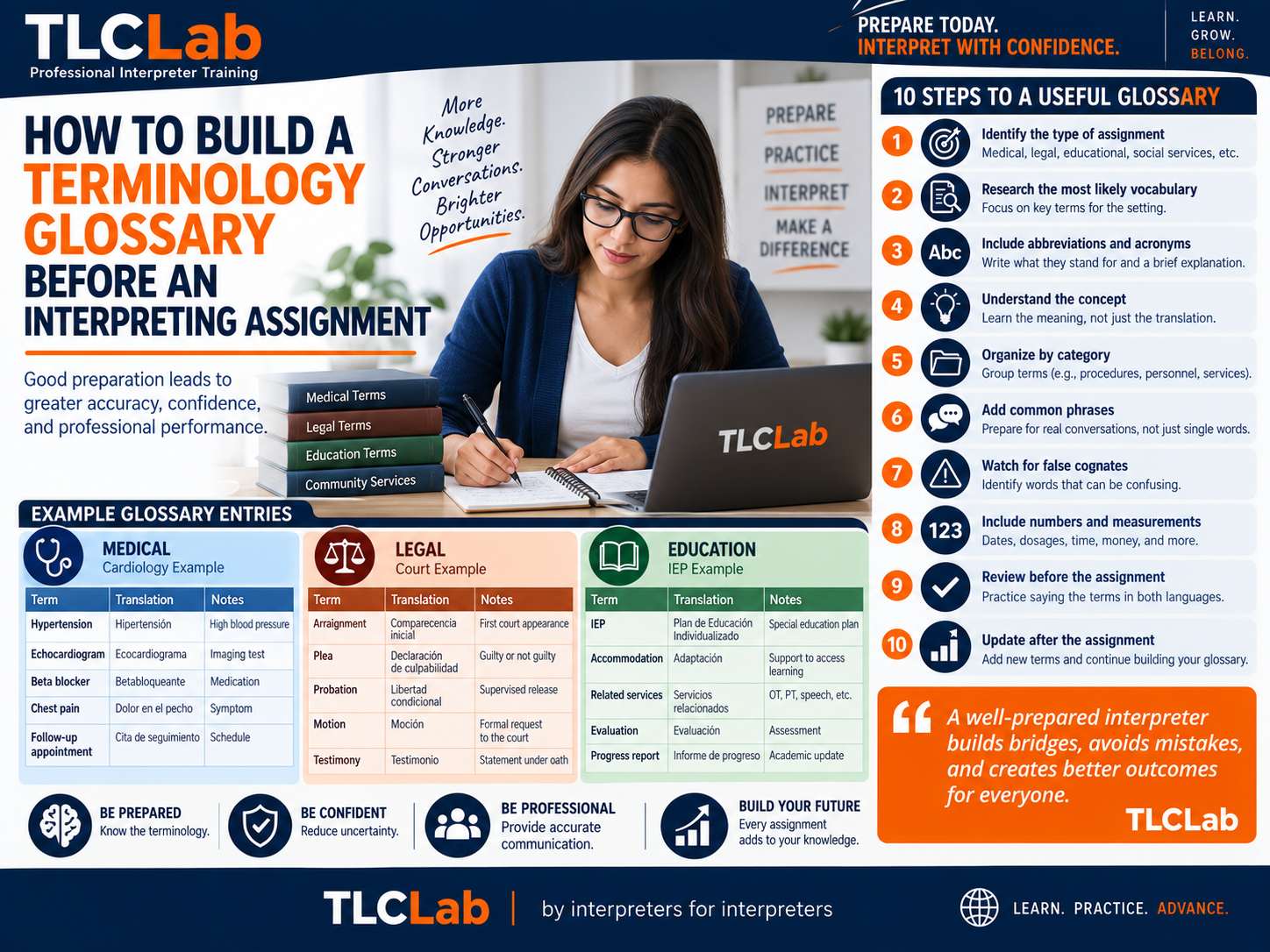
Professional interpreters rarely know every word that might appear during an assignment.
A medical appointment may suddenly involve a specialized procedure. A school meeting may include unfamiliar special education terminology. A legal assignment may introduce a motion, charge, or court process the interpreter has not encountered before.
This is where preparation becomes extremely important.
One of the most useful habits an interpreter can develop is creating a terminology glossary before an assignment.
A terminology glossary is a personal reference list of important words, phrases, abbreviations, acronyms, and concepts that may appear during a specific type of interpreting encounter. It helps the interpreter prepare mentally, recognize terminology more quickly, and reduce the risk of being caught completely off guard.
At TLCLab, interpreter training emphasizes that terminology preparation is part of professional performance. A glossary does not replace language proficiency or interpreting skill, but it can make the interpreter more confident, more efficient, and better prepared to protect accuracy.
Start With the Type of Assignment
Before creating a glossary, identify the general setting.
Ask yourself:
What type of appointment is this?
Is it:
* Medical
* Legal
* Educational
* Social services
* Insurance
* Business
* Government
* Mental health
* Community interpreting
* OPI or VRI
The setting gives you your first clue about what terminology may be relevant.
For example, if you know the assignment is an orthopedic appointment, you can prepare very differently than you would for a parent-teacher conference.
If the appointment involves a court hearing, you may need legal vocabulary, courtroom roles, and procedural terminology.
You do not need confidential case details to prepare effectively. Even knowing the general subject can help you narrow your research.
Identify the Most Likely Vocabulary
Once you know the setting, think about the words that are most likely to appear.
For a medical assignment involving cardiology, your glossary might include terms such as:
* Blood pressure
* Heart rate
* Artery
* Vein
* Chest pain
* Shortness of breath
* Electrocardiogram
* Echocardiogram
* Blood thinner
* Pacemaker
For an educational assignment involving special education, you might prepare terms such as:
* IEP
* Evaluation
* Accommodation
* Modification
* Related services
* Speech therapy
* Occupational therapy
* Learning disability
* Annual review
* Placement
The goal is not to predict every possible sentence.
The goal is to become familiar with the core vocabulary of the setting.
Include Abbreviations and Acronyms
Professional environments use abbreviations constantly.
Healthcare may include terms such as:
* MRI
* CT
* ICU
* ER
* BP
Education may include:
* IEP
* ESL
* ELL
* OT
* PT
Legal environments may include their own abbreviations and procedural shorthand.
Do not simply write down the abbreviation.
Include what it stands for and, when useful, a brief explanation of the concept.
For example:
MRI — Magnetic Resonance Imaging — imaging test using magnetic fields
This helps you recognize the term even if the speaker uses the abbreviation rather than the full phrase.
At TLCLab, students are encouraged to understand terminology in context rather than simply memorize isolated words.
Learn the Concept, Not Just the Translation
A glossary should not become a list of words that you memorize mechanically.
You should understand what the term means.
Suppose you learn the translation for a medical term but do not understand the concept.
When the provider uses related language, explains a procedure differently, or refers to the term indirectly, you may still become confused.
Understanding the concept gives you flexibility.
For example, knowing that an ultrasound is an imaging procedure helps you understand related statements about imaging, pregnancy, organs, or diagnostic testing.
The same applies in legal and educational interpreting.
Terminology becomes much easier to interpret when you understand how the words fit into the larger system.
Organize Your Glossary by Category
A long random list can become difficult to use.
Organizing your glossary makes preparation more efficient.
For a medical assignment, you might create sections such as:
Anatomy
Symptoms
Tests
Procedures
Medications
Instructions
For legal interpreting:
Court Personnel
Charges
Procedures
Evidence
Sentencing
Rights
For school interpreting:
Academic Terms
Special Education
Evaluations
Support Services
Discipline
Parent Communication
This structure helps your brain connect related terminology.
It also makes the glossary easier to review before future assignments.
Include Common Phrases, Not Just Individual Words
Interpreting usually involves complete ideas, not isolated vocabulary.
Your glossary can include phrases that frequently occur in the setting.
For example, a medical glossary might contain:
* Take with food
* Twice daily
* Follow-up appointment
* Family medical history
* Allergic reaction
* Range of motion
A legal glossary might include:
* Enter a plea
* Under oath
* Probable cause
* Right to counsel
* Failure to appear
An educational glossary might include:
* Grade-level performance
* Individualized instruction
* Parent consent
* Academic progress
* Behavioral support
Learning common phrases helps the interpreter process language more naturally.
Pay Special Attention to False Cognates
False cognates can create serious interpreting mistakes.
These are words that look or sound similar across languages but have different meanings.
New interpreters may recognize a familiar-looking word and immediately assume they know the meaning.
That can be dangerous.
As you build your terminology glossary, identify words that commonly create confusion in your language pair.
Mark them clearly.
You may even want to include a section called:
Common Traps
This can be particularly useful in medical and legal interpreting, where a single inaccurate word may significantly change the message.
Include Numbers and Measurement Terms
Terminology preparation should also include the way information is expressed.
Depending on the setting, this may involve:
* Dosages
* Temperature
* Height
* Weight
* Percentages
* Dates
* Financial amounts
* Time
* Distance
* Blood pressure readings
Numbers can be especially difficult because they move quickly through the conversation.
If you are preparing for medical interpreting, review common units such as milligrams, milliliters, pounds, kilograms, inches, centimeters, and degrees.
If you are preparing for business or financial interpreting, review currency and percentage terminology.
Understanding the vocabulary surrounding numbers can help reduce hesitation.
Use Reliable Sources
Your glossary is only useful if the information in it is accurate.
Avoid relying entirely on random internet translations or automatic translation tools.
Use reputable dictionaries, professional glossaries, official government resources, medical references, educational terminology guides, or recognized professional organizations when available.
If multiple translations exist, research the context.
Some terms may be translated differently depending on the country, region, institution, or specialty.
The interpreter needs to know not only what translation is possible, but which one is appropriate for the assignment.
Do Not Try to Memorize Everything
A glossary can become overwhelming if you create hundreds of entries for one assignment.
Focus on usefulness.
You might identify:
* 20 essential terms
* 10 important abbreviations
* 10 common phrases
* Several high-risk words or concepts
Then expand gradually.
Your goal is not to memorize an entire medical dictionary before a 30-minute appointment.
The goal is to make unfamiliar terminology more familiar before you hear it in real time.
Confidence comes from preparation, not from trying to know everything.
Review the Glossary Before the Assignment
Creating the glossary is only the first step.
Review it shortly before the assignment.
Read the terms aloud.
Practice saying them naturally in both languages.
Look at the abbreviations.
Review any terms you found difficult.
If possible, practice interpreting a few sample sentences using the vocabulary.
This helps move terminology from passive recognition into active use.
At TLCLab, students learn that terminology needs to be practiced in context. Recognizing a word on paper is different from producing it quickly while interpreting a live conversation.
Update the Glossary After the Assignment
Your glossary becomes more valuable when it continues growing.
After the assignment, think about terminology you encountered that you had not prepared.
Add it.
You may discover:
* A new abbreviation
* A specialized procedure
* A phrase used repeatedly
* A regional term
* A word that caused hesitation
Over time, your glossary can become a powerful personal professional resource.
You may eventually have separate glossaries for:
* Cardiology
* Orthopedics
* Mental health
* Court interpreting
* IEP meetings
* Social services
* Insurance
* OPI assignments
Each assignment helps strengthen the next one.
Protect Confidentiality When Creating Notes
A terminology glossary should contain terminology, not confidential client information.
Do not include patient names, case numbers, addresses, diagnoses tied to identifiable individuals, or other protected information unless your professional procedures specifically authorize it.
Your glossary should help you learn.
It should not become a record of confidential assignments.
This distinction is especially important when interpreters store notes electronically.
A Glossary Does Not Replace Clarification
Even the best preparation cannot predict everything.
You may still hear an unfamiliar term.
If that happens, do not guess simply because you prepared a glossary.
Ask for clarification when necessary.
Preparation reduces uncertainty.
Professional judgment handles the uncertainty that remains.
A strong interpreter knows both how to prepare and when additional information is needed.
How TLCLab Helps Interpreters Prepare Professionally
At TLCLab, interpreter training helps students understand that preparation is part of professional interpreting.
Learning terminology, recognizing abbreviations, understanding concepts, practicing note-taking, developing memory, and knowing when to ask for clarification all contribute to accurate communication.
Building personal terminology glossaries is one practical way interpreters can continue developing after training.
The more assignments you complete, the more your terminology knowledge can grow.
Start small.
Organize your vocabulary.
Understand the concepts.
Review before the assignment.
Add what you learn afterward.
Over time, your glossary becomes more than a list of words.
It becomes a record of your professional growth.
Prepare the terminology. Understand the setting. Practice the language. Protect the message.