

Starting out as a professional interpreter can feel intimidating.
You may know both languages well. You may have completed interpreter training. You may understand confidentiality, professional boundaries, consecutive interpreting, simultaneous interpreting, sight translation, and note-taking.
Then the first real assignment begins.
Suddenly, someone is speaking quickly. Another person is waiting for you to interpret. You hear unfamiliar terminology. You are trying to remember everything while also thinking about accuracy, tone, professionalism, and whether you are doing everything correctly.
For many new interpreters, the biggest challenge is not language ability.
It is confidence.
Confidence does not mean believing that you will never make a mistake. It means trusting your training, knowing how to respond when something becomes difficult, and understanding that professional interpreting skills improve through practice and experience.
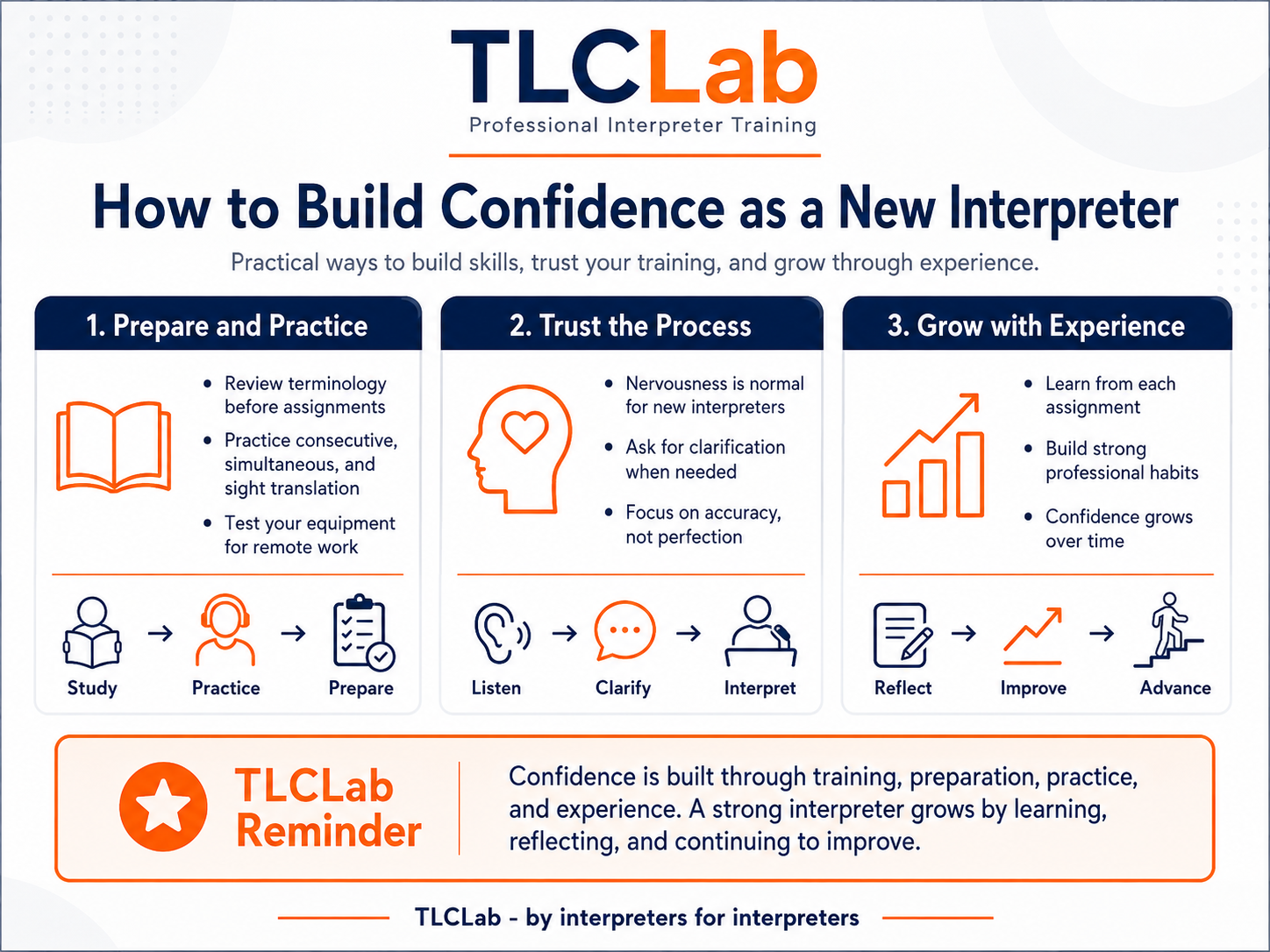
At TLCLab, we believe confidence is built through preparation, training, repetition, and professional habits. You do not need to feel completely fearless before you begin interpreting. You need a strong enough foundation to know what to do when challenges appear.
Understand That Nervousness Is Normal
Almost every new interpreter feels nervous at some point.
Your first medical appointment, school meeting, video call, or community interpreting assignment may feel very different from practicing in a classroom.
You are working with real people.
The information matters.
The speakers expect you to communicate accurately.
That responsibility can create pressure.
Feeling nervous does not automatically mean that you are unprepared. It often means that you understand the importance of the work.
The goal is not to eliminate every nervous feeling. The goal is to prevent nervousness from controlling your performance.
Instead of thinking:
"What if I make a mistake?"
try shifting your attention toward:
"What do I need to do to interpret this message accurately?"
That change in focus moves your attention away from yourself and back toward the communication.
Prepare Before the Assignment
Preparation is one of the fastest ways to build confidence.
Walking into an assignment with no idea what terminology may be used creates unnecessary stress.
If you know that the assignment involves healthcare, review relevant medical vocabulary.
If it is a school meeting, review educational terminology.
If you are interpreting remotely, test your headset, microphone, camera, internet connection, and platform access before the session begins.
Preparation may include:
* Reviewing terminology
* Confirming the assignment time
* Checking the location
* Planning travel time
* Testing equipment
* Reviewing professional protocols
* Preparing your note-taking materials
You will never know exactly what every speaker will say.
That is not the goal.
Preparation reduces the number of unexpected challenges competing for your attention.
At TLCLab, students are encouraged to treat preparation as part of the interpreting assignment rather than something optional.
Strengthen Your Skills Through Practice
Confidence without skill can become overconfidence.
Real professional confidence comes from knowing that you have practiced the skills you are being asked to use.
Practice consecutive interpreting with recorded conversations.
Listen to a short segment, take notes, and reproduce the message in another language.
Practice simultaneous interpreting with speeches, presentations, or news segments.
Practice sight translation using short documents.
Record yourself.
Then listen carefully.
Ask:
Did I omit anything?
Did I add information?
Did I change the speaker's tone?
Was my delivery clear?
Did I hesitate unnecessarily?
Did I keep the message complete?
Practice gives you evidence that your skills are improving.
That evidence builds confidence.
Do Not Compare Yourself to Experienced Interpreters
It is easy for a new interpreter to listen to someone with ten or twenty years of experience and think:
"I will never be able to do that."
But you are comparing your beginning to someone else's developed professional skill.
Experienced interpreters have worked through hundreds or thousands of conversations.
They have encountered difficult terminology, emotional situations, fast speakers, technical problems, and unexpected communication challenges.
Their confidence developed because they repeatedly practiced handling those situations.
Your goal should not be to immediately perform like an interpreter with twenty years of experience.
Your goal should be to perform your current assignments accurately and become slightly better with every experience.
Learn to Ask for Clarification Confidently
One of the biggest confidence problems for new interpreters is fear of saying:
"I did not understand that."
Some interpreters believe asking for repetition makes them look inexperienced.
In reality, guessing is far less professional.
If you did not hear the number, ask for repetition.
If a term is unclear, request clarification.
If the speaker talks too quickly, ask for a slower pace.
If several people are talking at once, manage the turn-taking.
You might say:
"Interpreter requests repetition of the last number."
or:
"Interpreter requests that the speaker pause more frequently to ensure accuracy."
These interventions are part of professional interpreting.
At TLCLab, students learn that asking for clarification is not a failure of confidence.
It is a demonstration of professional judgment.
Focus on Accuracy Instead of Perfection
New interpreters sometimes place enormous pressure on themselves to perform perfectly.
That pressure can actually reduce performance.
You begin analyzing every sentence while the next sentence is already being spoken.
You worry about a word you used thirty seconds ago.
You become so concerned about making a mistake that you stop listening effectively.
Professional interpreting requires concentration on the current message.
If you make a mistake and recognize it, correct it professionally.
Then continue.
Do not allow one imperfect moment to affect the rest of the assignment.
Confidence grows when you realize that professionalism is not the absence of mistakes.
Professionalism is knowing how to protect accuracy, correct problems, and continue working effectively.
Develop Strong Note-Taking Habits
Note-taking can give new interpreters additional confidence during consecutive assignments.
The important thing is to avoid trying to write everything.
Effective interpreter notes may capture:
* Names
* Dates
* Numbers
* Locations
* Sequences
* Key ideas
* Negations
* Important terminology
Use abbreviations and symbols that make sense to you.
Your notes should help you reconstruct the meaning of the message.
They are not supposed to become a complete transcript.
When you trust your note-taking system, you may feel less anxious about forgetting important information.
This frees your attention to listen more carefully.
Know Your Professional Role
Confidence also comes from knowing what you are responsible for—and what you are not responsible for.
You are responsible for interpreting the communication accurately.
You are not responsible for solving everyone's problems.
A patient may ask what medication they should take.
A parent may ask whether they should accept a school decision.
A client may ask whether they should sign a legal document.
You do not need to know the answer.
Your responsibility is to interpret the question so the appropriate professional can respond.
Knowing your boundaries removes unnecessary pressure.
You do not have to be the doctor, attorney, teacher, caseworker, and interpreter at the same time.
You need to be the interpreter.
Build Confidence Assignment by Assignment
Confidence develops gradually.
Your first assignment may feel difficult.
Your tenth may feel more familiar.
After fifty assignments, situations that once made you nervous may become routine.
Each assignment gives you an opportunity to improve:
* Listening
* Memory
* Terminology
* Delivery
* Professional presence
* Turn management
* Note-taking
* Clarification
* Cultural awareness
After an assignment, take a few minutes to review your performance.
Do not focus only on what went wrong.
Ask what went well too.
Maybe you handled a difficult term correctly.
Maybe you requested clarification at exactly the right moment.
Maybe you maintained your composure during an emotional conversation.
Recognizing progress is part of professional development.
Build Your Professional Presence
Confidence is also communicated through your professional behavior.
Arrive on time.
Dress appropriately for the setting.
Introduce yourself professionally.
Maintain a calm tone.
Avoid unnecessary side conversations.
Keep your body language neutral and attentive.
For remote assignments, maintain appropriate lighting, camera placement, audio quality, and background.
Small professional habits create an environment where both you and the participants feel more comfortable.
You may still feel nervous internally, but professional behavior gives you a structure to follow.
Over time, the internal confidence usually catches up.
Continue Learning
The most confident professional interpreters are often the ones who understand how much there is still to learn.
They continue building terminology.
They practice difficult interpreting modes.
They take continuing education courses.
They review their mistakes.
They seek feedback.
They learn about new technologies and professional standards.
Confidence should not come from believing that you know everything.
It should come from knowing that you have the ability to continue learning.
How TLCLab Helps Build Interpreter Confidence
At TLCLab, our goal is to help bilingual individuals develop the foundation needed to move toward professional interpreting with greater preparation and confidence.
TLCLab training introduces students to the skills and professional expectations they may encounter during real assignments, including ethics, confidentiality, professional boundaries, consecutive interpreting, simultaneous interpreting, sight translation, note-taking, terminology, remote interpreting, cultural awareness, clarification, and communication management.
The more you understand the interpreter's role, the easier it becomes to respond when something unexpected happens.
You begin to know when to ask for repetition.
You understand how to manage a fast speaker.
You recognize when a situation falls outside your role.
You know how to correct an error professionally.
Most importantly, you begin replacing uncertainty with professional judgment.
Confidence does not appear overnight.
It is built through training, preparation, practice, experience, and continued learning.
You do not need to know everything before taking your next step.
You need to keep improving, keep practicing, and keep protecting the accuracy of every message you are trusted to interpret.
Prepare. Practice. Learn. Improve.
That is how confidence becomes part of your professional interpreting career.