
Choosing an interpreter training program is an important decision.
A quick online search may produce dozens of courses promising to prepare you for medical, legal, community, OPI, or VRI interpreting. Some programs last only a few hours. Others require weeks or months of study. Some provide meaningful practice and assessments, while others mainly consist of videos and a certificate at the end.
So how do you know which program is right for you?
At TLCLab, we believe future interpreters should understand what they are purchasing before they enroll—even when they are evaluating our own training.
A professional interpreter training program should do more than provide information. It should help you understand the interpreter's role, develop practical skills, recognize professional boundaries, and prepare you for the realities of interpreting.
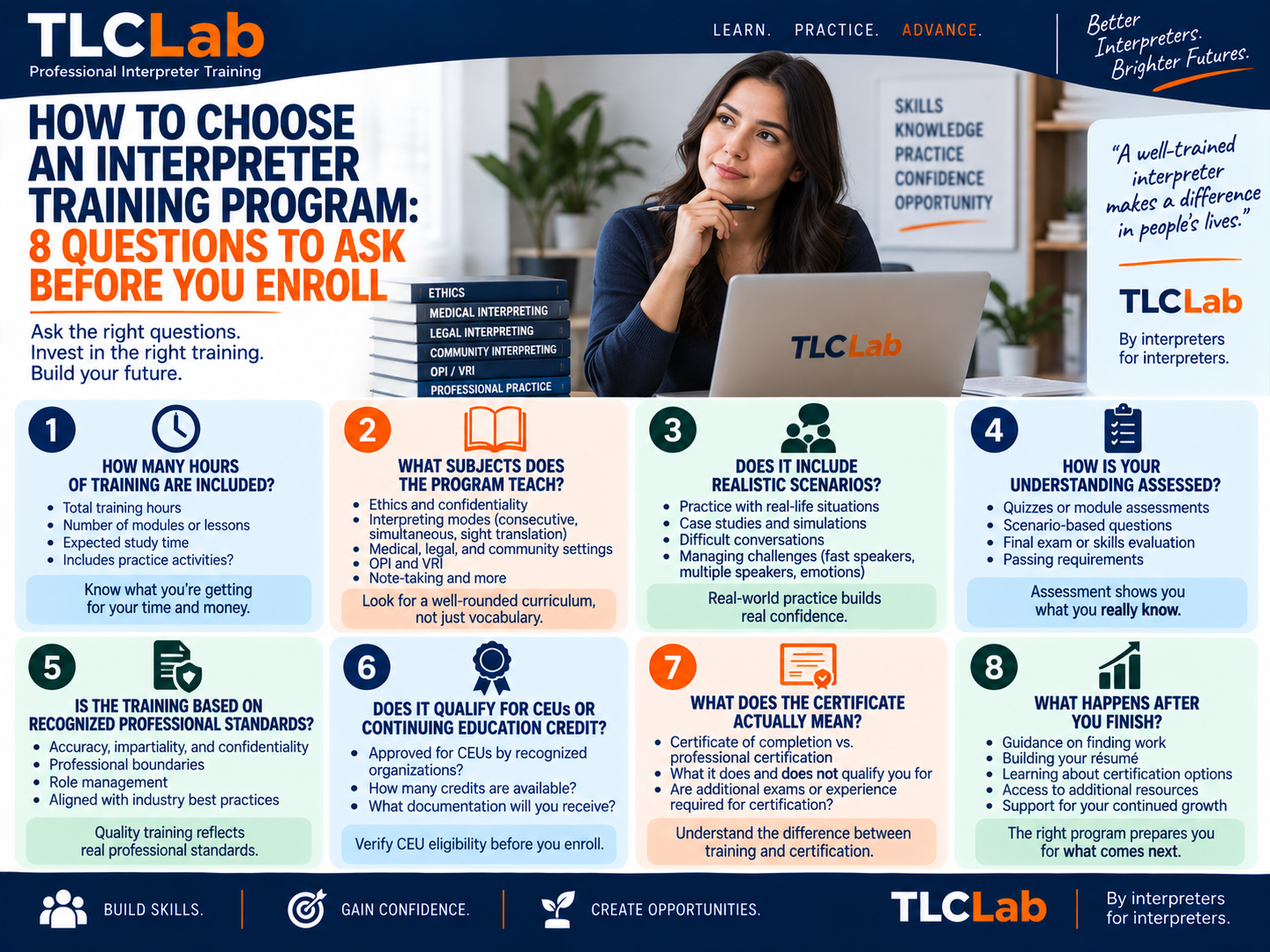
Here are eight questions every prospective interpreter should ask before enrolling in a training program.
1. How Many Hours of Training Are Included?
Start with something simple:
How much actual training am I receiving?
A program may advertise itself as "comprehensive," but that word means very little without knowing the amount and depth of instruction.
Look at:
* Total training hours
* Number of lessons or modules
* Expected study time
* Whether practice activities are included
* Whether the program covers multiple interpreting environments
More hours do not automatically mean better training, but extremely short programs may struggle to address the many skills professional interpreters need.
You should understand what you are getting for both your time and money.
2. What Subjects Does the Program Actually Teach?
A professional interpreter needs much more than vocabulary.
Look for instruction covering areas such as:
* Ethics
* Confidentiality
* Professional boundaries
* Consecutive interpreting
* Simultaneous interpreting
* Sight translation
* Note-taking
* Memory development
* Clarification
* Cultural awareness
* Medical or legal terminology
* OPI and VRI
* Difficult interpreting situations
A course that simply teaches terminology without explaining how professional interpreting works may leave important gaps.
At TLCLab, we emphasize the real situations interpreters encounter because knowing terminology is only one part of being prepared for the profession.
3. Does the Training Include Realistic Scenarios?
Interpreting becomes much more complicated when real people are involved.
What happens when someone talks too quickly?
What if a patient asks the interpreter for medical advice?
What if two people speak at once?
What if the interpreter makes a mistake?
What if someone becomes angry or starts using offensive language?
Training should expose students to situations like these.
Ask whether the program includes examples, scenarios, simulations, case studies, or exercises that require you to think like an interpreter rather than simply memorize definitions.
Real-world judgment is one of the most important skills a new interpreter can develop.
4. How Is Your Understanding Assessed?
Watching videos is not the same as demonstrating understanding.
Ask:
How does the program determine whether I learned the material?
A training program may use:
* Quizzes
* Module assessments
* Practice exercises
* Scenario questions
* Final examinations
* Skills evaluations
You should also understand the passing requirements.
An assessment helps students identify what they understand and where additional study may be needed.
The purpose should not simply be to make the course difficult. It should verify that important concepts have actually been learned.
5. Is the Training Based on Recognized Professional Standards?
Interpreter training should reflect accepted principles of professional practice.
Ask whether the curriculum addresses concepts such as:
* Accuracy
* Confidentiality
* Impartiality
* Professional boundaries
* Appropriate intervention
* Role management
* Continuing professional development
Be cautious when a course teaches practices that appear inconsistent with how professional interpreters are expected to operate.
Good training should help students understand why professional standards exist, not simply give them rules to memorize.
6. Does the Program Qualify for CEUs or Continuing Education Credit?
This question becomes especially important for interpreters who already hold a professional credential.
Some organizations require continuing education units or approved educational hours to maintain certification.
Do not assume that every interpreter course automatically qualifies.
Ask:
Is this training currently approved for CEUs by a particular organization?
How many credits are available?
What documentation will I receive?
If CEU eligibility is important to you, verify it before purchasing the course.
Requirements can differ between credentialing organizations, professions, and jurisdictions.
7. What Does the Certificate Actually Mean?
This may be the most important question of all.
A certificate of completion is not necessarily the same thing as professional interpreter certification.
If you complete a training program, the certificate may demonstrate that you successfully completed that education.
That does not automatically mean you can describe yourself as a certified interpreter.
Professional certification may require separate examinations, language assessments, experience requirements, or other qualifications through an independent certifying organization or government body.
A trustworthy training provider should clearly explain this distinction.
At TLCLab, we believe students should understand exactly what their training represents. Interpreter training can help build the foundation needed to pursue additional experience and, where appropriate, professional certification—but training and certification are not interchangeable terms.
8. What Happens After I Finish?
Finally, ask yourself whether the program helps you understand your next step.
Completing training is important, but new interpreters may still need guidance about:
* Building an interpreter résumé
* Applying to language service companies
* Preparing for a first assignment
* Continuing terminology development
* Gaining experience
* Understanding certification options
* Continuing professional education
A good training program should help you understand that professional development continues after the final lesson.
Choose Education, Not Just a Certificate
It can be tempting to compare interpreter training programs based only on price or how quickly you can receive a certificate.
A better question is:
What will I actually know and be able to do when I finish?
Look beyond the certificate.
Examine the curriculum.
Understand the training hours.
Review how students are assessed.
Look for realistic situations.
Ask about professional standards and CEUs.
Most importantly, make sure the provider clearly explains what its certificate does—and does not—qualify you to do.
At TLCLab, our goal is to help students develop a practical foundation in professional interpreting and understand the responsibilities that come with the role. We want students to learn how interpreters think, prepare, communicate, make professional decisions, and continue developing after training.
Whether you are considering TLCLab or another interpreter training program, ask questions before you enroll.
A good training provider should be comfortable answering them.
Choose the program that helps you build skills—not simply collect another certificate.