

A customer is frustrated because the interpreter arrived late. A parent becomes angry during a school meeting. A patient insists that the interpreter explain what the doctor “really means.” A caller raises their voice because they are having trouble understanding the process. Difficult interactions can happen in almost any interpreting environment.
For professional interpreters, learning how to deal with difficult customers is not simply about customer service. It is about protecting accuracy, maintaining professional boundaries, controlling the communication process, and preventing an emotional situation from affecting the quality of the interpretation.
At TLCLab, interpreter training focuses on preparing bilingual professionals for the realities of working with people, not just the mechanics of changing one language into another. Difficult customers are part of that reality. The way an interpreter responds can determine whether an uncomfortable situation becomes manageable or escalates unnecessarily.
Understand What Is Behind the Behavior
A difficult customer is not always a difficult person.
Someone may be upset because they are frightened, confused, embarrassed, rushed, or dealing with a situation that has serious consequences.
A patient may have just received unexpected medical news. A parent may be worried about their child's education. A defendant may be anxious about a court proceeding. A customer calling an organization may have already been transferred several times before reaching the interpreter.
Before reacting to the person's attitude, try to understand the situation.
This does not mean accepting abusive behavior. It means recognizing that frustration is often directed at the circumstances rather than personally at you.
Professional interpreters learn to separate the emotion of the encounter from the responsibility of the assignment.
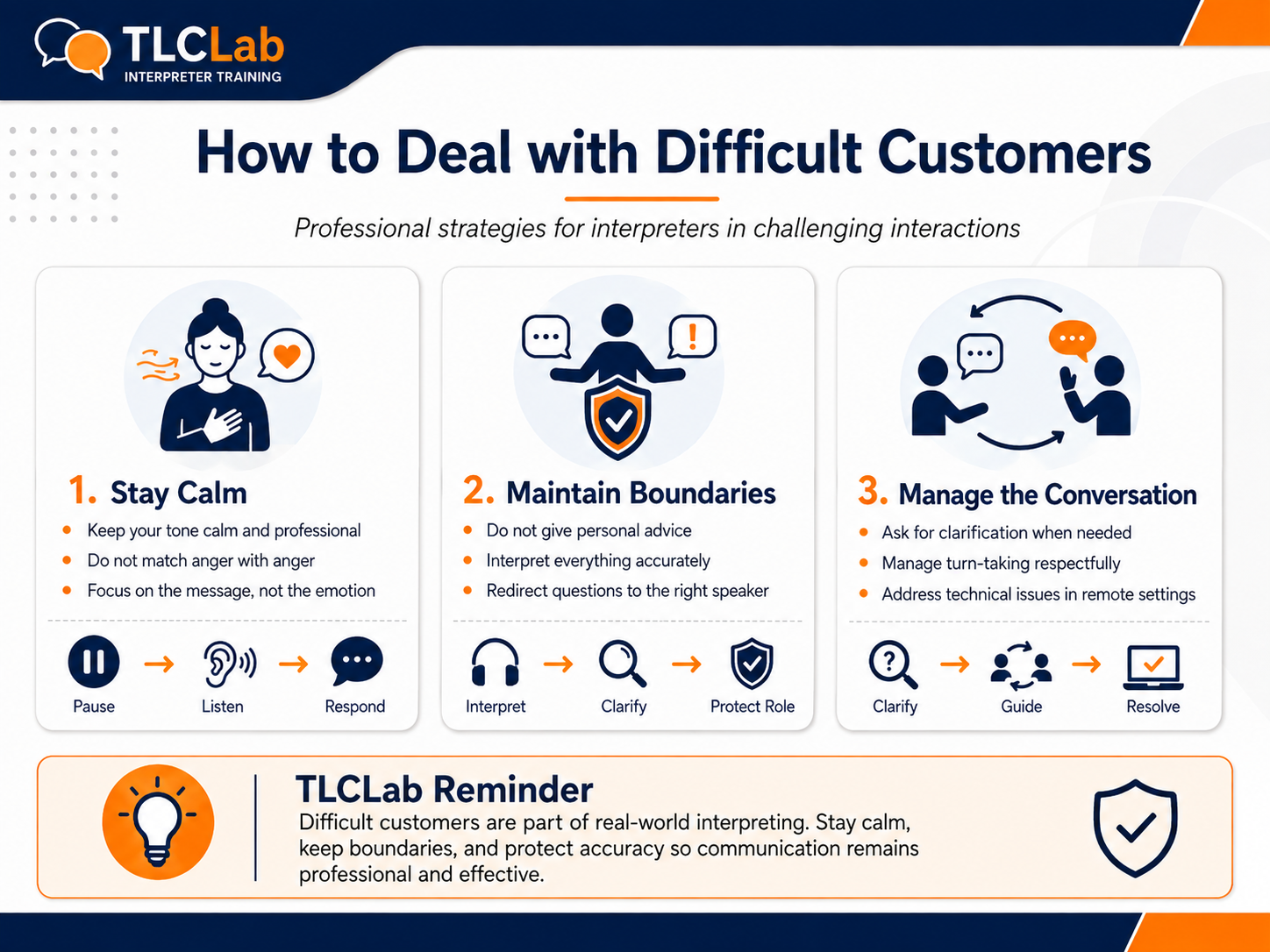
Stay Calm and Control Your Own Delivery
One of the fastest ways to make a difficult interaction worse is to match the customer's emotional intensity.
If someone begins speaking loudly, speaking louder in response usually increases the tension.
If the customer is impatient, becoming visibly irritated can make the interaction feel confrontational.
Instead, maintain a calm, controlled, professional delivery.
Your voice should communicate that you are paying attention and taking the situation seriously without becoming emotionally involved.
This is especially important for interpreters because your delivery can influence both parties in the conversation.
A frustrated customer's statement should still be interpreted with the appropriate emotional force, but the interpreter should not add their own frustration.
At TLCLab, this distinction is important: reflect the speaker's message without becoming part of the conflict.
Listen Before You Respond
Difficult customers often become more frustrated when they believe nobody is listening to them.
Avoid interrupting simply because you think you already understand the complaint.
Allow the person to finish whenever possible.
Listen for the actual problem.
Is the customer upset about:
* A misunderstanding?
* A delay?
* A billing issue?
* An appointment?
* The interpreting process?
* Something another person said?
* A technology problem?
* A language-access issue?
Once you understand the problem, you are in a much better position to determine whether it is something you should address or something that belongs to another professional.
Interpreters must be especially careful here because listening to a complaint does not mean taking responsibility for solving matters outside the interpreter's role.
Do Not Take Complaints Personally
Some customers may criticize the interpreter directly.
They may say:
"I don't understand you."
"That isn't what I said."
"The last interpreter was better."
"You're speaking too fast."
The natural reaction may be to become defensive.
Avoid it.
Instead, treat the statement as information that may help improve communication.
You might need to slow down, clarify terminology, ask the speaker to repeat a statement, or confirm that you understood what was said.
If you made a mistake, correct it professionally.
A simple correction is far better than attempting to defend an inaccurate interpretation.
Professional confidence does not mean pretending that mistakes never happen. It means knowing how to respond appropriately when they do.
Maintain Your Professional Boundaries
Difficult situations often create pressure for interpreters to step outside their role.
A customer may ask:
"What do you think I should do?"
"Can you explain this to me after the doctor leaves?"
"Tell them that this isn't fair."
"Can you convince them to change their decision?"
The interpreter may want to help, but giving personal advice or advocating outside the interpreter's authorized role can compromise neutrality.
Instead, keep ownership of the conversation with the participants.
For example, rather than answering a medical question yourself, interpret the question so the healthcare provider can respond.
Rather than explaining a school policy independently, help the parent ask the school representative for clarification.
At TLCLab, students learn that professional boundaries protect both the interpreter and the people receiving language services.
You can be helpful without becoming the decision-maker.
Use Clarification Instead of Guessing
A difficult customer may speak quickly, use unclear terminology, interrupt repeatedly, or provide information in a disorganized way.
That does not give the interpreter permission to guess.
If you did not understand something, ask for clarification.
If the speaker gave several numbers quickly, request repetition.
If people are speaking over each other, intervene professionally and explain that one person needs to speak at a time so the message can be interpreted accurately.
This is not a sign of weakness.
It is a sign of professional responsibility.
An interpreter who asks for clarification protects the conversation.
An interpreter who guesses may change it.
Know When to Set Limits
Professionalism does not require accepting abusive or threatening behavior.
There is an important difference between a frustrated customer and someone who becomes personally abusive.
If a customer begins using insults, threats, discriminatory language directed at the interpreter, or behavior that creates a safety concern, follow the procedures established by your employer, client, or language service provider.
Depending on the situation, that may involve:
* Calmly reminding participants of communication expectations
* Requesting assistance from a supervisor
* Contacting the appropriate staff member
* Documenting the incident
* Ending the assignment when authorized by policy
* Removing yourself from an unsafe environment
Your responsibility to interpret professionally does not eliminate your responsibility to follow workplace safety procedures.
Do Not Argue About Meaning
Sometimes a customer may challenge an interpretation.
If that happens, do not turn the assignment into an argument about which person is correct.
Clarify the source statement.
Ask for repetition if necessary.
Correct the record if you recognize that you made an error.
If the disagreement involves terminology, use the appropriate professional procedure to resolve it.
The goal is not to "win."
The goal is accurate communication.
This mindset can prevent a small disagreement from becoming a larger conflict.
Manage Difficult Remote Customers Professionally
Over-the-phone interpreting and video remote interpreting create additional challenges.
Customers may become frustrated because of:
* Poor audio
* Weak internet connections
* Background noise
* Multiple people talking
* Camera positioning
* Delays
* Difficulty understanding how the platform works
Do not allow technical frustration to become personal conflict.
Address the communication problem directly.
You may need to ask participants to move closer to the microphone, reposition the device, speak one at a time, repeat information, or reconnect according to platform procedures.
Remote professionalism is one of the areas emphasized in TLCLab because modern interpreters increasingly work through technology as well as face-to-face.
Review Difficult Encounters Afterward
Difficult assignments can be valuable learning experiences.
After the encounter, ask yourself:
What caused the tension?
Did I remain neutral?
Did I maintain professional boundaries?
Did I interpret everything accurately?
Could I have managed turn-taking better?
Did I intervene appropriately?
Was there anything I should handle differently next time?
Professional development comes from reviewing performance rather than simply moving from one assignment to the next.
You may also need to document unusual incidents according to organizational procedures.
TLCLab Helps You Prepare for the Human Side of Interpreting
Interpreter training must prepare students for more than terminology lists and vocabulary exercises.
At TLCLab, we focus on the practical skills interpreters need when real conversations become complicated. That includes maintaining neutrality, managing difficult customers, setting professional boundaries, requesting clarification, controlling turn-taking, handling remote assignments, and making appropriate ethical decisions under pressure.
These skills matter because interpreters frequently work with people during stressful moments.
You may encounter anger, fear, confusion, impatience, disagreement, or emotional reactions. Your job is not to eliminate those emotions. Your job is to make sure the communication remains as accurate, complete, professional, and respectful as possible.
TLCLab helps bilingual professionals build the foundation needed to approach these situations with greater confidence and preparation. The goal is to help you develop not only your language skills, but also the professional judgment required to handle real-world interpreting assignments successfully.
Difficult customers will not always become easy customers.
But a trained interpreter can learn how to keep a difficult situation from becoming a difficult interpretation.
Stay calm. Listen carefully. Maintain your boundaries. Protect accuracy. Remain professional.
Those habits are part of what separates simply being bilingual from becoming a professional interpreter.