

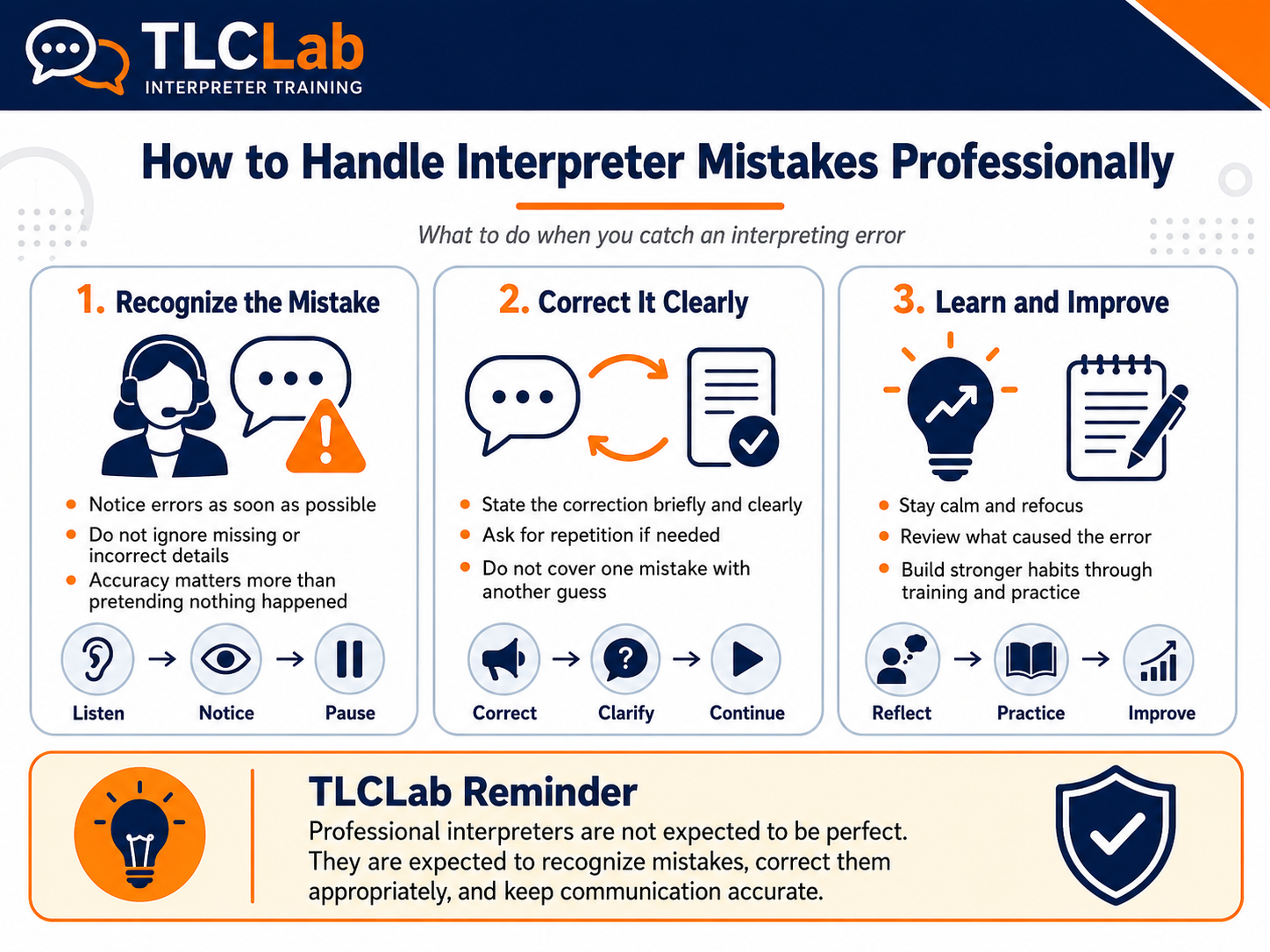
Every interpreter makes mistakes.
A word may be misunderstood. A number may be repeated incorrectly. A detail may be omitted. The interpreter may realize halfway through a sentence that the message was not rendered accurately.
The important question is not whether an interpreter will ever make a mistake. The important question is how the interpreter responds when a mistake happens.
Professional interpreting requires accuracy, but it also requires accountability. Trying to hide an error, guessing, or continuing as though nothing happened can create a much bigger problem than the original mistake.
At TLCLab, interpreter training emphasizes that professionalism includes recognizing errors, correcting them appropriately, and learning from them. A well-trained interpreter understands that correcting a mistake is not a sign of weakness. It is part of protecting the integrity of the communication.
Recognize the Mistake as Soon as Possible
The first step is awareness.
Interpreters must constantly monitor their own performance while listening, processing, and speaking.
You may suddenly realize:
* You interpreted a number incorrectly.
* You omitted an important word.
* You misunderstood a medical or legal term.
* You used the wrong tense.
* You changed a negative statement into a positive one.
* You confused two names.
* You gave an incomplete interpretation.
* You misunderstood who was being discussed.
The sooner the mistake is recognized, the easier it usually is to correct.
Do not hope that nobody noticed.
If the error could affect the meaning of the conversation, correct it.
Do Not Try to Hide the Error
New interpreters sometimes fear that correcting themselves will make them appear unprofessional.
In reality, attempting to conceal an error can create a much greater risk.
Imagine a physician says:
"Take one tablet twice a day."
The interpreter accidentally says:
"Take two tablets twice a day."
If the interpreter notices the mistake, it must be corrected immediately.
Continuing without correction could affect the patient's understanding of the medication instructions.
Professionalism means protecting accuracy even when doing so requires admitting that you made an error.
A short, clear correction is usually enough.
For example:
"Interpreter correction: the provider said one tablet twice a day."
Then continue interpreting.
There is usually no need for a long explanation or apology.
Correct the Record Clearly
When correcting an error, the participants should understand that the correction is coming from the interpreter and not from the original speaker.
This is one of the limited situations where the interpreter may briefly step outside first-person interpreting to identify the correction.
For example:
"Interpreter correction: I previously interpreted the date as June 15. The speaker said June 50—"
If you realize you are still uncertain, stop and ask the speaker to repeat the date rather than making another guess.
The correction should be:
* Immediate
* Clear
* Brief
* Accurate
Avoid creating confusion by giving multiple explanations about what you thought you heard or why the mistake occurred.
The purpose is simply to restore the correct meaning.
Never Correct a Mistake With Another Guess
Sometimes an interpreter knows that something was wrong but is not completely sure what the correct information should be.
This is where another important professional skill becomes necessary: clarification.
Suppose a speaker rapidly gives an address and you realize that you may have interpreted the street number incorrectly.
Do not simply choose another number.
Ask for repetition.
You might say:
"Interpreter requests repetition of the street number."
Once the speaker repeats it, interpret the correct information.
Accuracy is more important than appearing fast or confident.
At TLCLab, students learn that requesting clarification is a professional tool, not an embarrassment.
Distinguish Between Small Corrections and Meaningful Errors
Not every verbal stumble requires stopping an entire conversation.
An interpreter may briefly mispronounce a word and immediately correct it without affecting meaning.
However, errors involving important information require clear correction.
Examples include:
* Dates
* Times
* Medication instructions
* Dosages
* Financial amounts
* Names
* Addresses
* Legal rights
* Medical symptoms
* Conditions
* Negations
* Appointment instructions
* Deadlines
A missing word such as "not" can completely reverse the meaning of a sentence.
For example:
"I did not take the medication."
is very different from:
"I took the medication."
The interpreter should evaluate mistakes based on whether they changed or could have changed the message.
What If Someone Else Identifies the Mistake?
Sometimes a participant may challenge the interpretation.
A patient might say:
"That's not what I said."
A parent might tell the interpreter that an important detail was missing.
Another bilingual person in the room may question a particular word.
Do not immediately become defensive.
Instead, focus on accuracy.
If appropriate, ask the original speaker to repeat or clarify the statement.
Then interpret it again.
The goal is not to prove that you were right.
The goal is to make sure everyone receives the correct message.
Professional confidence includes the ability to handle questions about your interpretation without turning the situation into an argument.
Avoid Over-Apologizing
When interpreters make a mistake, some become embarrassed and begin apologizing repeatedly.
A brief acknowledgment may be appropriate, but the assignment should remain focused on the speakers.
Long apologies can shift attention toward the interpreter and disrupt the conversation.
Instead of saying:
"I'm so sorry. I don't know why I said that. I thought I heard something else and I apologize."
a professional correction may simply be:
"Interpreter correction: the speaker said Tuesday, not Thursday."
Then continue.
Correct the message and move forward.
Stay Calm After the Mistake
Once an interpreter makes an error, anxiety can sometimes cause additional mistakes.
The interpreter may begin speaking too quickly, overthinking every sentence, or losing concentration.
Do not allow one error to control the rest of the assignment.
Correct it.
Refocus.
Listen carefully to the next speaker.
Professional interpreters develop the ability to recover quickly because high-pressure environments do not always allow time to dwell on what just happened.
A mistake should become a correction, not a chain reaction.
What If the Mistake Is Discovered Later?
Sometimes an interpreter realizes after the assignment that an important error may have occurred.
What happens next depends on the situation, organization, and potential impact of the error.
Follow your employer's or language service provider's procedures.
You may need to report the incident to a supervisor, coordinator, or appropriate contact.
Do not independently contact a patient, student, client, or other participant unless authorized to do so.
Professional boundaries and confidentiality still apply.
If the possible mistake involved high-risk information, such as medical instructions or legal rights, reporting it through the proper process may be especially important.
Learn From the Mistake
A professional interpreter should not simply forget about an error once the assignment ends.
Mistakes can identify areas that need improvement.
Ask yourself:
Why did the mistake happen?
Was the speaker talking too quickly?
Did I allow the segment to become too long?
Did I misunderstand terminology?
Was my note-taking ineffective?
Did I lose concentration?
Was I unfamiliar with the subject matter?
Should I have requested clarification earlier?
The purpose of reviewing mistakes is not to criticize yourself. It is to improve your future performance.
For example, if you repeatedly struggle with numbers, practice interpreting dates, phone numbers, measurements, money, and medication dosages.
If unfamiliar medical terminology caused the problem, study that terminology before similar assignments.
If long segments cause omissions, work on note-taking and turn management.
Preparation Prevents Many Mistakes
Not every mistake can be avoided, but preparation reduces risk.
Before an assignment, learn as much as you appropriately can about the setting.
Review relevant terminology.
Make sure your technology works for remote assignments.
Arrive ready to concentrate.
For interpreting work, preparation might include reviewing vocabulary related to:
* Healthcare
* Education
* Courts
* Social services
* Insurance
* Business
* Government programs
The better prepared you are, the more mental capacity you have available for listening and processing the actual message.
TLCLab Helps Build Professional Interpreter Habits
At TLCLab, we prepare interpreters for situations that go beyond vocabulary and language proficiency.
Professional interpreting means knowing what to do when communication becomes difficult, when you do not understand something, and when you realize that you made a mistake.
TLCLab training helps students develop skills in accuracy, ethics, consecutive and simultaneous interpreting, sight translation, note-taking, professional boundaries, terminology, clarification, and real-world decision-making.
Learning how to correct mistakes professionally is part of that preparation.
A strong interpreter is not someone who pretends to be perfect.
A strong interpreter recognizes when something went wrong, takes responsibility for protecting the message, makes the necessary correction, and continues the assignment professionally.
Every mistake can become an opportunity to improve.
Recognize it. Correct it. Learn from it. Move forward.
That is not only good interpreting practice. It is part of becoming the kind of professional interpreter that clients, organizations, and colleagues can trust.