

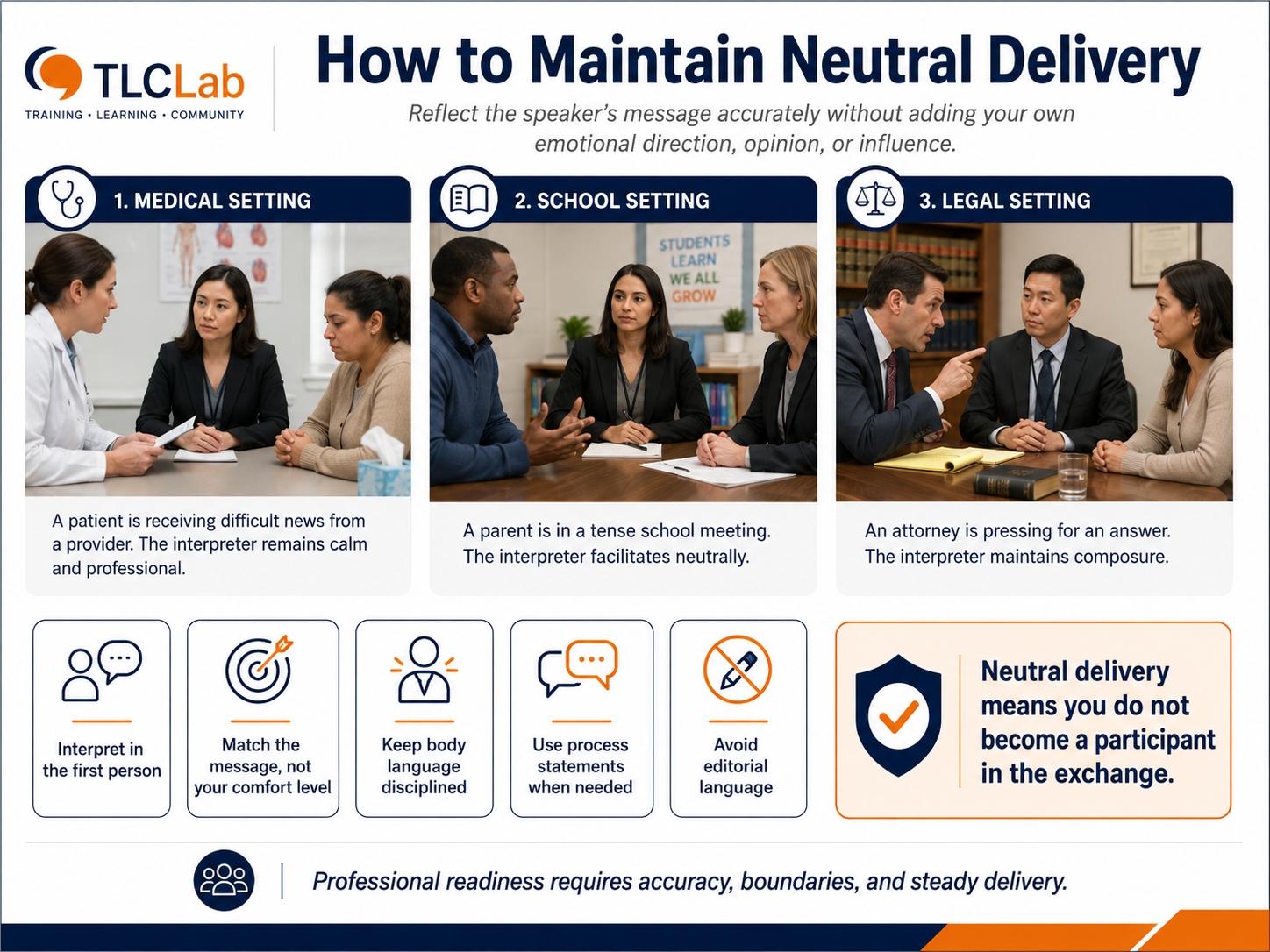
A patient receives frightening news. A parent becomes angry during a school meeting. An attorney presses for a direct answer. In these moments, the interpreter’s delivery can either preserve each person’s voice or quietly reshape the conversation. Learning how to maintain neutral delivery is not about sounding cold, flat, or detached. It is about carrying the speaker’s message accurately without adding your own emotional direction, opinion, or influence.
Speaking two languages is only the beginning. Professional interpreters are trusted to work beside people during decisions that may affect health, family, education, legal status, employment, or safety. Neutral delivery is one of the skills that makes that trust possible.
What Neutral Delivery Actually Means
Neutrality is often misunderstood as having no expression and no feeling. That approach can make an interpreter sound mechanical, especially when a speaker is grieving, frustrated, relieved, or urgent. It can also reduce accuracy. If a speaker is crying, raising their voice, whispering, or speaking with clear sarcasm, those features are part of the message.
Neutral delivery means you do not become a participant in the exchange. You do not soften a harsh statement because it makes you uncomfortable. You do not intensify a calm statement because you believe the listener needs to take it seriously. You do not signal agreement through your tone, facial expression, word choice, or side comments.
Your job is to reproduce the message’s meaning, intent, register, and emotional force as faithfully as possible while keeping your own reactions out of it. The distinction matters: reflect the speaker’s emotion, but do not perform your own emotion.
Consider the difference between these two interpretations of a frustrated parent’s statement: “I have called three times and nobody called me back.” If the interpreter says it with a dismissive tone, adds “she is upset,” or turns it into “She says she has been trying to reach someone,” the message has changed. The parent’s frustration, specific complaint, and urgency have been reduced or reframed.
Why Neutral Delivery Is Hard Under Pressure
Most interpreters do not lose neutrality because they do not care. They lose it because they care deeply, feel caught between people, or are trying to keep a difficult interaction moving. High-stakes work invites human reactions.
You may feel protective of a patient who appears confused. You may feel sympathy for a client whose story is painful. You may believe a provider, caseworker, teacher, or attorney is speaking too quickly or too bluntly. Those reactions are normal. Acting on them through your delivery is where professional boundaries can begin to slip.
Neutrality is also harder when power is uneven. A client may be nervous in a courtroom, unfamiliar with medical terminology, or intimidated by an institution. The interpreter may feel pressure to explain more, advocate informally, or make the client sound more polished. Yet changing the message to help one party can compromise the very access that interpreting is meant to provide.
This does not mean interpreters ignore access barriers or ethical concerns. It means they address them through the proper professional action: requesting clarification, asking a speaker to slow down, identifying a need for repetition, or following the protocol required in that setting. The remedy is not to quietly edit the message.
How to Maintain Neutral Delivery in Real Time
Neutrality is a performance skill. It must be practiced before the assignment, monitored during the interaction, and reviewed afterward. The following habits are practical because they work in the conditions interpreters actually face.
Interpret in the first person
First-person interpreting helps keep ownership of the message with the speaker. “I have pain here” is more direct and accurate than “She says she has pain there.” It also reduces the interpreter’s temptation to narrate, explain, or become a buffer between the parties.
There are exceptions when a setting or protocol requires clarification of roles, but the basic discipline remains useful: speak as the voice of the person who spoke, not as a commentator on what they said.
Match the message, not your comfort level
If the speaker is formal, preserve formality. If they are brief, do not expand. If they are angry, convey the anger without becoming angry yourself. If they use plain language, do not replace it with technical language to sound more professional.
Matching delivery does not require imitation. You do not need to mimic an accent, exaggerate tears, or copy every vocal mannerism. Instead, carry the communicative force. A firm statement should sound firm. A hesitant answer should not become confident. A joking remark should not be delivered as a serious declaration.
Keep your body language disciplined
Listeners read the interpreter even when they do not understand the interpreted language. A raised eyebrow, sympathetic nod, grimace, sigh, folded arms, or visible impatience can influence how a message is received.
Aim for attentive, calm, professional presence. Maintain appropriate eye contact according to the setting, but do not use your face to endorse or challenge what someone says. In video interpreting, this requires even more awareness. Your face may be the largest image on the screen, and small reactions can become highly visible.
Use process statements when the communication breaks down
When a speaker talks too long, uses unclear language, or speaks over another person, do not guess and do not silently repair the exchange. Interrupt appropriately and state the interpreting need. For example: “The interpreter requests a pause for interpretation,” or “The interpreter requests repetition of the last statement.”
A concise process statement protects accuracy without taking sides. It is far more professional than rushing, summarizing, or leaving out details because the pace feels uncomfortable.
Watch for editorial language
Editorial language often enters through small words. Terms such as “basically,” “just,” “kind of,” “they mean,” or “what she is trying to say” can subtly alter a message. So can adding explanations that were never spoken.
Train yourself to notice when you are smoothing, correcting, softening, or strengthening. A speaker may use incomplete grammar, repeat themselves, or choose words that sound blunt in English. Unless clarification is needed for accurate interpretation, that is their message to own.
Prepare for the Emotional Weight of the Assignment
Preparation supports neutral delivery long before the first word is spoken. Review relevant terminology, understand the assignment’s setting, test your technology, and know the expected protocol. When you are searching for vocabulary or worried about your audio connection, your ability to manage tone and boundaries becomes weaker.
It also helps to prepare mentally. Before an assignment, remind yourself of your role: facilitate accurate communication, preserve confidentiality, and maintain professional boundaries. This brief internal reset can be especially useful before medical consultations, legal proceedings, child welfare meetings, and emotionally charged family conversations.
After a difficult assignment, do not confuse neutrality with pretending you were unaffected. Professional composure during the encounter should be followed by appropriate decompression afterward. Depending on the situation, that may mean documenting a procedural concern, consulting a supervisor within confidentiality rules, using peer support, or taking a moment before your next call. Emotional resilience is not denial. It is having a responsible way to process what the work carries.
When Neutrality Does Not Mean Silence
There are situations where an interpreter must speak up about the process. If you cannot hear the speaker, if multiple people speak at once, if a person uses a term with more than one possible meaning, or if a request falls outside the interpreter role, neutrality does not require you to stay silent.
The key is to address the issue transparently and without becoming an advocate for one side. Identify yourself as the interpreter, state the communication problem, and return control of the conversation to the participants. This protects everyone better than making an assumption in the name of being helpful.
Professional judgment is knowing the difference between intervening for access and intervening to direct an outcome. That difference is not always comfortable, but it is central to ethical practice.
Build Neutral Delivery Through Deliberate Practice
You can improve this skill by recording short practice interpretations and reviewing more than word accuracy. Listen for changes in volume, pace, emotional intensity, formality, and added language. Watch for facial expressions or gestures that reveal your opinion.
Practice with material that has emotional range: a calm intake question, a frustrated complaint, a frightened patient, a formal legal instruction, and a tense workplace conversation. Ask yourself after each exercise: Did I preserve the speaker’s intent? Did I add anything? Did my delivery make either person sound more reasonable, more credible, or more emotional than they were?
At TLCLab, this is the kind of practical judgment that separates bilingual ability from professional readiness. Neutral delivery develops through repeated, honest practice with the real pressures of the job in mind.
The goal is not to become invisible as a person. The goal is to become reliable as a professional: present, prepared, accurate, and steady enough that the people in the conversation can hear each other clearly.