

A physician begins explaining a treatment plan without pausing. A parent speaks rapidly during an emotional school meeting. An attorney reads from a document at a pace that makes it difficult to follow. A caller gives names, dates, and numbers in one long sentence.
For interpreters, fast speakers are not unusual.
The challenge is not simply keeping up. The real responsibility is making sure the message remains accurate, complete, and understandable.
A professional interpreter should never allow pressure to "keep up" to become a reason for guessing, summarizing, or omitting information.
At TLCLab, interpreter training emphasizes that managing the flow of communication is part of professional interpreting. Interpreters are not passive machines expected to process unlimited amounts of speech at any speed. They must recognize when the pace is interfering with accuracy and know how to intervene professionally.
Why Fast Speech Creates Problems for Interpreters
Interpreting requires several mental processes to happen very quickly.
The interpreter must:
* Listen
* Understand the meaning
* Analyze context
* Remember important details
* Select appropriate terminology
* Reproduce the message accurately
* Continue listening to what comes next
When a speaker talks too quickly, the interpreter has less time to complete those steps.
The problem becomes even greater when the speaker includes:
* Numbers
* Dates
* Names
* Addresses
* Medication dosages
* Technical terminology
* Long lists
* Complicated instructions
* Emotional information
A fast sentence containing several ordinary ideas may still be manageable.
A fast sentence containing six dates, three medications, and several instructions may not be.
Professional interpreters learn to recognize the difference.
Do Not Sacrifice Accuracy for Speed
One of the biggest mistakes an interpreter can make is trying to prove that they can keep up with an extremely fast speaker.
Speed is not the standard.
Accuracy is the standard.
If the speaker becomes too fast, some interpreters begin shortening sentences or leaving out details just to remain close to the conversation.
That is not an appropriate solution.
For example, suppose a provider says:
"Take one tablet in the morning and one at night for seven days, but if the swelling becomes worse or you develop difficulty breathing, stop the medication and call us immediately."
An interpreter should not reduce this to:
"Take it twice a day and call if you have problems."
The general idea may sound similar, but important instructions have been lost.
When the pace threatens accuracy, the interpreter needs to manage the communication.
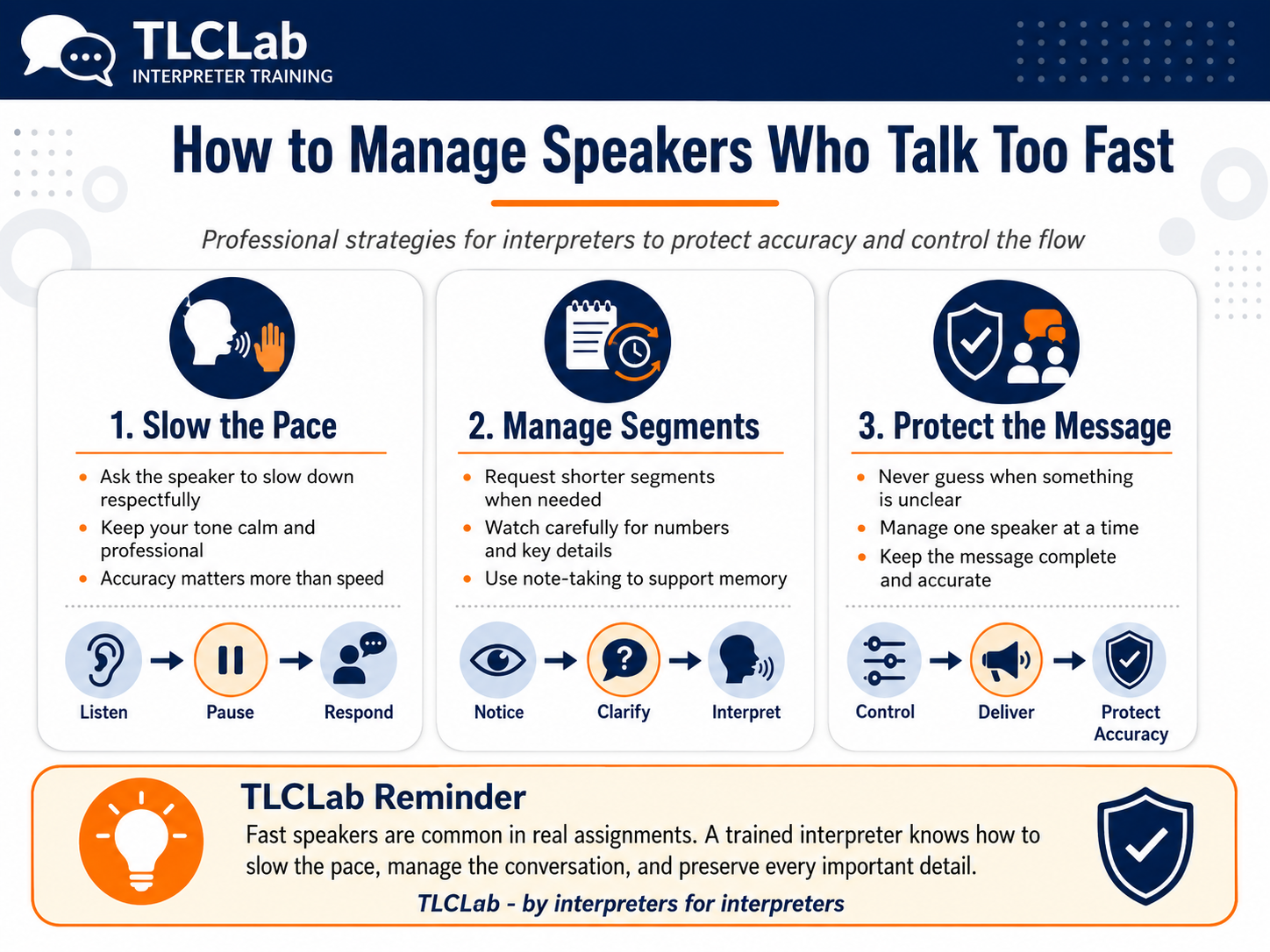
Ask the Speaker to Slow Down
It is professionally appropriate to ask a speaker to reduce their pace when necessary.
The request should be brief and respectful.
For example:
"Interpreter requests that the speaker slow down slightly to ensure accuracy."
You do not need to apologize repeatedly.
You also do not need to make the speaker feel that they have done something wrong.
The purpose of the intervention is simple: protect communication.
At TLCLab, students learn that appropriate interpreter intervention is not the same as controlling the conversation for personal convenience. It is used when necessary to preserve accurate language access.
Request Shorter Segments
Sometimes the problem is not how quickly someone speaks but how long they speak without pausing.
This is especially important during consecutive interpreting.
A person may speak at a reasonable speed but continue for three or four minutes without stopping.
Even an experienced interpreter can lose details when the segment becomes too long.
If necessary, ask the speaker to pause more frequently.
You might say:
"Interpreter requests shorter segments to ensure the complete message is interpreted."
This helps establish a more manageable rhythm:
Speaker → Pause → Interpreter → Speaker → Pause → Interpreter
The goal is not to interrupt after every sentence.
It is to create sections that the interpreter can accurately retain and reproduce.
Pay Special Attention to Numbers
Fast speakers often create the greatest risk when giving numerical information.
Consider the difference between:
* 15 and 50
* 13 and 30
* 14 and 40
* $1,500 and $15,000
* 0.5 milligrams and 5 milligrams
A small listening error can create a major difference in meaning.
If a speaker rapidly gives a phone number, address, dosage, date, financial amount, or identification number, do not hesitate to request repetition.
Professional interpreters should develop the habit of treating numbers as high-priority information.
At TLCLab, note-taking and accuracy techniques help students learn how to capture important numerical details without losing the rest of the message.
Use Effective Note-Taking
Note-taking can be extremely helpful when working with fast speakers.
However, trying to write every word usually makes the problem worse.
If your attention shifts entirely to the page, you may stop listening effectively.
Instead, focus notes on key information such as:
* Names
* Dates
* Numbers
* Locations
* Sequences
* Key actions
* Negations
* Important terminology
Symbols can also save time.
An arrow may represent movement or change.
A question mark can identify uncertainty.
A plus or minus symbol may represent an increase, decrease, positive, or negative depending on your personal system.
Your notes only need to make sense to you.
The goal is not to create a transcript. The goal is to support memory.
Manage Interruptions and Overlapping Speech
Fast conversations sometimes become even more difficult because several people start talking at once.
This can happen during:
* Family discussions
* School meetings
* Medical appointments
* Legal encounters
* Business meetings
* Video calls
When two or three people speak simultaneously, the interpreter may be unable to hear any complete message.
Do not attempt to combine several voices into one interpretation.
Intervene professionally.
For example:
"Interpreter requests that one person speak at a time so everything can be interpreted accurately."
This protects all participants.
Without turn management, one person's voice may be interpreted while another person's comments disappear completely.
Do Not Pretend You Heard Something You Missed
A fast speaker may say a word or phrase that the interpreter does not catch.
Never fill in the missing information based on what you think probably happened.
Suppose you hear:
"The patient should return in ___ weeks."
You think the speaker may have said two weeks, but you are not certain.
Do not interpret "two weeks."
Ask.
"Interpreter requests repetition of the return timeframe."
A short interruption is much safer than providing incorrect information.
At TLCLab, students are encouraged to view clarification as a professional skill rather than a sign of failure.
Stay Calm Under Pressure
Fast speakers can make new interpreters nervous.
Once anxiety begins, interpreters may start:
* Speaking too quickly
* Forgetting information
* Losing their place
* Using poor terminology
* Making unnecessary corrections
* Missing the next sentence
Try not to match the speaker's speed emotionally.
Maintain your own controlled delivery.
You may need to interpret efficiently, but efficient does not mean rushed.
A calm interpreter is more likely to hear accurately, think clearly, and recognize when intervention is necessary.
Fast Speech in Simultaneous Interpreting
Simultaneous interpreting presents a different challenge because the interpreter is listening and speaking at nearly the same time.
A fast speaker can quickly increase the interpreter's lag and cognitive workload.
If the interpreter falls too far behind, information may begin to disappear.
Strong simultaneous interpreters develop techniques such as:
* Anticipating sentence structure
* Managing lag time
* Processing ideas rather than isolated words
* Using concise but equivalent language
* Maintaining concentration
* Preparing terminology in advance
However, simultaneous interpreting still has limits.
No interpreter can accurately process unlimited information at unlimited speed.
When conditions make accurate interpretation impossible, the issue must be addressed according to the setting's procedures.
Remote Interpreting Can Make Fast Speech Harder
Over-the-phone and video remote interpreting introduce additional challenges.
A fast speaker may become harder to understand because of:
* Poor audio quality
* Background noise
* Weak connections
* Echo
* Microphone distance
* Speakers talking away from the device
In these situations, asking someone to slow down may not be enough.
The interpreter may also need to request better microphone placement, reduced background noise, or repetition.
Professional remote interpreting requires both language skills and communication management.
That is one reason TLCLab includes remote interpreting concepts as part of preparing students for modern interpreting environments.
Practice Managing Fast Speech Before the Assignment
The ability to work with fast speakers improves through practice.
Try listening to recordings at gradually increasing speeds.
Practice identifying the main idea while also capturing:
* Numbers
* Names
* Dates
* Negations
* Sequences
Record your interpretation and compare it with the original.
Did you omit anything?
Did you change the meaning?
Did you begin summarizing because the speaker was too fast?
Did you retain the numbers accurately?
This type of practice develops both listening speed and self-awareness.
TLCLab Helps You Learn to Manage the Conversation Professionally
At TLCLab, interpreter training is designed to prepare students for the situations that happen during real assignments.
Speakers will not always pause perfectly.
They will not always use simple terminology.
They may speak quickly, interrupt, change subjects, provide long explanations, or give several important details at once.
A trained interpreter needs strategies for managing those moments without changing the message.
TLCLab helps students develop skills in consecutive interpreting, simultaneous interpreting, note-taking, clarification, professional boundaries, terminology, remote interpreting, and communication management.
Learning how to work with fast speakers is part of developing professional judgment.
The goal is not to become the fastest person in the room.
The goal is to make sure every person receives the message as accurately and completely as possible.
When the speaker becomes too fast, remember:
Do not guess. Do not summarize. Do not silently drop information.
Ask for a slower pace when necessary. Request shorter segments. Clarify information you did not hear. Manage turn-taking professionally.
A skilled interpreter does not simply follow the pace of the conversation.
A skilled interpreter protects the accuracy of the conversation.