

Your first medical interpreting assignment can feel intimidating.
You may be walking into a hospital, clinic, physician’s office, or telehealth appointment where unfamiliar terminology, fast-paced conversations, medications, symptoms, and emotional situations can appear without warning.
Good preparation can make a major difference.
At TLCLab, interpreter training emphasizes that preparation is not about memorizing an entire medical dictionary. It is about building enough familiarity with the setting, terminology, and professional expectations so you can focus on what matters most: accurate communication between the patient and healthcare provider.
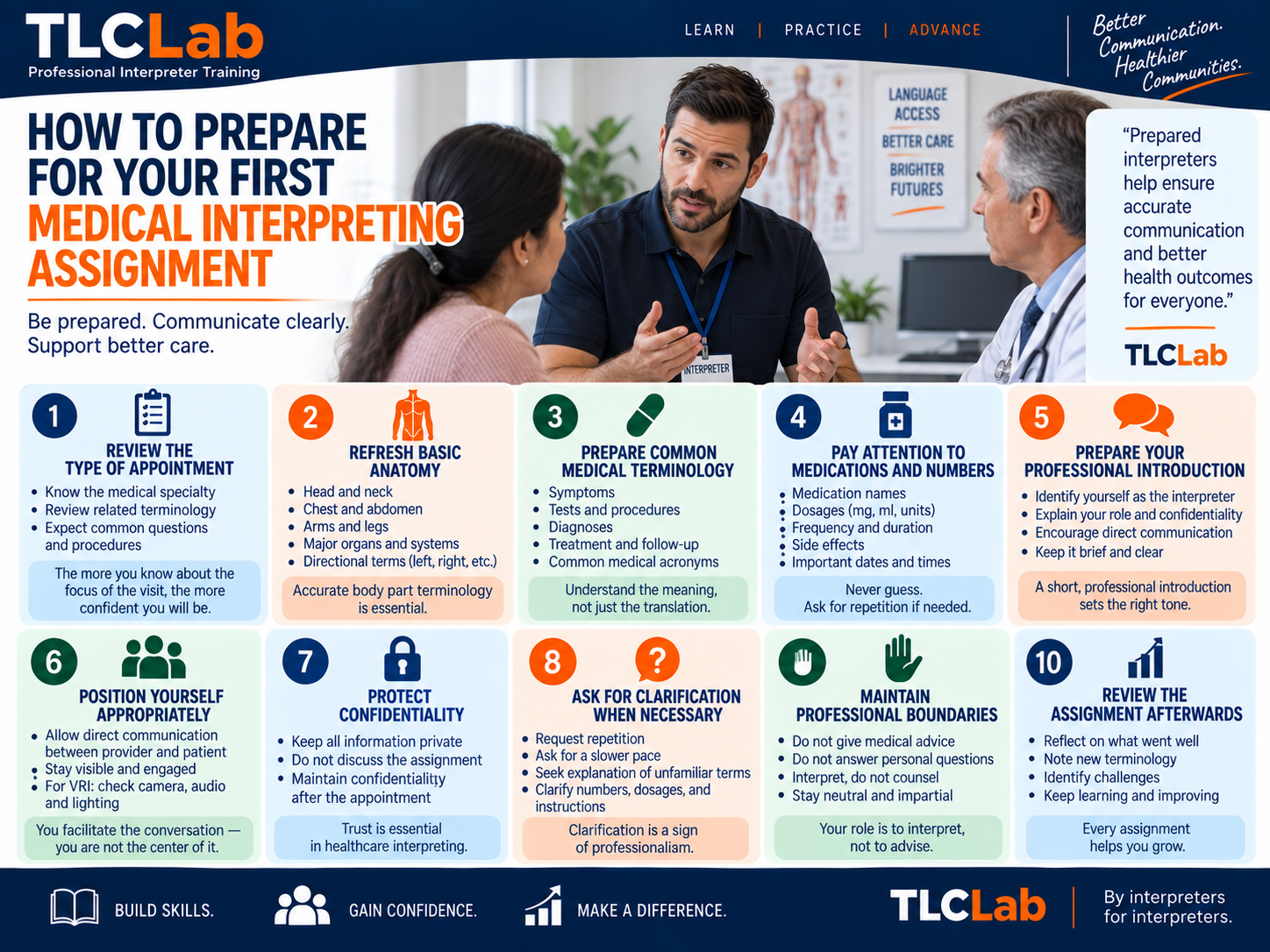
Here is a practical checklist to help you prepare.
1. Review the Type of Appointment
If you know the general purpose of the appointment, use that information to guide your preparation.
For example, an orthopedic appointment may involve:
* Bones
* Joints
* Fractures
* Pain levels
* Range of motion
* Physical therapy
A cardiology appointment may include:
* Heart rate
* Blood pressure
* Chest pain
* Arteries
* Medications
* Diagnostic testing
You do not need confidential patient information. Even knowing the medical specialty can help you review the right vocabulary.
2. Refresh Basic Anatomy
A strong foundation in anatomy is extremely useful for medical interpreters.
Review common body systems and body parts, including:
* Head and neck
* Chest
* Abdomen
* Back
* Arms and legs
* Major organs
* Bones and joints
Be comfortable with directional terms such as left, right, upper, lower, front, back, inside, and outside.
A patient saying, “The pain starts in my lower back and travels down my left leg,” requires the interpreter to communicate location precisely.
Small changes can matter.
3. Prepare Common Medical Terminology
Before the assignment, review terminology likely to appear.
Focus on practical categories such as:
Symptoms: pain, swelling, dizziness, nausea, weakness, numbness
Tests: blood work, X-ray, MRI, CT scan, ultrasound
Procedures: examination, injection, surgery, biopsy, therapy
Instructions: fasting, follow-up, take with food, avoid driving
At TLCLab, we encourage interpreters to understand the concept behind a term rather than simply memorize a translation.
Understanding the meaning helps you interpret more confidently when the provider explains the same concept in different words.
4. Pay Special Attention to Medications and Numbers
Medication discussions require careful listening.
You may hear:
* Medication names
* Dosages
* Milligrams
* Frequency
* Duration
* Side effects
* Refill instructions
Numbers deserve special attention.
There is a major difference between:
5 mg and 50 mg
or:
Once daily and twice daily
If you are uncertain about a number, dosage, date, or instruction, ask for repetition.
Never guess.
5. Prepare Your Professional Introduction
A brief interpreter introduction can help establish expectations at the beginning of the encounter.
Depending on the organization’s procedures, you may explain that you will interpret everything that is said, maintain confidentiality, and request clarification when necessary.
Keep it brief.
The goal is not to give a speech. It is to establish how the interpreted conversation will work.
Professional introductions can also encourage the provider and patient to speak directly to each other rather than speaking to the interpreter.
6. Position Yourself Appropriately
For onsite interpreting, positioning matters.
Whenever possible, the patient and healthcare provider should be able to communicate directly with each other.
Avoid positioning yourself as the center of the conversation.
You should be visible and able to hear everyone clearly, but the interaction belongs to the patient and provider.
For VRI, make sure the camera, audio, lighting, and screen placement support clear communication.
7. Protect Confidentiality
Medical assignments often involve private and sensitive information.
You may hear details about:
* Diagnoses
* Medications
* Mental health
* Pregnancy
* Family history
* Surgery
* Personal habits
Do not discuss the assignment with friends, family members, or people who do not have an authorized professional reason to know the information.
Confidentiality continues after the appointment ends.
8. Ask for Clarification When Necessary
New interpreters sometimes believe they should understand everything immediately.
That is unrealistic.
If you do not hear something clearly, ask for repetition.
If a provider uses an unfamiliar term, request clarification.
If someone speaks too quickly, ask for a slower pace or shorter segments.
For example:
“Interpreter requests repetition of the medication dosage.”
A clarification request is far more professional than an incorrect interpretation.
At TLCLab, students learn that clarification is one of the tools interpreters use to protect accuracy.
9. Maintain Professional Boundaries
Patients may sometimes ask the interpreter questions such as:
"Do you think I should have the surgery?"
"Is this medication safe?"
"What would you do?"
Do not answer these questions personally.
Interpret them to the healthcare provider.
You are not the doctor, nurse, counselor, or decision-maker.
Your responsibility is to make sure the patient can communicate directly with the appropriate healthcare professional.
10. Review the Assignment Afterwards
After your first medical assignment, take a few minutes to reflect.
Ask yourself:
Which terms were difficult?
Did I miss any numbers?
Did I ask for clarification when necessary?
Did I stay within my role?
What terminology should I review before the next appointment?
Add new terminology to your personal glossary.
Every assignment should help prepare you for the next one.
TLCLab Helps You Build the Foundation
At TLCLab, interpreter training helps students prepare for the realities of medical interpreting, including terminology, anatomy, confidentiality, professional boundaries, clarification, note-taking, communication management, OPI, VRI, and real-world scenarios.
Your first medical assignment does not require you to know everything.
It requires you to be prepared, accurate, professional, and willing to ask for clarification when necessary.
Prepare the terminology. Know your role. Protect confidentiality. Never guess. Keep learning.