

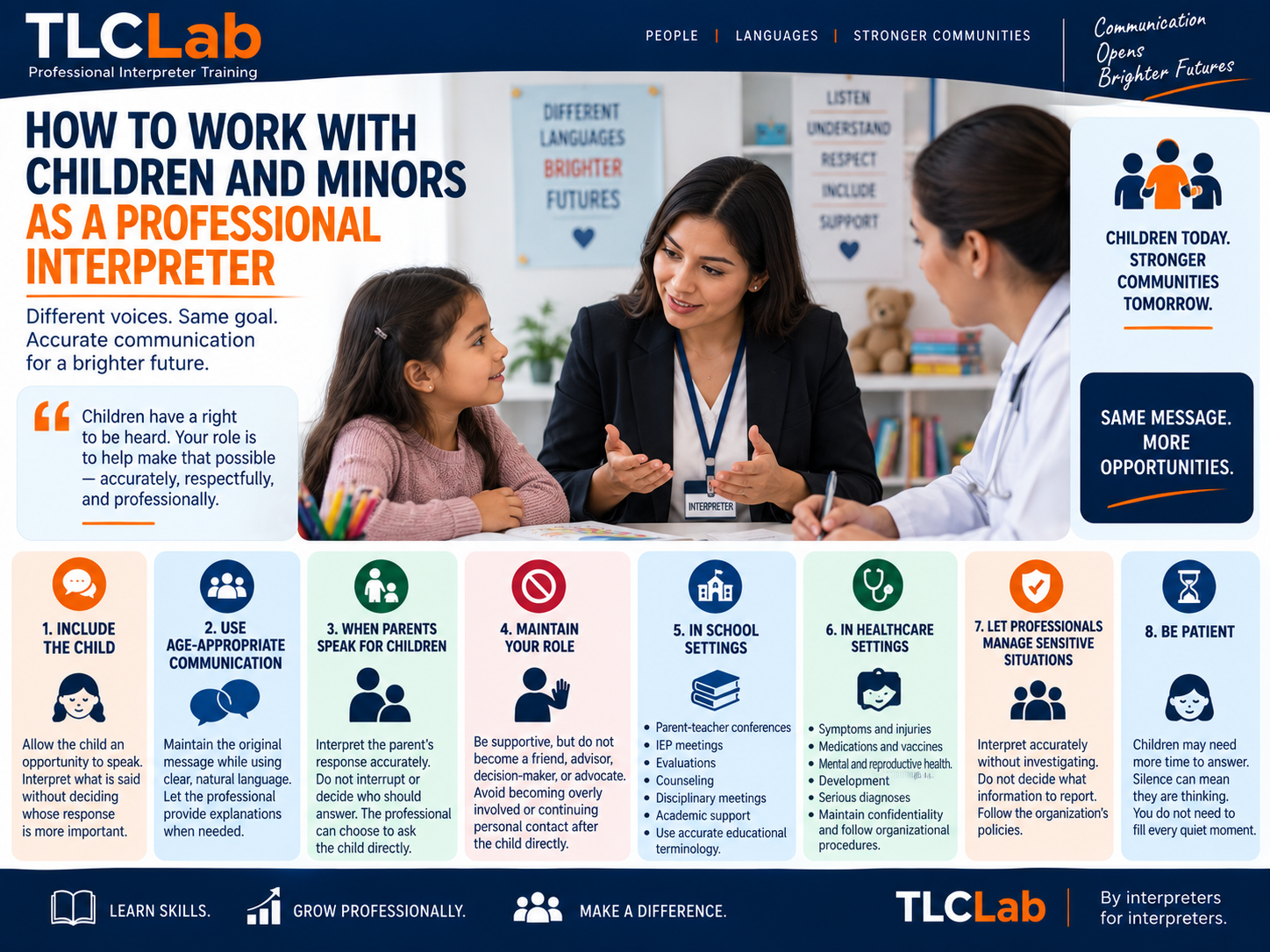
Interpreting for children and minors can be very different from interpreting for adults.
A child may use simple vocabulary, answer with only a few words, become distracted, look to a parent before responding, or struggle to explain what they are feeling. At the same time, adults in the room may naturally want to speak on the child's behalf.
For the professional interpreter, the responsibility remains the same: communicate accurately while maintaining appropriate professional boundaries.
At TLCLab, interpreter training emphasizes that working with children requires patience and sensitivity—but the interpreter must still remain an interpreter rather than becoming a parent, teacher, counselor, or advocate.
Remember That the Child Is a Participant
One of the most important principles is simple: do not overlook the child.
During a medical appointment or school meeting, adults may dominate the conversation. However, when a question is directed to the child, the interpreter should allow the child an opportunity to answer.
For example, if a doctor asks:
"Where does it hurt?"
and the parent immediately begins explaining, the interpreter should accurately interpret what is being said rather than deciding whose response is more important.
The healthcare provider can determine whether they need an answer directly from the child.
The interpreter should not make that decision.
Use Age-Appropriate Communication—Without Changing the Message
Children communicate differently depending on their age and development.
A six-year-old may describe pain differently from a sixteen-year-old.
However, interpreters must be careful not to independently simplify or rewrite what a professional says.
If a provider uses language the child does not understand, the interpreter should not automatically create a simpler explanation.
Instead, the interpreter can allow the child or parent to request clarification, or appropriately indicate that clarification is needed.
The original speaker should generally be the person who explains or simplifies the information.
The interpreter then accurately interprets that explanation.
At TLCLab, this distinction is important: interpreters facilitate understanding, but they should not independently become the person providing the explanation.
When Parents Speak for Their Children
Parents naturally want to help their children.
A physician may ask a teenager:
"How long have you been having headaches?"
and the parent may immediately answer:
"About three weeks."
The interpreter should not tell the parent to stop speaking simply because the question was directed to the child.
Interpret what is actually said.
The provider can then decide whether to ask the child again.
This protects the interpreter from taking control of the conversation.
The same principle applies in educational settings. If a teacher asks a student a question and a parent responds, interpret the parent's response accurately rather than deciding whose answer should be accepted.
Avoid Becoming the Child's Friend or Protector
Children may quickly become comfortable with an interpreter who speaks their language.
A child might sit closer to the interpreter, ask personal questions, or look to the interpreter for reassurance.
It is appropriate to be calm, respectful, and approachable.
But professional boundaries still matter.
Avoid becoming overly involved by:
* Giving personal advice
* Promising that everything will be okay
* Making decisions for the child
* Answering questions meant for a parent or professional
* Becoming emotionally aligned with one side
* Continuing unnecessary personal contact after the assignment
You can be warm without stepping outside your professional role.
Interpreting in School Settings
Schools create many situations where interpreters work with minors.
These may include:
* Parent-teacher conferences
* IEP meetings
* Academic evaluations
* Counseling discussions
* Disciplinary meetings
* Attendance concerns
* Special education services
Educational terminology can be complex, so preparation is important.
The interpreter should accurately interpret what teachers, parents, specialists, and students say without advocating for a particular decision.
For example, if a parent asks:
"Do you think I should agree to this IEP?"
the interpreter should not offer an opinion.
Interpret the question to the appropriate school professional so the parent can receive information and make their own decision.
Interpreting in Healthcare Settings
Medical encounters involving children can be especially sensitive.
The interpreter may encounter discussions about:
* Symptoms
* Medications
* Vaccinations
* Injuries
* Mental health
* Reproductive health
* Development
* Serious diagnoses
These conversations may include information that is uncomfortable or emotional.
The interpreter should maintain the speaker's meaning and tone without softening difficult information simply because a child is present.
Confidentiality is also essential.
Certain situations involving minors may have specific institutional or legal procedures. The interpreter should follow the organization's policies rather than independently deciding what information should or should not be shared.
Let Professionals Manage Sensitive Questions
A child may say something unexpected or concerning.
The interpreter's responsibility is to interpret it accurately.
Do not investigate further on your own.
Do not begin interviewing the child.
Do not decide whether a statement is important enough to report to someone else outside established procedures.
The appropriate healthcare professional, teacher, counselor, social worker, or other authorized person should manage the situation.
The interpreter protects communication while remaining within the interpreter role.
Be Patient With Silence
Children may need more time to answer.
A new interpreter may feel uncomfortable during silence and be tempted to repeat the question immediately or encourage the child to respond.
Allow reasonable time.
Silence may simply mean the child is thinking, nervous, or trying to find the right words.
The interpreter does not need to fill every quiet moment.
Patience can be an important part of accurate communication.
TLCLab Helps Prepare Interpreters for Real-World Situations
At TLCLab, interpreter training prepares students for more than vocabulary and terminology.
Professional interpreters need to understand how their role applies to different people, environments, and communication situations—including assignments involving children and minors.
Training helps interpreters develop skills in confidentiality, professional boundaries, clarification, cultural awareness, school and healthcare terminology, communication management, and accurate interpreting.
When working with children, remember:
Be patient. Interpret accurately. Allow the child a voice. Respect the parent's role. Let professionals make professional decisions. Maintain your boundaries.
Children may require a different communication approach, but the interpreter's fundamental responsibility remains the same: protect the integrity of the message while helping everyone involved understand one another.