

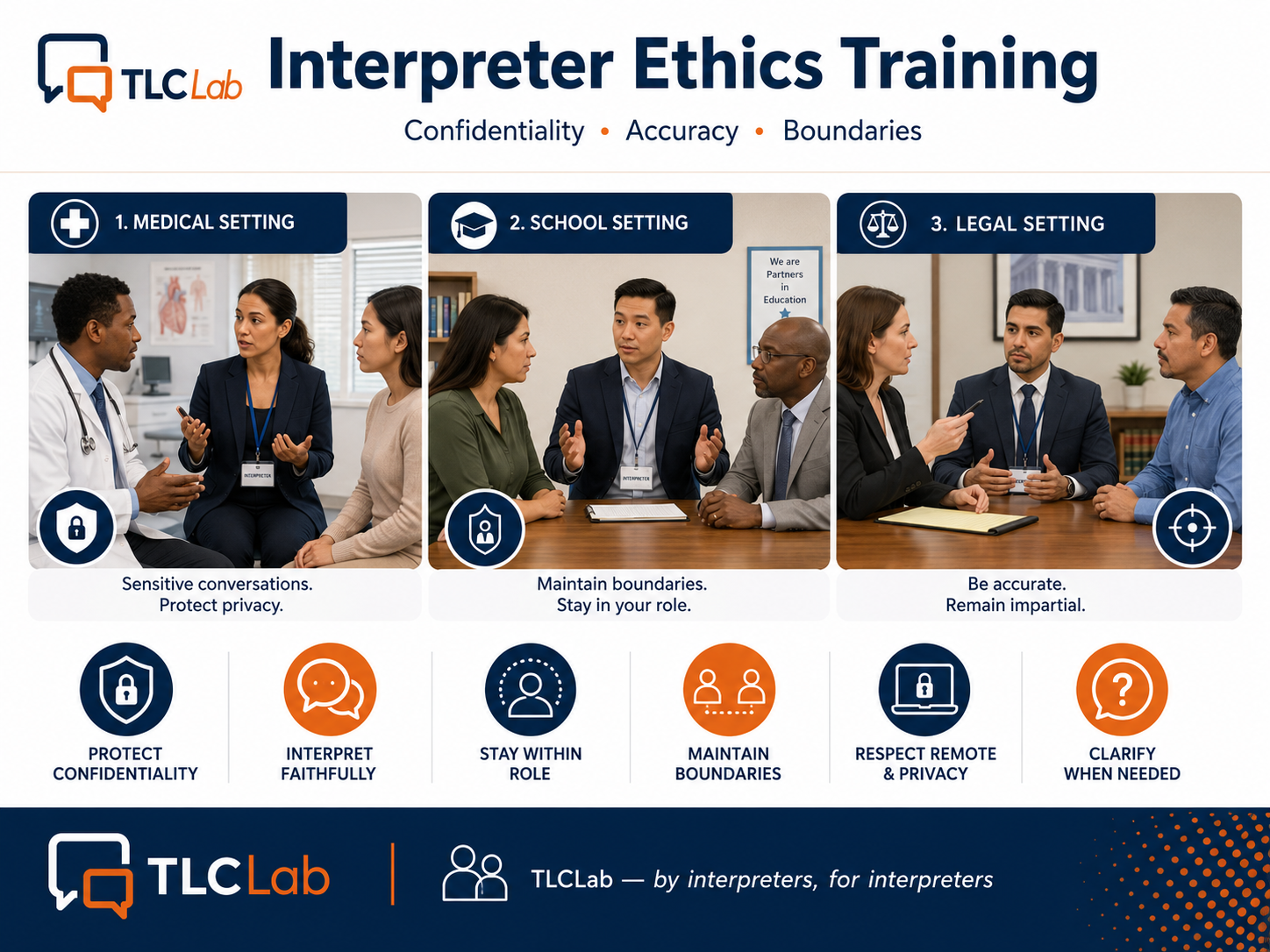
A patient pauses before answering a sensitive question. A parent looks to you, not the school administrator, for advice. An attorney asks you to explain what their client “really meant.” These are not vocabulary tests. They are moments when interpreter ethics training determines whether you protect trust, preserve accuracy, and stay within your role.
Speaking two languages is only the beginning. Professional interpreters are entrusted with information, relationships, and decisions that may affect someone’s health, legal rights, education, employment, or safety. Ethical practice is what helps an interpreter remain useful without becoming a participant in the conversation.
What Interpreter Ethics Training Must Prepare You to Do
Ethics is sometimes taught as a set of rules to memorize before an exam. Rules matter, but real assignments move faster than a quiz. A working interpreter needs to recognize an ethical issue while listening, manage it calmly, and make a defensible decision without pulling attention away from the people who need to communicate.
That requires more than knowing that confidentiality is required or that interpreters should be impartial. It requires understanding what those principles look like when conditions are imperfect: the speaker talks too fast, the family member interrupts, the provider uses unclear language, a supervisor asks for a favor, or a remote platform creates a privacy concern.
Strong interpreter ethics training develops three connected abilities: recognizing the problem, choosing an appropriate response, and documenting or reporting concerns through the right channels when needed. Each ability protects the people in the room and the interpreter’s professional credibility.
Confidentiality Is an Active Practice
Confidentiality is not just a promise not to repeat what you heard after an assignment. It begins before the session. A professional interpreter considers who can overhear a call, whether screens or documents are visible, how notes are handled, and whether a public location is appropriate for a sensitive conversation.
In healthcare, a casual hallway conversation can expose protected information. In court, discussing a case with someone outside the authorized process can cause serious harm. In video interpreting, a person walking behind your workspace or a recording setting left on by mistake can compromise privacy before anyone says a word.
The right response depends on the setting and policy, but the habit is consistent: identify the risk early, address it directly, and protect information without dramatizing the moment. Sometimes that means asking to move to a private space. Sometimes it means declining to use an unsecured communication method. Sometimes it means following an employer’s incident-reporting procedure after the fact.
Accuracy Includes More Than Words
Ethical accuracy means interpreting the message as faithfully and completely as possible. It does not mean cleaning up a speaker’s grammar, making a provider sound warmer, softening a threatening statement, or changing a client’s response because you think it may create a better outcome.
This can be uncomfortable. A speaker may be rude, vague, emotional, or mistaken. The interpreter’s role is not to improve the message or shield one party from it. The role is to render what was said, including the tone and register when they carry meaning, while using professional techniques to manage practical barriers.
There are limits. If you cannot hear, understand, or accurately interpret a statement, ethical practice calls for clarification. If a speaker uses an ambiguous term, ask the speaker to clarify rather than guessing. If pace prevents a complete interpretation, intervene briefly to request manageable segments. Accuracy is not passive silence. It is disciplined communication management in service of the original speakers.
Boundaries Protect Everyone
Many ethical challenges begin with a reasonable human impulse. You may want to help a frightened patient fill out a form, explain a school procedure to a parent, comfort a witness, or answer a question after the appointment. But being helpful and acting within your professional role are not always the same thing.
An interpreter can provide language access. An interpreter should not independently give medical, legal, educational, financial, or social-service advice. Even when you know the answer, stepping into another role can influence a person’s choices, create confusion about responsibility, and expose the interpreter and client to risk.
A clear boundary does not need to sound cold. You can state that you are there to interpret and ask the appropriate professional to answer. If the person needs help locating the right resource, follow the assignment protocol or request guidance from the responsible staff member. The goal is not to avoid responsibility. It is to carry the responsibility that belongs to your role.
The Hard Part: Ethical Decisions Under Pressure
Most interpreters understand the obvious examples. The harder cases are the ones where two good principles appear to conflict.
Consider a provider who asks you to summarize a long explanation because the appointment is behind schedule. Efficiency matters, but summarizing changes the interpreter’s function and may omit information the patient needs. Or consider a family member who insists on interpreting for a relative during a sensitive medical discussion. Respect for family dynamics matters, yet privacy, accuracy, and informed communication may require a qualified interpreter.
These situations do not always have a one-sentence answer. Requirements vary by setting, employer, contract, and applicable law. A professional should know the code of ethics relevant to the assignment, follow site procedures, and seek supervisory guidance when appropriate. Training should teach you how to reason through the situation, not simply repeat “it depends” and move on.
A useful decision process begins with the purpose of the interaction. Who needs to communicate, and what is at stake? Next, identify the ethical duties involved: accuracy, confidentiality, impartiality, respect, professional competence, and role boundaries. Then consider the least disruptive action that protects communication. Finally, if the issue cannot be resolved in the moment, know how to document facts and escalate through the proper process.
This approach helps because it keeps the interpreter from reacting emotionally or making the decision about personal comfort. The question becomes: what action best preserves access, trust, and the integrity of the encounter?
Why Practice-Based Ethics Training Matters
Ethical judgment develops through repeated application. Reading a code is necessary, but it cannot fully prepare you for a client who asks for your phone number, a manager who wants you to skip an introduction, or a remote call where another person suddenly enters the room.
Practice-based training uses scenarios that resemble the conditions of paid work. You should be asked to identify what is happening, explain the competing concerns, choose language for a professional intervention, and reflect on what should happen next. That process builds composure. It also reveals where terminology knowledge, delivery skills, or setting-specific procedures are affecting your decisions.
For example, an interpreter may understand the principle of impartiality but struggle to state an intervention without sounding defensive. A practical exercise can help them practice a brief, neutral statement: “The interpreter needs the speaker to clarify that term to provide an accurate interpretation.” The wording is simple, but using it at the right time is a professional skill.
Training should also address technology. Telephone and video assignments add ethical responsibilities around workspace privacy, identity verification, audio quality, visual access, platform controls, and interruptions. Remote work is not a lesser form of interpreting. It requires the same standards, applied through different tools and constraints.
Build Ethical Habits Before the Assignment Starts
The most reliable ethical choices are often made before the first word is interpreted. Prepare your workspace, confirm assignment expectations, review relevant terminology, understand reporting procedures, and remove avoidable distractions. If you are new to a setting, ask focused questions about protocol before a sensitive moment forces the issue.
During the session, stay alert to changes in who is present, what information is being shared, and whether you can still hear and interpret accurately. Afterward, protect notes and information, complete required documentation, and reflect on any situation that felt unclear. Reflection is not second-guessing every assignment. It is how working professionals sharpen judgment over time.
TLCLab approaches ethics as part of the daily work of interpreting, alongside accuracy, terminology, delivery, technology, and professional boundaries. Experienced interpreters do not become ethical because they never face difficult situations. They become dependable because they know how to respond when the situation is difficult.
Your voice may be the bridge that allows someone to understand a diagnosis, defend a right, participate in a meeting, or advocate for a child. Treat that responsibility with preparation. The next ethical decision may arrive quietly, in the middle of an ordinary assignment, and your calm, well-practiced judgment will matter.