

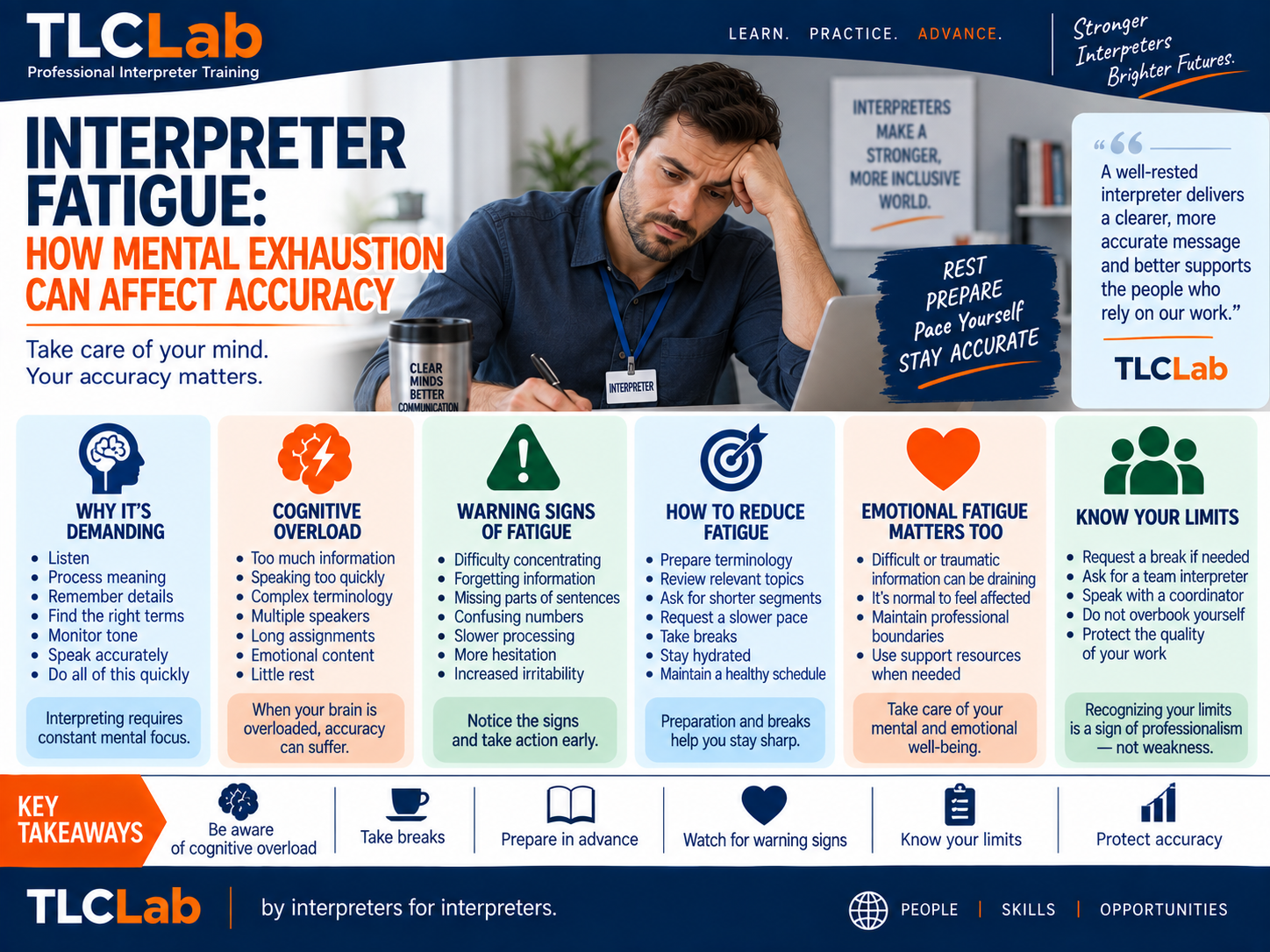
Professional interpreting requires intense concentration.
An interpreter may be listening, processing meaning, remembering details, choosing the correct terminology, speaking clearly, monitoring tone, and preparing for the next sentence—all within seconds.
That mental workload can be exhausting.
For new interpreters especially, it is easy to underestimate how much energy an assignment requires. A long medical appointment, court proceeding, conference, or series of back-to-back OPI calls can gradually reduce concentration and increase the risk of mistakes.
At TLCLab, interpreter training emphasizes that recognizing fatigue is part of professionalism. Knowing your limits is not weakness. It is one of the ways interpreters protect accuracy.
Why Interpreting Is Mentally Demanding
Interpreting requires several cognitive tasks to happen almost at the same time.
The interpreter must:
* Listen carefully
* Understand meaning
* Remember details
* Process terminology
* Reproduce the message accurately
* Monitor tone and register
* Continue listening while speaking
* Manage turn-taking
* Notice when clarification is needed
During simultaneous interpreting, the mental demand can be even greater because the interpreter is listening and speaking nearly at the same time.
During consecutive interpreting, long segments place heavy demands on memory and note-taking.
This constant mental processing can eventually create cognitive overload.
What Is Cognitive Overload?
Cognitive overload happens when the brain is being asked to process more information than it can comfortably manage.
For interpreters, this may occur when:
* The speaker talks too quickly
* Segments become too long
* Terminology is highly technical
* Several people speak at once
* The interpreter has been working for an extended period
* The assignment is emotionally difficult
* The interpreter has had little rest between assignments
As mental capacity decreases, accuracy may begin to suffer.
The interpreter may still feel like they are working normally while small mistakes start appearing.
That is why recognizing warning signs is important.
Warning Signs of Interpreter Fatigue
Fatigue can affect interpreters differently, but common warning signs may include:
* Difficulty concentrating
* Forgetting information more quickly
* Missing parts of sentences
* Confusing numbers
* Slower processing
* Increased hesitation
* Difficulty finding familiar words
* More frequent corrections
* Losing track of who is speaking
* Becoming unusually irritated or impatient
You may also notice that note-taking becomes less organized or that you are struggling to remember information that would normally be easy.
These signs should not automatically be ignored.
They may indicate that your mental performance is declining.
Fatigue Can Lead to Accuracy Problems
Interpreter fatigue is not simply about feeling tired.
It can affect the quality of the interpretation.
For example, an exhausted interpreter may accidentally change:
15 to 50
or forget an important negative such as:
"I did not take the medication."
A tired interpreter may also begin summarizing rather than interpreting everything accurately.
The person may not intentionally omit information. Their brain may simply be struggling to keep up.
That is why fatigue should be treated as a professional issue rather than only a personal inconvenience.
Long Assignments Require Planning
Some assignments last much longer than others.
A routine doctor's visit may take thirty minutes.
A court proceeding may last several hours.
A conference may continue throughout the day.
Before accepting a long assignment, understand what will be expected.
Ask whether:
* Breaks are scheduled
* Team interpreters will be available
* Simultaneous interpreting is required
* The assignment includes extended periods of continuous interpreting
In some environments, interpreters work in teams so they can alternate and reduce cognitive fatigue.
When that is possible, use the support appropriately.
Take Breaks When Appropriate
Short breaks can help restore concentration.
During long assignments, a few minutes away from continuous interpreting may allow the interpreter to mentally reset.
Breaks may provide time to:
* Drink water
* Stretch
* Review terminology
* Rest your voice
* Reset concentration
* Organize notes
The exact procedure will depend on the setting.
Interpreters should follow the policies of the organization or language service provider.
The important point is that continuous high-level concentration cannot always be maintained indefinitely without some decline in performance.
Preparation Reduces Mental Load
Preparation is one of the best ways to reduce interpreter fatigue.
When terminology is familiar, the brain does not have to work as hard to understand every concept.
Before an assignment, review relevant:
* Medical terminology
* Legal terminology
* Educational vocabulary
* Abbreviations
* Names of procedures
* Common phrases
At TLCLab, students are encouraged to create terminology glossaries before specialized assignments.
Preparation allows more mental energy to remain available for listening, memory, and accurate delivery.
Avoid Scheduling Too Much
New interpreters may be eager to accept as many assignments as possible.
But several demanding assignments back-to-back can create accumulated fatigue.
An interpreter who finishes a difficult two-hour medical appointment and immediately begins another complex assignment may not perform at the same level.
When possible, consider the mental demands of your schedule.
Professional reliability includes understanding whether you will still be able to perform accurately when the next assignment begins.
Sometimes accepting less work is better than accepting more work and performing poorly.
Emotional Fatigue Matters Too
Mental exhaustion does not come only from concentration.
Some assignments involve emotionally difficult information.
Interpreting conversations about trauma, serious illness, violence, grief, or family crises can create emotional fatigue.
Even if the interpreter maintains professional boundaries, repeated exposure to difficult conversations can still be mentally draining.
Recognize when emotional stress is beginning to affect concentration.
Use appropriate employer resources, breaks, or professional support while continuing to protect confidentiality.
Know When You Need Help
Professional interpreters should not wait until accuracy has completely broken down before responding.
Depending on the setting, you may need to:
* Request a short break
* Ask for shorter speaking segments
* Request a slower pace
* Ask for repetition
* Use a team interpreter
* Speak with a coordinator or supervisor
The purpose is not personal comfort.
The purpose is protecting communication quality.
At TLCLab, students learn that appropriate intervention is part of professional judgment.
Your Limits Are Part of Professionalism
New interpreters sometimes think experienced professionals should be able to interpret indefinitely without difficulty.
That is unrealistic.
Interpreting is cognitively demanding work.
Recognizing your limits demonstrates awareness and responsibility.
A professional interpreter understands that accuracy depends on more than language ability.
It also depends on concentration, preparation, mental endurance, and knowing when performance is beginning to decline.
How TLCLab Helps Interpreters Build Sustainable Skills
At TLCLab, interpreter training prepares students for both the language demands and the mental demands of professional interpreting.
Training helps students develop techniques in note-taking, memory, terminology preparation, clarification, communication management, interpreting modes, and professional boundaries.
These skills can reduce unnecessary cognitive strain and help interpreters work more effectively.
The goal is not to push through exhaustion at any cost.
The goal is to maintain professional performance.
Pay attention to your concentration.
Prepare before demanding assignments.
Take appropriate breaks.
Recognize warning signs.
Know when to ask for support.
A tired interpreter may still be bilingual.
But a professional interpreter understands when fatigue could begin affecting the message.
Protect your concentration. Respect your limits. Protect the accuracy of every interpretation.