

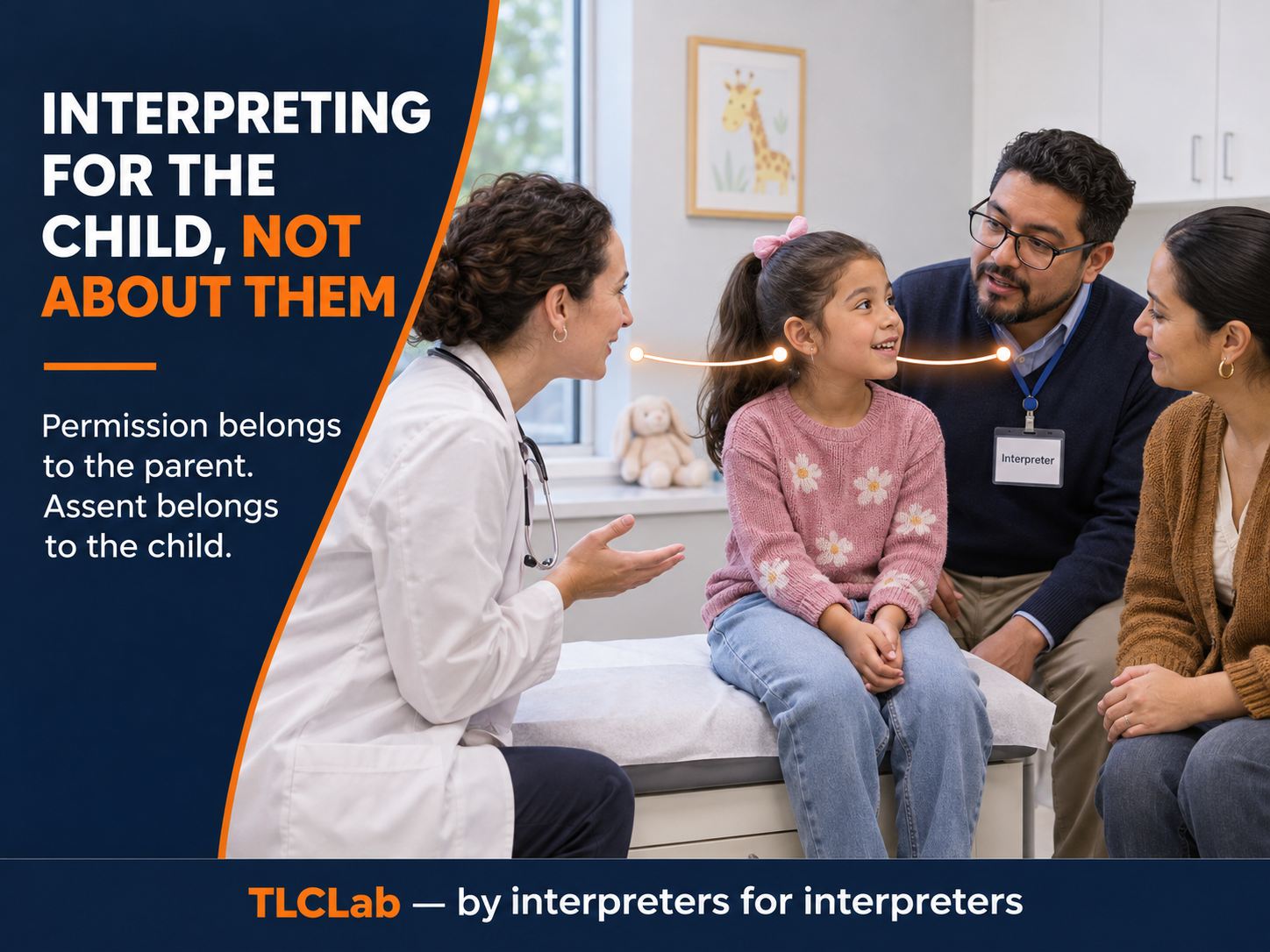
A seven-year-old is asked where it hurts. Before she can answer, her mother answers for her.
The provider writes it down.
Pediatric encounters have a structure adult encounters do not: a patient who is present but not in charge, a parent who holds the legal authority, and a conversation that constantly drifts toward being about the child rather than with them.
The interpreter either reinforces that drift or helps hold against it.
Permission Belongs to the Parent. Assent Belongs to the Child.
Understanding this distinction changes how you hear the whole encounter.
Under the American Academy of Pediatrics policy on informed consent in pediatric practice — issued in 2016 and reaffirmed in 2023 — parents or guardians technically provide informed permission for diagnosis and treatment. The child, where appropriate, provides assent.
Assent is agreement, not legal authorization. The AAP notes that assent from children as young as seven can foster moral growth and developing autonomy, grounded in the developmental shift that typically begins around that age. It is a process, not a signature.
And crucially: parental permission is legally binding and can override the child’s assent.
Why this matters to you: when a provider turns to a child and asks whether it is okay to look at her arm, that is not a formality you can compress. It is a defined part of pediatric practice, and the child’s answer — including a reluctant one, or a refusal — is information the provider needs in the child’s own words.
Interpret to the Child, in the Child’s Register
The core skill is simple to state and easy to lose.
When the provider speaks to the child, you speak to the child. Same direction, same person, first person.
Match the register the speaker used. If the provider says “we’re going to take a tiny bit of blood from your arm,” you do not render it as a clinical description. If a nine-year-old says “my tummy feels wobbly,” that is what you say — not “the patient reports abdominal discomfort.”
Both directions matter. Upgrading a child’s language makes them sound more precise than they were, which can mislead a clinician assessing comprehension or development. Downgrading an adolescent’s language is condescending and equally distorting.
A few practical consequences:
Shorter segments. Children lose the thread faster than adults. Work in smaller chunks.
Do not add explanation. The temptation to help a child understand is strong and it is still the provider’s job. If the explanation is over the child’s head, make that visible: “Interpreter note: the interpreter is not confident the explanation was understood at the child’s level.” The provider rephrases.
Let silence be silence. A child who does not answer may be frightened, confused, or thinking. Filling it or rephrasing it yourself removes that information.
When the Parent Answers for the Child
This happens constantly, and it is one of the clearest tests of role discipline.
The provider asks the child a question. The parent answers.
What you do: interpret what the parent said, and interpret it as the parent’s words — not as the child’s answer. The provider needs to know who spoke.
What you do not do: redirect the question to the child yourself. That is the provider’s call. Deciding that the child should answer is a clinical judgment about this family, and you do not have the context for it.
If the pattern is persistent enough that it is affecting the encounter, you can make it visible once, neutrally: “Interpreter note: the parent has been answering the questions directed to the child.” Then let the provider manage it.
Some parents answer out of protectiveness, some because the child is genuinely unable, some for reasons rooted in how their family or culture handles children in formal settings. None of that is yours to assess.
The Adolescent’s Private Portion
The AAP recommends that clinicians offer teens time alone, commonly beginning around age eleven. This is routine practice, not a sign that something is wrong, and in many settings it is built into every well visit.
You are usually in the room for it. That makes you the only other person present for a conversation designed to be private.
Three things follow.
The confidentiality is the point. Adolescents disclose differently when they believe the conversation is private. An interpreter who treats this segment casually undermines the clinical purpose of it.
You are not an exception. The parent will sometimes ask you afterward — in the hallway, in the elevator, in the waiting room — what their child said. The answer is that you cannot share what was said in the encounter, delivered kindly and without elaboration. Refer them to the provider. This is uncomfortable and it is not optional.
Minor consent law is real law. States allow minors to consent to certain categories of care on their own — the specifics vary widely by state and by service type, and there are doctrines covering emancipated and mature minors. Where a minor legally consents to care, their information carries confidentiality protections against parental access. You do not need to know the statute. You do need to understand that the privacy of that segment may be legally protected, not merely polite.
The Child Who Is Being Used as the Interpreter
You will sometimes arrive to find that the child has been doing this job for the family for years, and that everyone in the room — including the child — finds your presence awkward.
Two notes. First, your arrival is the correction, and you do not need to apologize for it. Second, if staff or family begin routing questions through the child anyway, that is a communication problem worth naming to the provider.
A child interpreting their own diagnosis, or their parent’s, is the situation professional interpreting exists to prevent.
How TLCLab Covers It
At TLCLab, pediatric practice is taught as its own setting, because the triad becomes a square and the usual rules about who speaks to whom get harder to hold.
The discipline is one sentence: when someone speaks to the child, so do you.