

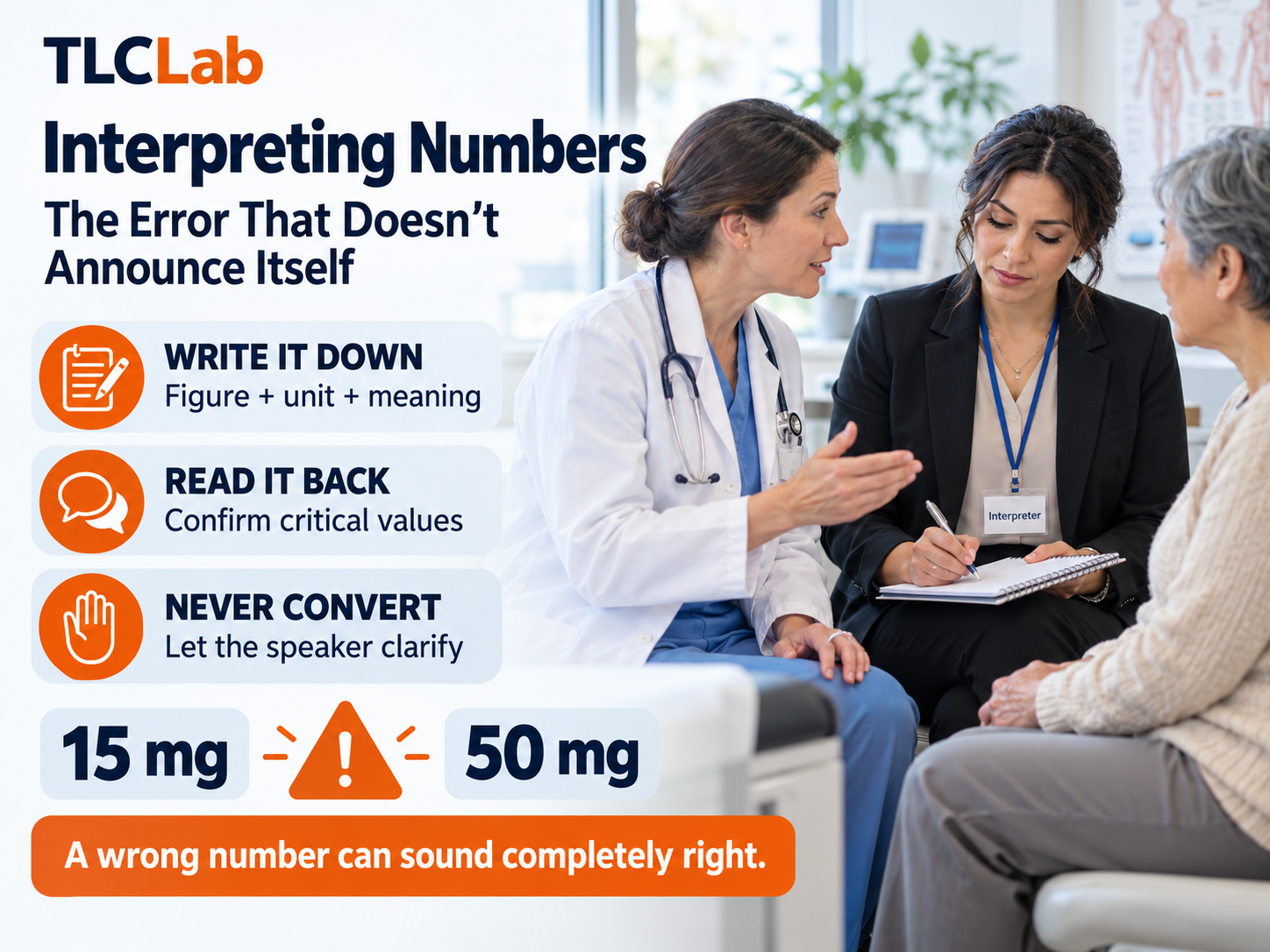
Most interpreting errors leave a trace.
A mistranslated word produces a sentence that sits oddly. A missing clause makes an answer feel incomplete. A register slip sounds wrong. Someone in the room may notice.
Numbers do not behave this way.
If a provider says "two tablets twice a day" and the interpreter renders "two tablets once a day," nothing sounds wrong. The sentence is grammatical, plausible, and clinically ordinary. The patient nods. The provider moves on.
A wrong number is a correct-sounding answer.
What the Research Found
The foundational work here is Glenn Flores and colleagues' study of errors in pediatric encounters, published in Pediatrics in 2003. Across thirteen encounters producing 474 pages of transcript, reviewers identified 396 interpreter errors — a mean of 31 per encounter. Omission was the most common type at 52%, followed by false fluency, substitution, editorialization, and addition.
Sixty-three percent of all errors had potential clinical consequences.
A follow-up study in Annals of Emergency Medicine in 2012 compared professional interpreters, ad hoc interpreters, and encounters with no interpreter. Errors with potential clinical consequences accounted for 12% among professional interpreters, 22% with ad hoc interpreters, and 20% with no interpreter.
The finding most relevant to training: among professional interpreters, those with 100 or more hours of training had errors of potential clinical consequence in 2% of cases, compared with 12% for those with less training. Interpreters with 100-plus hours averaged 12 errors per encounter; those below that threshold averaged 33.
And among the examples reported of clinically significant errors from that work: mistaking tablespoons for teaspoons of medicine.
A unit error. A threefold dosing difference, delivered fluently.
Why Numbers Are Structurally Different
Language has redundancy. If you lose a word, the surrounding sentence often carries enough that a listener can reconstruct the meaning, or at least notice something is missing.
Numbers carry no redundancy. Each digit is independent information. Lose one and nothing signals the loss — the remaining digits form a complete, valid number.
Three consequences follow.
There is no error signal. The listener has no basis for suspecting the figure is wrong.
The error survives. The number enters a chart, a prescription, a transcript. It is acted on.
Magnitude errors are easy. Slipping by one decimal place changes a dose tenfold. The Institute for Safe Medication Practices has documented tenfold overdoses for decades from exactly this mechanism — "1.0 mg" read as 10 mg, ".5 mg" read as 5 mg. The same slip in spoken rendition produces the same result with less of a paper trail.
Where It Goes Wrong
Separator conventions. Whether a comma or a period marks the decimal varies by country, and it is not consistent within language groups — Spain and Mexico differ from each other, as do many Spanish-speaking countries. An interpreter who writes a figure down using one convention and reads it back using the other has introduced an error between their own ear and their own mouth.
Counting systems that are structurally different. This is the underappreciated category.
German and Dutch invert the digits in two-digit numbers — einundzwanzig is literally "one-and-twenty." The interpreter hears the units digit first and must hold it while the tens digit arrives. In a rapid sequence of figures, this is where things come apart.
French builds 70, 80, and 90 compositionally: soixante-dix (sixty-ten), quatre-vingts (four-twenties), quatre-vingt-dix (four-twenty-ten). Belgian and Swiss French use septante and nonante instead, so a single language has two systems depending on the speaker.
Danish retains vigesimal forms where the number word does not transparently indicate its value.
Chinese, Japanese, and Korean group digits by four rather than three, built around a unit for ten thousand. One hundred thousand is expressed as ten of that unit, not as a hundred of a thousand. An interpreter converting between a three-digit-grouping language and a four-digit-grouping one is performing arithmetic in real time, not substitution.
South Asian languages use lakh (one hundred thousand) and crore (ten million), with a grouping pattern that differs from Western convention.
In every one of these cases the interpreter is not retrieving a word. They are computing. Under time pressure, with the next sentence already arriving.
Scale words. English billion means a thousand million. Spanish billón means a million million — a thousandfold difference. Spanish uses mil millones for the English billion. This matters less in clinical work and a great deal in financial, legal, and business interpreting.
Units. Tablespoons and teaspoons. Milligrams and micrograms, where a confusion is a thousandfold error — ISMP flags mcg and mg as a mix-up pair for exactly that reason. Pounds and kilograms. Fahrenheit and Celsius. Feet and inches against centimeters. Milliliters against ounces.
Dates. Most of the world writes day before month; the United States does not. "Three-four" is March 4th or April 3rd depending on who is speaking. Spoken dates are equally exposed.
Times. Twenty-four-hour and twelve-hour conventions, plus day-part terms that do not map cleanly across languages.
Clinical formats. Blood pressure said as one number over another. Gestational age given in weeks in some systems and months in others. Pain rated on a scale whose endpoints the patient may not have been told. Lab values with reference ranges attached.
The Rule That Prevents Most Harm: Do Not Convert
Interpreters are frequently tempted to help by converting — rendering Fahrenheit into Celsius, pounds into kilograms, so the listener gets something familiar.
Do not.
Conversion is alteration. You are producing a number the speaker did not say. If your arithmetic is wrong, the error is yours and invisible. If it is right, the record now contains a figure nobody uttered, and a provider reading the chart cannot tell which number came from whom.
Interpret the unit as given. If the mismatch is creating a genuine comprehension problem, make it visible and let the parties resolve it:
"Interpreter note: the provider gave the weight in pounds; the patient uses kilograms. May the provider clarify?"
The provider converts, or asks the question differently. You interpret that. The conversion is now attributable to the person qualified to make it.
The same applies to apparent slips. If a figure seems wrong — a dose that sounds implausible, a date that cannot be right — you do not fix it. You interpret it accurately and, if the inconsistency makes the message genuinely unclear, request clarification so the speaker can correct their own statement.
Write Numbers Down. Always.
This is the single highest-value habit in this article.
Memory for figures is poor and degrades fast under cognitive load. Professional note-taking treats numbers as a mandatory capture category, alongside names and lists, because these are precisely the elements that cannot be reconstructed from context.
Practical guidance:
Write the digits, not the words. Record 1 4 rather than "fourteen." Digits transcribe faster and leave less room for your own misreading.
Write it the instant you hear it. Not at the end of the segment. A number held in memory while you process the rest of the sentence is a number at risk.
Record the unit with the figure. "250" alone is useless. "250 mg" is information.
Note what the number attaches to. A page with three bare figures and no indication of which is the dose, which is the frequency, and which is the duration will not help you.
Mark anything you are unsure of. A question mark next to a figure you did not fully catch tells you to clarify rather than guess.
Use a consistent personal convention for decimals so you never have to wonder which mark you meant.
Read Numbers Back
In clinical settings, the standard for critical values is read-back: repeat the figure to the person who gave it, and have them confirm.
Interpreters can adopt a version of this without stepping out of role.
Where the number is consequential and you have any uncertainty, make it transparent:
"Interpreter note: the interpreter requests confirmation of the dosage."
This is not an admission of weakness. Nurses do it with physicians. Pharmacists do it with prescribers. It is normal professional practice around high-risk information, and interpreters have the same reason to use it.
Where you are confident, read-back is not necessary for every figure — that would make encounters unworkable. Reserve it for doses, frequencies, dates with consequences, and any number you did not catch cleanly the first time.
Correct Immediately
If you realize you rendered a figure wrong, correct it the moment you notice, explicitly:
"Interpreter correction: the provider said fifteen milligrams, not fifty."
Both the error and the correction, stated clearly. Numbers are the category where the stakes of an uncorrected slip are highest and the chance of anyone else catching it is lowest.
Prepare the Numbers Before You Start
Much of this is manageable in advance.
Know the conventions used by the communities you serve — decimal marks, date order, and which measurement system patients are likely to use. Know whether your language pair involves digit inversion, non-decimal grouping, or compositional number words, and drill those specifically rather than hoping they go smoothly.
Practice number sequences out loud, both directions, at speed. Most interpreters practice terminology and almost none practice numbers, even though numbers are where the consequential errors concentrate.
And for an assignment you know will be number-heavy — a medication review, a financial deposition, lab results — pull the relevant figures into your preparation the way you would terminology.
How TLCLab Trains This
At TLCLab, numbers are treated as a distinct skill area with its own drills, because the research is specific about where harm happens and because training volume measurably reduces it. The 2012 study found interpreters with 100 or more hours of training producing errors of potential clinical consequence at 2% versus 12% below that threshold.
That is not a small difference, and numbers are one of the places it shows up most directly.
Everything else an interpreter does has some margin for recovery. A slightly awkward rendition still communicates. A near-synonym usually lands.
A number is right or it is wrong, nobody can tell which from listening, and it goes into the chart either way.
Write them down. Read them back. Never convert them.
TLCLab - by interpreters for interpreters
Sourcing: error rates and types from Flores et al., Pediatrics 2003 and Annals of Emergency Medicine 2012