
"I've spoken Spanish my whole life."
"I grew up translating for my parents."
"I'm fluent in both."
These are the most common answers people give when asked about their language ability, and none of them is a measurement. They describe a history, not a level.
That distinction matters more than most new interpreters expect, because language proficiency is measurable, the certifying bodies require proof of it, and the required level is higher than many bilingual speakers assume.
At TLCLab, proficiency is addressed before interpreting skills, because training cannot supply a foundation that is not there. Knowing where you actually stand is the first professional decision an aspiring interpreter makes.
Proficiency Is a Measured Thing
Two scales dominate this conversation in the United States.
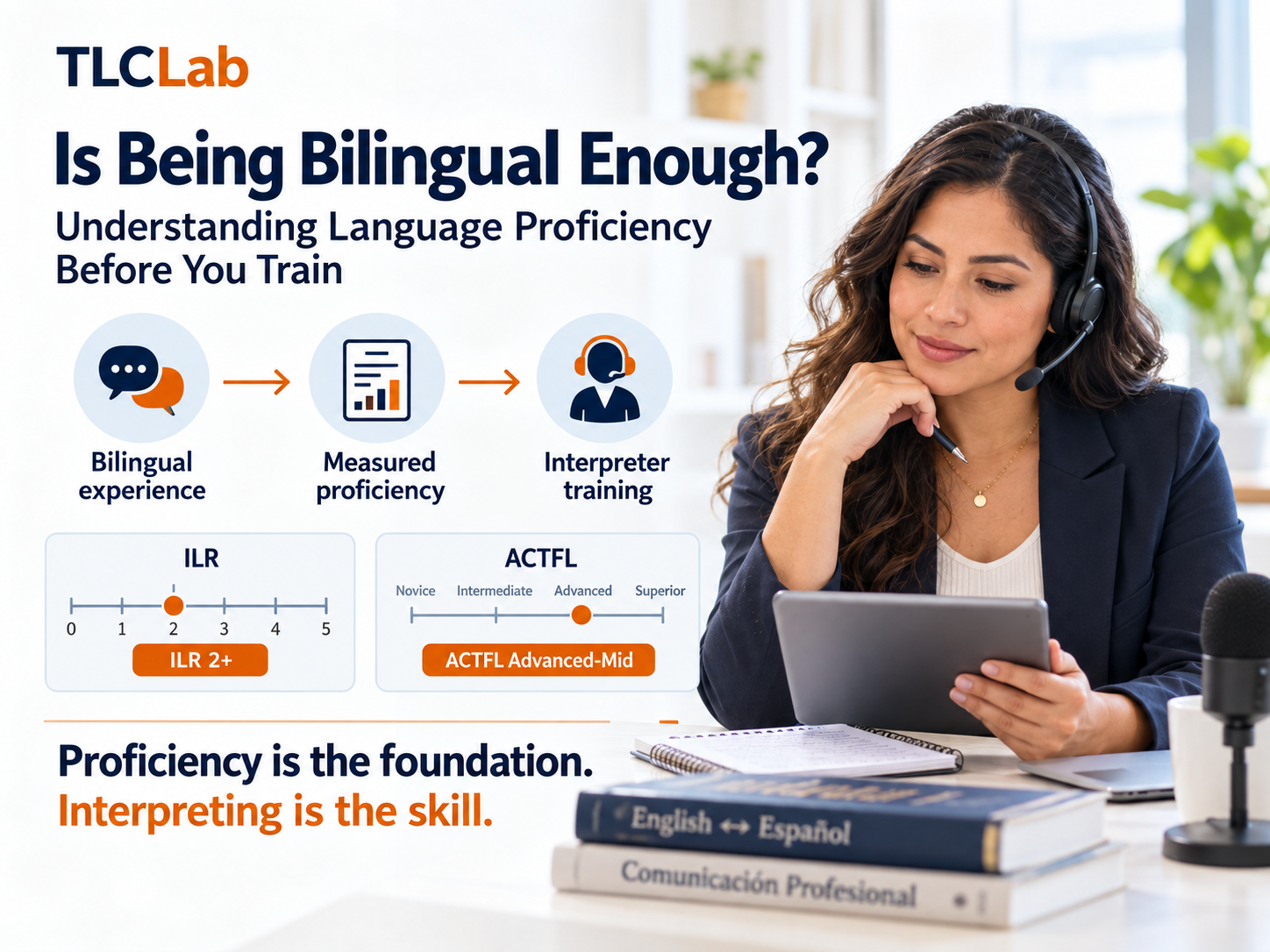
The ILR scale comes from the Interagency Language Roundtable and is the federal government's standard. It runs from 0 to 5, where 0 means no functional ability and 5 means the ability of a well-educated native speaker. A plus designation — 1+, 2+, 3+ — marks someone who clearly exceeds a level without fully meeting the next one. Ratings are given separately for speaking, listening, reading, and writing.
The ACTFL scale was developed from the ILR scale by the American Council on the Teaching of Foreign Languages and is the standard in most American schools and civilian programs. It uses four main levels — Novice, Intermediate, Advanced, and Superior — with the first three divided into Low, Mid, and High sublevels. Distinguished sits above Superior.
Both describe what a person can actually do with language in unrehearsed, real-world situations. Neither asks how long you have spoken it or whether it was your first language.
That is the point. A scale measures function, not biography.
What Level Does Interpreting Require?
The Certification Commission for Healthcare Interpreters sets a published floor, and it is a useful reference point whether or not you pursue that credential.
Since November 2023, CCHI has required applicants to demonstrate proficiency in their language other than English at a minimum of Advanced-Mid on the ACTFL scale or 2+ on the ILR scale, or a documented equivalent on another approved test.
That requirement was not chosen arbitrarily. CCHI conducted a national survey on language proficiency for interpreters in 2022, gathering responses from 470 people in the field, and the Commissioners used those results to set the level.
Other bodies land in similar territory. Oregon's health care interpreter pathway, for example, uses Advanced-Mid on the ACTFL scale as its passing level across the language tests it accepts.
Two things are worth saying plainly about that number.
First, it is a floor, not a target. It marks the point below which interpreting is not a realistic option yet. It does not describe a strong interpreter.
Second, it applies to both languages. Which brings us to the part people miss.
English Is Often the Weaker Language
Interpreters preparing for certification tend to focus anxiety on their other language. In practice, English is frequently where the gap sits.
Consider what CCHI's English-language performance exam actually scores: grammar, register, vocabulary precision, and quality of speech, all in English. An interpreter can have complete command of Tagalog or Haitian Creole and still lose points for verb agreement, word order, or hesitation in English.
The same is true in the other direction for people who were educated in English and speak their heritage language at home. Their English is polished and their other language is warm, fluent, and limited to the domains where they use it: family, food, feelings, daily life.
Ask that person to render "the biopsy showed no evidence of malignancy, but we'd like to repeat imaging in six months" into the language they grew up speaking, and the gap becomes visible immediately.
Neither situation means someone cannot become an interpreter. It means the work is not evenly distributed, and pretending otherwise wastes the training.
Why Heritage Speakers Often Test Lower Than Expected
This surprises people, so it is worth explaining rather than asserting.
Growing up with a language typically builds enormous strength in everyday register and near-perfect listening comprehension. What it often does not build is formal and technical vocabulary, reading ability in that language, and the range to move between registers on demand.
Those three are exactly what interpreting demands. Advanced and Superior level descriptions are largely about handling complex, abstract, and unfamiliar content — not about sounding natural.
A person can be completely at ease in a language and still test at Intermediate on a scale that measures exactly the abilities their life never required them to develop.
That is not a judgment about anyone's language. It is information about which direction to study.
Proficiency Is the Starting Point, Not the Skill
Here is the distinction that reorganizes everything else.
CCHI states it directly: for interpreters, proficiency in two languages is a starting point, and interpreters must also possess the interpreting skills that let them convert meaning from one language into another.
They are equally direct about training. The Commissioners have stated that 40 hours of healthcare interpreter training alone will not turn a bilingual speaker into a competent interpreter.
This is why the field maintains separate measurements. The ILR publishes Interpretation Performance Skill Level Descriptions, developed in 2006, as a distinct instrument from its language proficiency scale. Being able to speak a language and being able to interpret are different things, measured separately, because they are different skills.
Interpreting requires you to hold a message in memory while analyzing it, render it into another language without altering it, manage the flow of a conversation, apply ethical judgment under pressure, and do all of it simultaneously.
Proficiency is the raw material. Interpreting is what you build with it. A training program can teach the building. It cannot supply the material.
How to Judge Yourself Honestly
Before you enroll anywhere, sit with these. They are not a test, but they are diagnostic.
In each of your languages, can you:
- Explain how a medication works to someone with no medical background, and then describe the same thing to a clinician?
- Follow a speaker discussing something unfamiliar to you, for several minutes, without losing the thread?
- Move between formal and casual registers deliberately, rather than defaulting to one?
- Read a page of dense, formal text and understand it fully?
- Speak for two minutes on an abstract topic without switching to the other language for a word?
If any of those is comfortable in one language and difficult in the other, you have located your work.
Be especially careful with the reassurance of being understood. Family and friends are generous listeners who fill gaps automatically. A provider in a clinical conversation is not, and neither is a rater.
How to Get an Actual Rating
Self-assessment tells you where to look. A test tells you where you are.
CCHI accepts several kinds of proof, which is worth knowing because the routes differ in cost and effort. These include passing a language proficiency test from an approved testing vendor at Advanced-Mid or ILR 2+ or above; passing an established interpreter or translator certification exam that includes a language-specific performance component, such as a National Center for State Courts exam or the NBCMI CMI; and, within defined parameters, attestations from qualifying employers or community organizations. CCHI also maintains language tiers that govern which documentation applies to which language.
If you plan to certify eventually, check the current requirements directly with the certifying body before you spend money on a test, since these have been revised in recent years and CCHI is building a registry of accredited proficiency tests.
If you do not plan to certify, an oral proficiency interview is still one of the most useful investments an aspiring interpreter can make. It converts "I think I'm fluent" into a level, and a level can be worked on.
If You Are Below the Line
This is not a verdict. It is a starting position, and it is a common one.
Proficiency is buildable, but it builds through deliberate work rather than exposure. Reading extensively in the weaker language, consuming professional and technical content rather than only conversational material, studying terminology systematically, and practicing formal speech are all things that move a level.
What does not move a level is more conversation with the people you already talk to.
An interpreter who spends a year raising proficiency and then trains will go further than one who trains immediately and spends that year discovering the gap during assignments.
How TLCLab Approaches This
At TLCLab, language proficiency standards are addressed explicitly in the curriculum rather than assumed. Students learn what the ILR and ACTFL scales measure, where the certification thresholds sit, how to evaluate their own level honestly, and where to get a real rating.
That is a deliberate choice. A program that tells every bilingual applicant they are ready is selling something. A program that helps you find out where you stand is training you.
Being bilingual is what makes interpreting possible for you.
It is not, by itself, enough.