

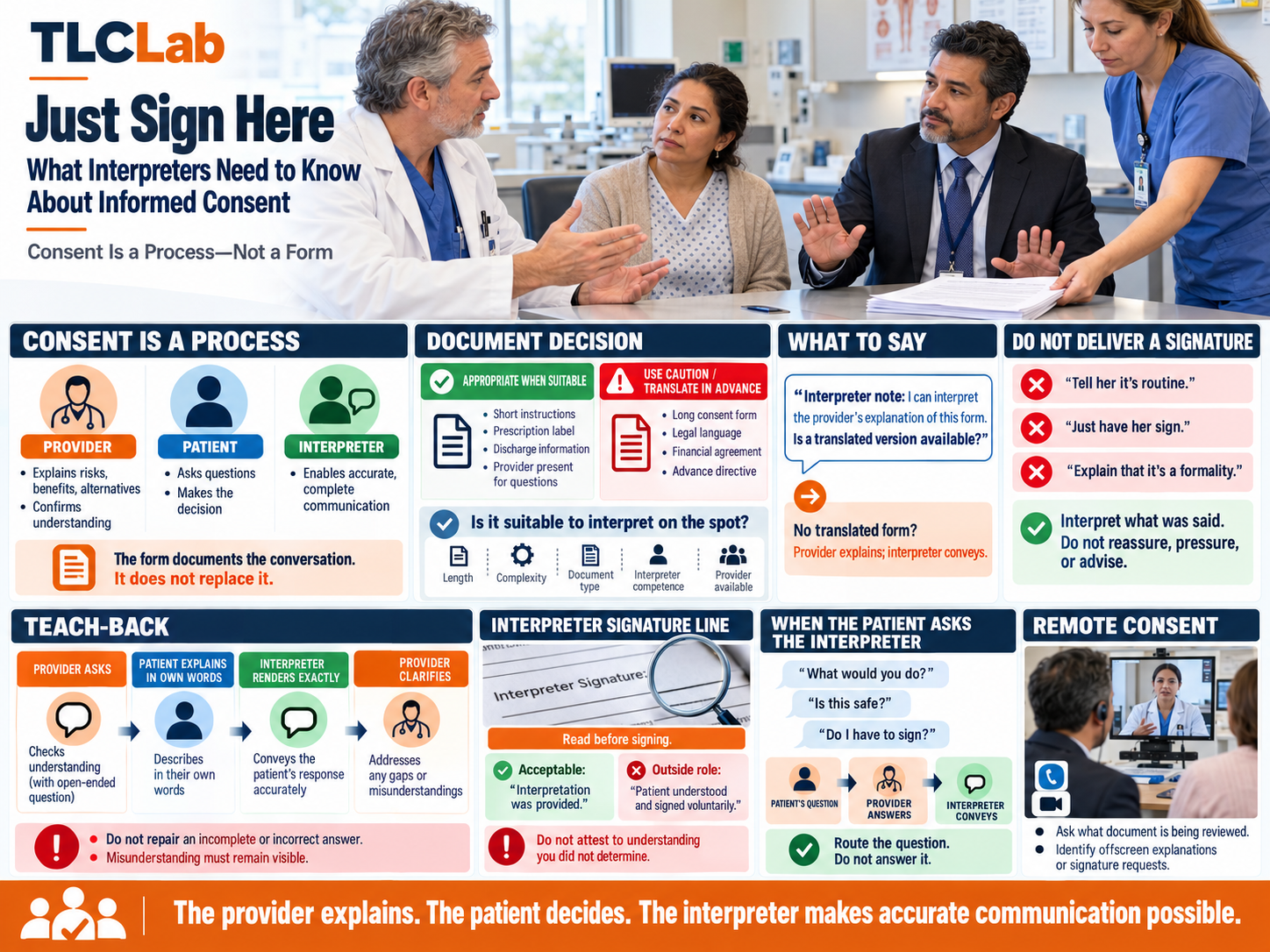
A surgeon finishes explaining a procedure. A nurse slides a four-page consent form across the table and says to the interpreter:
"Can you just read this to her and have her sign it?"
The patient is waiting. The room is busy. The form is in English. Everyone is looking at you.
This is one of the most consequential moments an interpreter will encounter, and it is one of the most commonly mishandled.
At TLCLab, interpreter training treats informed consent as its own skill area, because consent is where medical interpreting and legal interpreting overlap. A signature on a consent form is a legal act. The conversation that leads to it is a medical one. The interpreter sits in the middle of both.
Consent Is a Process, Not a Form
New interpreters often think of consent as paperwork. It is not.
Informed consent is a conversation in which a provider explains a procedure, its risks, its benefits, and the alternatives, and then confirms that the patient understood. The form documents that conversation. It does not replace it.
This distinction matters for the interpreter because it identifies who is responsible for what.
The provider is responsible for explaining and for confirming understanding. The Joint Commission's standards place that duty on the practitioner, and it cannot be handed to someone else.
The interpreter is responsible for accurate, complete communication between them.
When the interpreter takes on the explaining, the consent stops being informed in any meaningful sense, because the person who knows the procedure is no longer the person describing it.
Should You Sight Translate the Consent Form?
Usually, no. And this surprises many working interpreters.
The National Council on Interpreting in Health Care groups patient documents into categories and gives different guidance for each. Consent forms fall under legal documents, alongside financial agreements and advance directives. NCIHC's guidance is that these should be professionally translated in advance and then, if needed, read aloud to the patient.
The reasoning is practical.
Consent forms are written in high, formal register with legal terminology. A medical interpreter may be excellent at clinical language and still be unprepared for indemnification clauses or liability language. Translating that accurately, on the spot, with no preparation, is a different skill from interpreting a conversation.
The forms are also long. A patient who listens to four pages of dense legal language read aloud will retain very little of it. The process can look thorough while accomplishing almost nothing.
NCIHC does treat other documents differently. Short, specific instructions — a prescription label, discharge instructions, preparation for a procedure — are appropriate for sight translation, with the provider present so the patient's questions go to the provider.
The guidance is not that interpreters never sight translate. It is that length, complexity, and document type determine the answer.
What to Say When You Are Handed the Form
Declining is not the same as refusing to help. The professional move is to redirect toward a better process.
You might say:
"Interpreter note: I can interpret the provider's explanation of this form. Is a translated version of this consent available in the patient's language?"
If a translated form exists, the correct process is usually for the patient to read it, or for the interpreter to read it aloud, while the provider remains present to answer questions.
If no translated form exists, ask the provider to explain the document's contents. You interpret that explanation. The provider stays accountable for accuracy and for anything the patient asks.
If you are asked to sight translate anyway and you do not feel qualified for that document, say so plainly. NCIHC's Standards of Practice call for interpreters to disclose skill limitations and to avoid sight translation of complex or critical documents when they lack the skill. Disclosing a limitation is professional conduct, not a failure.
"Just Tell Her to Sign Here"
This request comes in many forms.
"Tell him it's routine."
"Explain that this is just a formality."
"Tell her she has to sign before we can start."
Each one asks the interpreter to characterize the document, reassure the patient, or apply pressure. None of it is interpreting.
The interpreter's response is to interpret exactly what was said and let the provider own it. If a nurse says "tell him it's routine," you interpret that the nurse said it is routine. You do not add your own reassurance, and you do not soften or strengthen the claim.
If the patient then hesitates, that hesitation is information the provider needs. It should reach them accurately, not be smoothed away.
Professional interpreters do not deliver signatures. They deliver messages.
Supporting Teach-Back Without Taking It Over
Teach-back is the method providers use to confirm understanding. Rather than asking "Do you understand?", the provider asks the patient to explain the plan in their own words.
It is one of the strongest safeguards in the consent process, and interpreters encounter it constantly.
The interpreter's job during teach-back is narrower than it feels. Interpret the provider's question. Interpret the patient's answer exactly as given, including the parts that are incomplete or wrong.
This is where interpreters are most tempted to help. The patient gives a partial answer. You know what the provider meant. Filling the gap feels kind.
It defeats the purpose entirely.
Teach-back works by revealing misunderstanding. AHRQ's health literacy training describes a case in which a patient undergoing a sterilization procedure explained, through an interpreter, that she planned to have her tubes untied in five years when she was ready to start a family. The teach-back exposed the misunderstanding, the surgeon corrected it, and the patient declined the procedure.
If the interpreter had improved her answer, the procedure would have gone ahead.
An incomplete answer, interpreted faithfully, is the system working.
The Interpreter Signature Line
Many consent forms include a line for the interpreter to sign. Read it before you sign it, because these lines are not standardized.
Some attest only that interpretation was provided, which an interpreter can truthfully confirm.
Others go further and ask the interpreter to attest that the patient understood what was interpreted and signed voluntarily. That is a different claim. Patient understanding is the provider's determination to make, and an interpreter is not positioned to certify it.
If a signature line asks you to attest to something outside your role, raise it with the provider or the facility rather than signing and hoping. Many facilities will accept a note of what you actually did, and some remote services use an interpreter ID number in place of a signature.
Knowing what you are signing is part of professional practice.
When the Patient Turns to You
"What would you do?"
"Is this safe?"
"Do I have to sign this?"
These questions arrive in consent conversations more than almost anywhere else, because the patient is frightened and you are the only person in the room speaking their language.
The answer is to route the question, not to answer it.
"Interpreter note: the patient is asking the interpreter whether the procedure is safe."
The provider answers. You interpret the answer. The patient gets a response from the person qualified to give one, and the record reflects what happened.
Consent by Phone and Video
Remote interpreters face the same moment with less information. You may not know what document is in front of the patient, whether anyone is pointing at a signature line, or whether a family member has begun explaining things on their own.
Ask. "Interpreter requesting clarification: is the patient currently reviewing a written document?"
Remote work removes the visual cues, which makes explicit questions more important rather than less.
How TLCLab Prepares Interpreters for Consent
At TLCLab, students work through consent scenarios where the pressure is realistic: the staff member is busy, the form is long, the patient is anxious, and the shortcut is available.
Interpreters learn to recognize which documents are appropriate for sight translation, how to decline one without sounding uncooperative, how to support teach-back without repairing the patient's answer, and how to read a signature line before signing it.
The core of it is a distinction worth remembering:
The provider explains and confirms understanding. The patient decides. The interpreter makes the conversation possible, accurately and completely, and adds nothing to it.
Consent is where that discipline matters most.