
The pre-session appears in every standards document and gets skipped in most real assignments.
The provider is behind. The patient is already talking. You are connected to a call in progress. There is no moment that feels like the right one, so it does not happen — and then everything the pre-session exists to prevent happens instead.
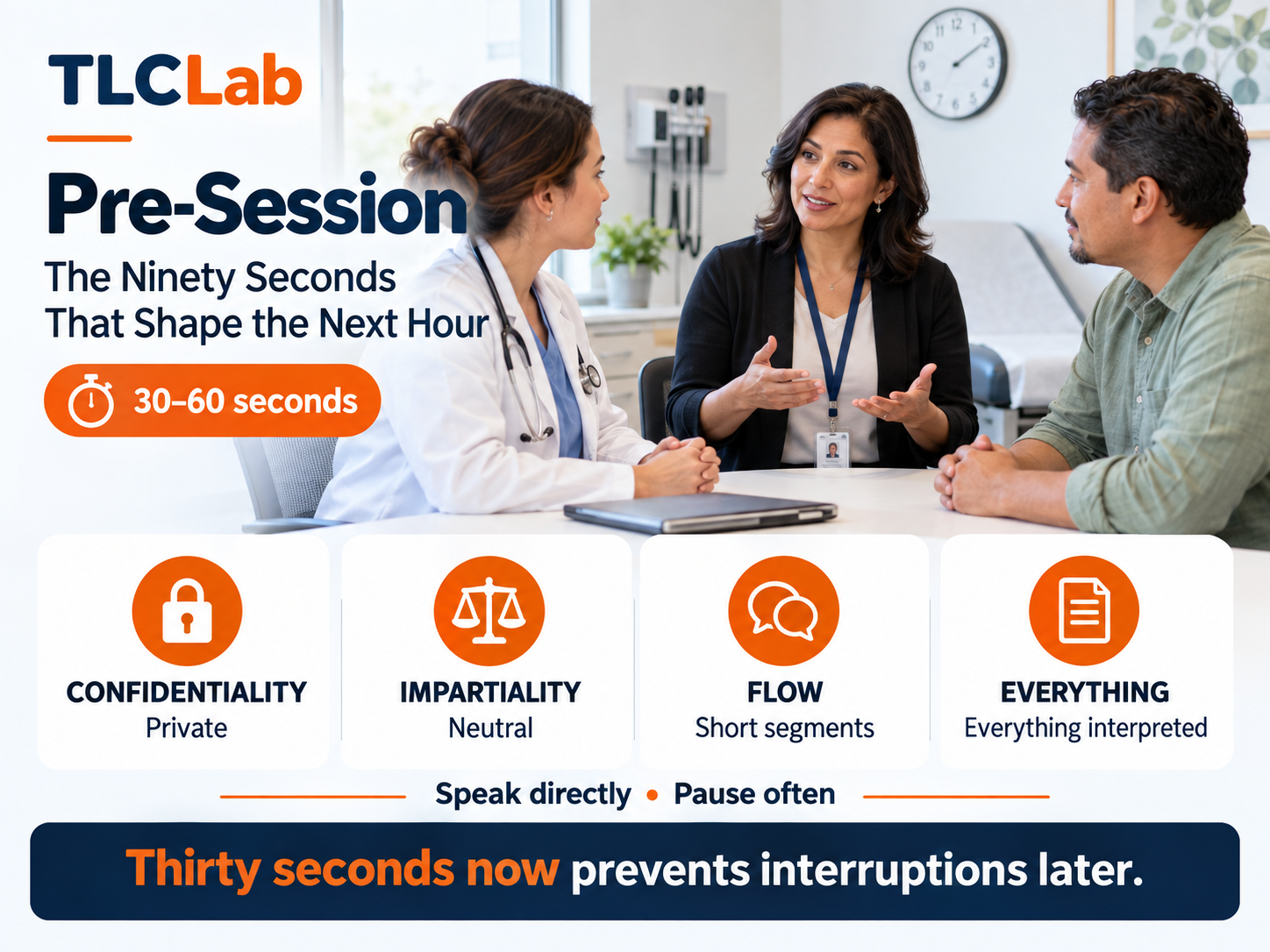
It takes thirty to sixty seconds. EthnoMed's guidance puts it at that range and notes it is usually more than sufficient.
What It Actually Prevents
Without a pre-session, the predictable failures arrive in order:
The provider talks to you instead of the patient. "Ask her if she's been taking it." Now you are a third party in a conversation that should have two.
Nobody pauses. The provider delivers four minutes of explanation and stops. You either omit or ask them to repeat — and you are now the person slowing things down.
The patient treats you as their helper, because nobody told them otherwise.
Someone says something they assumed was private. They did not know everything gets interpreted.
And nobody mentioned that a family member is in the room, that the appointment is a biopsy result, or that the patient's variety is not the one you were booked for.
Each of these is an interruption later. The pre-session front-loads them into one minute.
The Content
With the provider, before entering if possible: confirm you are the interpreter and the language. Ask the nature of the visit. Ask them to speak directly to the patient in short segments and to pause. Ask whether anything about the encounter you should know — difficult news, a family member present, documents involved.
With the patient, usually taught as CIFE: Confidentiality — everything stays private. Impartiality — you are not on either side. Flow — you will ask people to pause. Everything said will be interpreted.
That last one is NCIHC Standard 3, and it is the one interpreters skip most and need most. It is what allows you to interpret the aside nobody meant for the patient, without it being a betrayal.
Write your own version, refine it once, and practice delivering it until it runs under thirty seconds without sounding rushed.
When There's No Time
Which is most of the time.
The provider walks in late, patient already talking. Do it in front of both of them. EthnoMed's own examples show provider and interpreter communicating their intentions transparently with the patient present, precisely because the clean pre-session often does not happen. An orientation delivered in the room is not a failed pre-session — it is a transparent one.
You are mid-call on OPI. A compressed version works: identify yourself, state that everything will be interpreted, ask for short segments and direct speech. Fifteen seconds.
The provider waves you off. Do the patient-facing half anyway. The patient needs the orientation more than the provider does.
True emergency. Interpret first. Orient at the first break. A trauma bay is not the place to explain your role.
Longer, When It's Warranted
Some encounters justify more. Guidance for speech and language therapy settings recommends ten to fifteen minutes of briefing in advance for complex sessions — purpose and format of the meeting, materials the clinician plans to use, cultural factors that may bear on the session, and an opportunity for the interpreter to raise concerns.
The same logic covers a disclosure of a serious diagnosis, a psychiatric assessment, a care conference, or an IEP meeting. Ask for the briefing. Most people say yes if you ask before the day of.
The Part That Matters Right Now
When NCIHC published its 2024 guidance for healthcare organizations evaluating AI-generated interpreting, it did not argue. It listed what qualified human interpreters do and asked vendors how their system accomplishes each one.
The first item on that list is the pre-session — assuring that all parties address each other, understand that everything will be interpreted, and pause often enough for accurate consecutive interpreting.
How does the AI accomplish this?
It does not. A machine converts speech. It does not establish how a conversation will be conducted before the conversation begins.
Which means the pre-session is no longer only good practice. It is part of the answer to what human interpreters provide that automated systems do not — and an interpreter who skips it has quietly given away one of the clearest arguments for their own necessity.
How TLCLab Trains It
At TLCLab, students write and rehearse their own pre-session until it runs under thirty seconds in both languages, and then practice the compressed versions: mid-call, provider already talking, no time at all.
The skill is not reciting it. It is delivering it in the conditions where it is inconvenient, which is nearly always.
Thirty seconds at the start, or fifteen minutes of correction spread across the next hour.