

A patient describes her symptom using a word you have never heard.
You speak the same language. You have interpreted for fifteen years. And you do not know what she just said.
This is not a rare event. In a 2026 study of professional Spanish-language interpreters, 58% — eleven of nineteen — reported that the most common reason they paused interpretation to ask for clarification was that the patient spoke a different dialect than their own.
The most common reason. More than medical terminology, more than speed, more than audio quality.
Yet dialect handling is barely covered in most interpreter training, and interpreters are often left to develop their own methods, usually after an encounter that went badly.
First, the Honest Scope
It is worth being precise, because both overstating and understating this cause problems.
The standardized medical and legal register is largely shared. A Cuban patient in a cardiology consultation with a Mexican interpreter will generally have no comprehension problem, because the clinical vocabulary of that conversation is close to uniform across varieties. A qualified interpreter from any region handles most encounters accurately.
Variation concentrates in predictable places: everyday vocabulary, colloquial and regional terms, body parts and bodily functions described informally, food, occupational vocabulary, folk illness concepts, and the words people reach for when they are frightened and stop speaking carefully.
Which is to say: variation shows up least in the technical content and most in what the patient says about themselves.
Researchers studying Spanish-speaking patients and their navigators recorded the point exactly. One participant observed that even when everyone speaks Spanish, everyone has different words — and noted that while medical terminology is broadly universal, ordinary terms for things like the stomach, chest, shoulder, or neck can vary.
So the risk is not that you will fail to render "myocardial infarction." It is that you will mishandle how she described where it hurts.
Three Ways It Goes Wrong
The word you don't know. The least dangerous, because you are aware of it. You know you have a gap and can act.
The word you think you know. Considerably worse. The same form carries different meanings across varieties, and nothing signals the mismatch. In parts of the Caribbean, guagua is a bus; in parts of the Andes, it is a baby. Pena leans toward embarrassment in some varieties and sorrow in others. Folk illness terms — empacho, susto, and their equivalents in many languages — carry specific meaning in some communities and function loosely in others.
With a false friend, you produce a confident rendition that is wrong, and no one in the room has any reason to question it.
The comprehension failure you don't see. The direction interpreters monitor least. Your rendition into the patient's language uses vocabulary from your variety. The patient does not recognize a term, does not want to appear uneducated in front of a doctor, and nods.
The encounter proceeds. Everyone believes it went well.
Checking Understanding Without Condescending
This is the part interpreters most often get wrong, usually out of politeness.
The instinct is to avoid implying the patient doesn't understand their own language. That instinct is good and the resulting silence is dangerous. The solution is to locate the problem in the language or in yourself, never in the patient.
Make yourself the source of the gap.
"Interpreter note: the interpreter is not familiar with that term and requests clarification."
That is accurate, professional, and carries no implication about the patient. Not knowing a regional term is a fact about your dialect, not a deficiency in anyone.
Offer alternatives rather than asking whether they understood.
"Do you understand?" invites yes. Supplying a second term for the same concept does not put the patient on the spot — it simply gives them a word that may land better. If you suspect a term may be unfamiliar, offering an alternative alongside it is ordinary good practice.
Watch for the signs rather than waiting to be told. A delayed response. An answer that addresses a slightly different question. A patient who was voluble and becomes brief. Agreement that arrives too fast.
Route it to the provider. When you suspect the patient did not follow, the fix is not to re-explain in simpler words. That makes you the explainer. Make the uncertainty visible: "Interpreter note: the interpreter is not confident the explanation was understood. May the provider rephrase?"
The provider rephrases. You interpret the rephrasing. Everyone stays in role.
Transparency Is the Whole Technique
Every move above shares a structure: the clarification is audible to both parties.
A quiet exchange between interpreter and patient to sort out a word is a side conversation. The provider does not know it happened, cannot evaluate it, and the record does not reflect it. If the patient's word turns out to matter clinically — and symptom descriptions often do — the person who needed that information never received it.
A dialect clarification handled transparently is simply professional practice. The same clarification handled privately is the interpreter editing the encounter.
When to Disclose a Mismatch
Interpreters ask where the line sits between managing variation and flagging a problem.
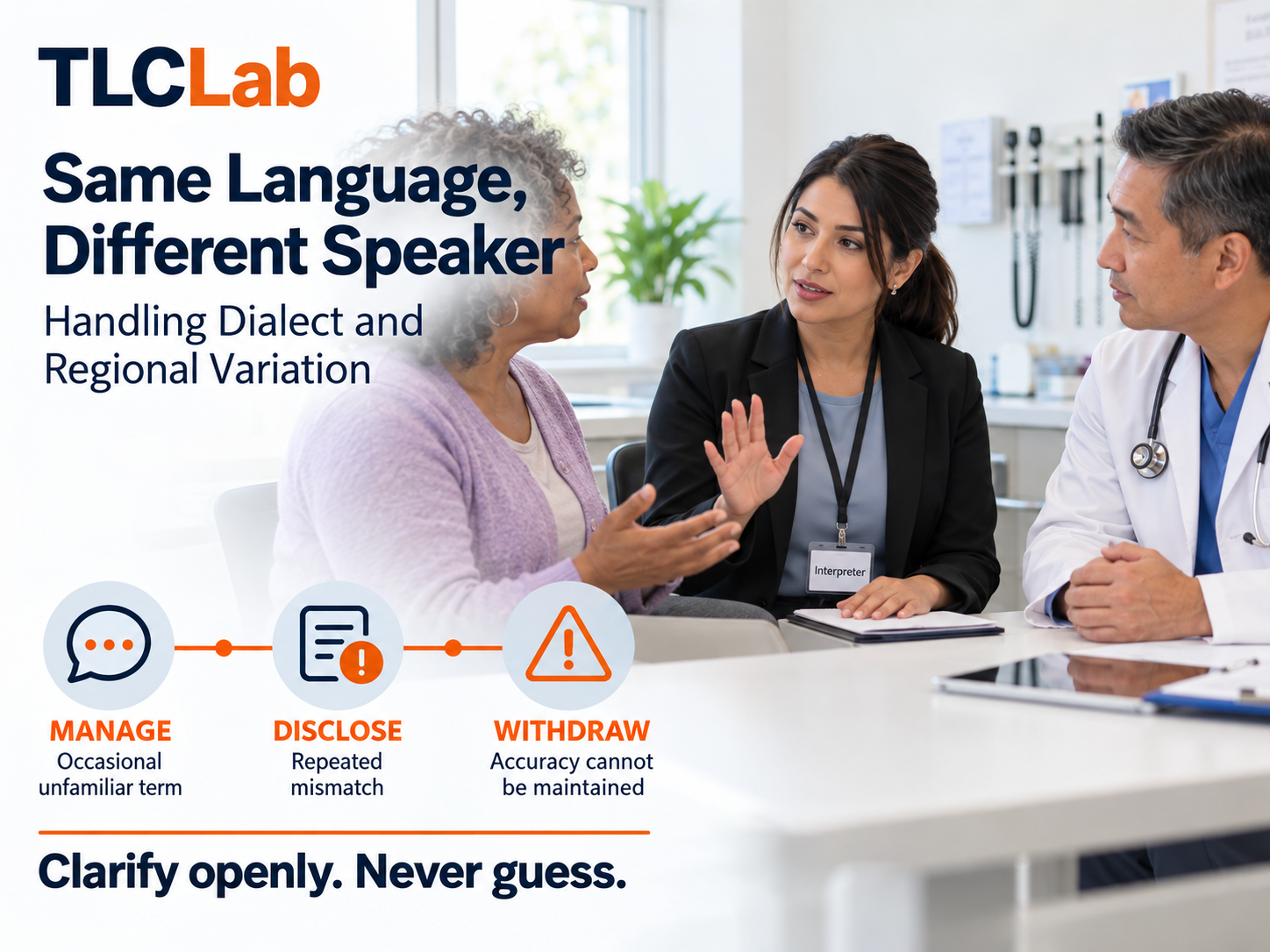
Manage it when you are encountering occasional unfamiliar terms and resolving them cleanly. This is normal work. It does not require an announcement.
Disclose it when the pattern suggests the mismatch is affecting the encounter: repeated clarifications on ordinary vocabulary, recurring sense that the patient is not following you, or content where a subtle error would be consequential.
Disclosure is brief and factual:
"Interpreter note: the interpreter speaks a different regional variety than the patient and has needed frequent clarification. The provider may wish to consider an interpreter who shares the patient's variety."
No apology. No editorializing. The information belongs to the people making decisions in the room.
Withdraw when you cannot interpret reliably. NCIHC's Standards of Practice call for interpreters to disclose skill limitations with respect to particular assignments, and a variety you cannot handle at the needed level is a skill limitation like any other. Continuing anyway is the error — not stopping.
Weigh the stakes. Twenty minutes of friction in a routine follow-up is manageable. The same friction during consent, a psychiatric assessment, or testimony is not.
The Adjacent Case: They May Not Speak That Language
Something that presents as dialect difficulty may be something else.
Interpreters in the 2026 study described patients booked as Spanish speakers who in fact speak an
Indigenous language, with Spanish as a limited second language. The patient manages ordinary exchanges and reaches the limit of their Spanish precisely when the content becomes complex — which is to say, when it matters.
Signs: vocabulary that stays very simple regardless of topic, grammar that departs from any regional variety in consistent ways, difficulty specifically with abstract or technical content, or a patient who grows noticeably more hesitant as the conversation deepens.
This is not a dialect problem and cannot be solved by clarifying terms. The correct move is to raise it so the right language can be identified and arranged — which is also an access issue, since speakers of Mam, K'iche', Mixteco and similar languages are frequently served in a language they do not fully command.
When the Structure of the Language Causes It
Some languages are built around this problem.
Arabic is the clearest case. Modern Standard Arabic is the formal variety used in writing, education, and broadcast — and it is not spoken natively by anyone. Alongside it sit regional dialects — Levantine, Egyptian, Gulf, Iraqi, Maghrebi and others — that differ substantially from MSA and from one another, with some pairings offering limited mutual intelligibility. Linguists call this diglossia.
Industry practice reveals the gap plainly: at least one major interpreting platform lists Modern Standard Arabic as its default supported variety. A patient from rural Morocco and an interpreter working in MSA are not having the smooth encounter that booking implies.
Research on Arabic-speaking migrants' experiences with interpreters found that their preferred interpreter depended on dialect and on the ability to interpret correctly — among other personal factors they identified as mattering.
Chinese presents a comparable structure, where "Chinese" on a booking form may mean several mutually unintelligible spoken varieties. So do many other language groupings reduced to a single line in a scheduling system.
Interpreters working in these languages should know their own range precisely and be able to state it, because the booking system will not state it for them.
Building Your Range
Dialect competence is learnable, and the interpreters with the widest range built it deliberately.
Consume media from across your language's regions, not only your own. Keep a running list of terms you encounter and could not have produced. Learn the regional variation specifically for high-frequency clinical content: symptom descriptions, body parts, pain vocabulary, bodily functions, family terms, food. Ask colleagues from other regions how they would say something. Know which communities your service area actually contains.
And know your own limits precisely enough to state them. "I interpret Spanish" is less useful, and less professional, than knowing which varieties you handle comfortably and which cost you.
How TLCLab Treats This
At TLCLab, dialect and register variation is taught as a core competency rather than a footnote, because the research places it at the top of the list of reasons interpreters have to intervene in real encounters.
Students practice the clarification scripts, the comprehension checks, the disclosure language, and the judgment about when a mismatch is manageable and when it is not.
The skill being built is not a bigger vocabulary, though that helps.
It is the willingness to say, out loud and in front of both parties, that you are not certain a word landed — and to do it in a way that costs the patient nothing.